Which DW-5600 are you actually buying?
This is the part most reviews skip, and it is the only genuinely confusing thing about the watch. "DW-5600" is a family, not a single reference, and several versions are commonly on sale at the same time at different prices.
The DW-5600E-1V is the classic: the one Casio has sold for years, with an electro-luminescent backlight — the pale glow that lights the whole display from behind — and a published battery life of approximately two years on a CR2016 cell. It is the cheapest way into the case and it is the version people mean when they say a G-Shock costs fifty dollars.
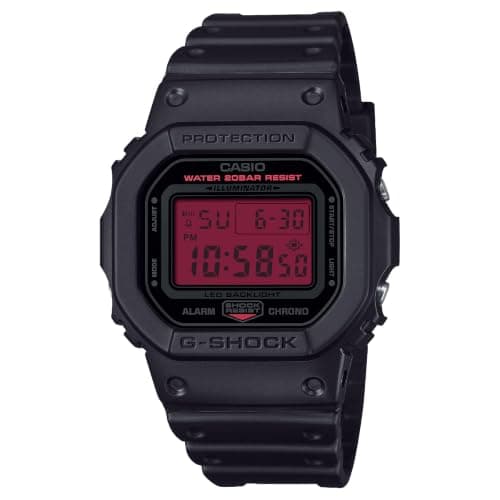
The newer DW-5600UE-1 keeps the case and swaps the module. Casio replaced the EL backlight with an LED backlight and raised the published battery life to approximately five years, at a higher list price. The DW-5600BBR-1 — the blacked-out version with the deep red display, and the listing whose live price is shown above — belongs to that same newer generation: Casio publishes the LED backlight and the five-year battery, in a 48.9 x 42.8 x 13.4mm case weighing about 52 grams.
How to choose between them without overthinking it. If you want the cheapest possible G-Shock and do not care about the backlight, buy the plain DW-5600E. If you will read the watch in the dark often — night shifts, early starts, a sleeping house — the LED versions are brighter and last longer between battery changes, which on a 200m case means fewer trips to a watchmaker who has to reseal it. Everything else on this page applies equally to all of them.
The case: big numbers, small watch
Casio publishes the case as 48.9mm long, 42.8mm wide and 13.4mm thick, at roughly 52 to 53 grams depending on the reference. Read those numbers in the right order, because the first one is the one that misleads.
A 48.9mm case length sounds enormous — larger than the Seiko Turtle, which we describe as a big watch and mean it. But the DW-5600 is a square with the band leaving the case at the very top and bottom of that 48.9mm, so there are no lug tips hanging in space, and 52 grams of resin sits on the wrist like nothing at all. The practical result is a watch that measures large and wears genuinely small. It is one of the few watches on this site we are happy recommending on a 6-inch wrist and a 7.5-inch wrist with equal confidence — the mechanism behind that is explained on what size watch to buy for your wrist.
The 13.4mm thickness is the honest compromise. That is thicker than most dress watches and it will catch on a shirt cuff, because inside the case is a resin bumper structure whose entire job is to hold the module away from whatever the watch just hit. If a slim square is what you want, the GA-2100 ranked second here is 11.8mm and that is the reason it exists.
What the module actually does
The DW-5600 is a pure digital quartz, and the published function list has barely changed in decades because it was close to complete when it arrived. Casio publishes a 1/100-second stopwatch measuring to 23:59'59 — hundredths for the first sixty minutes, then seconds — a countdown timer settable in one-second units up to 24 hours, a multi-function alarm with an hourly time signal, a full auto-calendar, 12/24-hour display, and a backlight with afterglow. Accuracy is quoted at plus or minus 15 seconds per month.
That function list matters more than it looks. A stopwatch and a countdown timer you can operate blind, with gloves on, in the rain, is the actual argument for a digital watch over a mechanical one — and it is why this watch keeps appearing on our occupational rankings like the best watches for work and the best watches for nurses. Fifteen seconds a month is also, bluntly, better timekeeping than any mechanical watch on this site will manage in a week; quartz versus automatic sets out why that gap exists and why it still does not settle the argument.
What it does not have: no world time, no solar charging, no radio or phone time-setting, no step counting and no notifications. Those live further up the G-Shock range and on the smartwatch shelf, and the DW-5600's price is what you pay for leaving them out. If you want that comparison in full, we ran it on a traditional watch against a smartwatch.
200 meters, and what that rating is not
The DW-5600 is rated to 200m and it is shock resistant — a published Casio construction standard rather than a marketing adjective. Shower in it, swim in it, take it snorkeling, wash your hands two hundred times a shift in it. None of that is a risk, and watch water resistance explained sets out what each tier of rating is actually tested for.
What it is not is a dive watch in the formal sense. There is no rotating elapsed-time bezel, so you cannot time a dive the way our bezel guide describes, and it carries no ISO 6425 diver's marking. What makes a dive watch a dive watch covers the difference, and dive watch versus G-Shock puts this family head to head with two real divers. A 200m rating on a G-Shock means the case is extremely well sealed, not that the watch is diving equipment.
Two practical notes Casio does not print on the box. The resin band and keeper will eventually perish — resin is a consumable, replacement bands are sold, and this is the one part of the watch you should expect to replace. And mineral glass sits on the front, not sapphire, so the crystal will pick up scratches; at this price that is the correct material choice, and the reasoning is on sapphire versus mineral crystal.
The band is the catch, and on this site we lead with it
Every watch page here prints a lug width, because the lug width is the number that tells you which strap fits. The DW-5600 does not have one. The band is a proprietary G-Shock resin strap on a slide-lever fitting, not a spring bar between two lugs, so none of the straps on our strap rankings will go anywhere near it.
There is an aftermarket — replacement resin bands, nylon bands cut for the 5600 case, and third-party adapters that convert the fitting to a 20mm or 22mm spring bar are all widely sold. We rank none of them, for the same reason we gave on the GA-2100 review: we have not verified a specific listing, and an adapter that fits badly on a 200m case turns a sealing question into a water problem. Treat the resin band as the band. If that is unacceptable, the next two sections are for you.
DW-5600 or the Casio Duro MDV106?
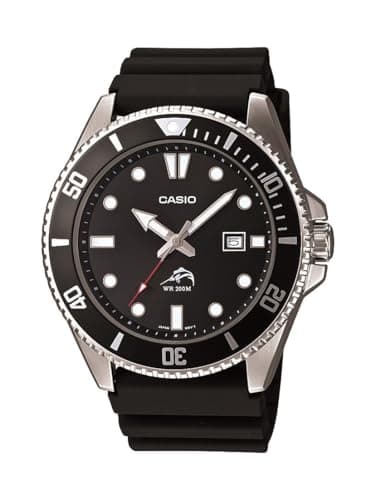
This is the real decision for anyone who came to this site because of straps. The Casio Duro is an analog 200m diver with a rotating timing bezel, a 44mm steel case and — the part that matters — a standard 22mm lug width. It usually sells for less than the newer DW-5600 versions, and it opens onto the entire strap drawer: fit one of our 22mm strap picks and it becomes a different watch for the price of lunch.
Buy the Duro if you want an analog dial, a timing bezel and strap freedom. Buy the DW-5600 if you want the timer, the stopwatch, the backlight and a case you can be careless with. The Duro is the nicer object; the square is the tougher tool, and it is the only one of the two you can fall over wearing without checking it afterwards.
DW-5600 or GA-2100?
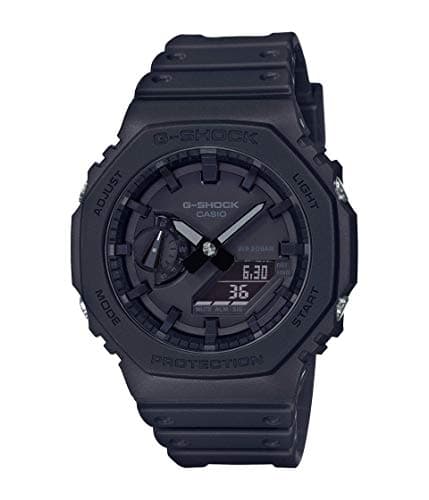
The GA-2100 — the "CasiOak" — is the same brand solving a different problem: an analog-digital dial in an 11.8mm carbon-reinforced case, with world time across 31 zones and a slimmer profile that slides under a cuff. It costs more than a DW-5600E and lands in roughly the same bracket as the LED versions.
Choose by what you want to read. If you want to glance at hands, buy the GA-2100. If you want a number — and a timer you can start without looking — buy the square, which is also lighter and cheaper to replace. Both share the band situation, so neither is the answer if strap swapping is the point. The long version is on our GA-2100 review.
DW-5600 or F-91W?
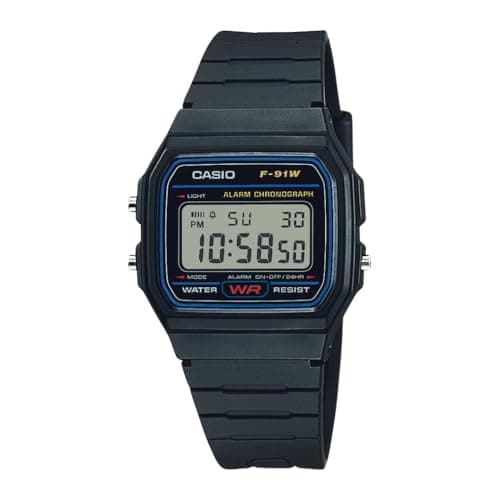
The F-91W is the other famous cheap Casio and it is a genuinely different proposition: about 21 grams, a published battery life of roughly seven years, and a price that rounds to nothing. What it is not is tough. Casio rates it to 30m, which is splash resistance, and the case has none of the shock structure the G-Shock is built around.
Buy the F-91W as the lightest possible watch for dry conditions, or as a second watch you keep in a bag. Buy the DW-5600 if the watch has to come swimming, or has to survive a job site, or has to be the only watch you own. The price difference between them buys a water rating nearly seven times deeper, and that is the whole trade. Both are ranked together on the best digital watches.
Who should buy it
Buy the DW-5600 if you want one watch that you never have to think about: a watch for the gym, the garden, the beach, the workshop and the hospital ward, which tells the time to within a few seconds a month and costs little enough that losing it is annoying rather than expensive. On those terms nothing else on this site competes, which is why it ranks on the best watches for work and the best watches under $200.
Do not buy it if you want hands on a dial, a watch that looks like a watch with a jacket, or a case you can put a leather strap on. The first two are taste and the third is physics — and on a site named after lugs and leather, we would rather say so plainly than sell you a watch that cannot take either.