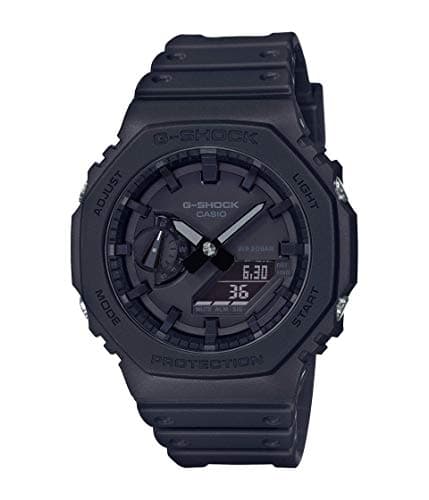
The Casio G-Shock GA-2100 — the "CasiOak," a nickname Casio never chose and has never been able to shake — is the watch that made G-Shock something you could wear with a shirt. Casio's published specification is a 48.5 x 45.4 x 11.8mm resin and carbon case weighing 51 grams, rated to 200 meters, running module 5611 behind mineral glass. It went on sale in August 2019 and has been one of the most cross-shopped watches under $150 ever since.
A note on what this review is and is not. We do not own this watch and we did not put it through a drop test. What follows is built from Casio's published specifications for the GA-2100 line, the arithmetic of comparing it against the alternatives on this site, and the method set out on how we review. Where a figure is not published we say so rather than filling the gap.
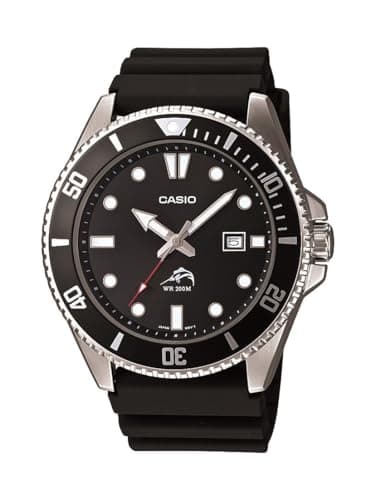
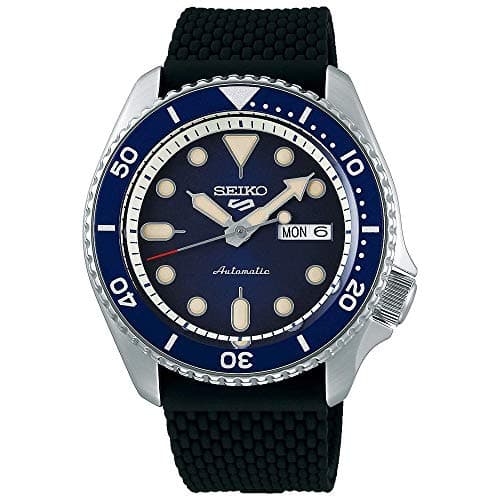
The verdict up front: at this price nothing else gives you a 200m case, a genuinely shock-resistant construction and a slim enough profile to disappear under a cuff. The catch is the one thing this site exists to talk about — the band. The GA-2100 does not have a lug width. It takes G-Shock-specific bands and adapters, not the 20mm and 22mm straps that fit almost everything else we cover. If swapping straps is part of why you want a watch, the two picks ranked below it are the honest answer: the Casio Duro MDV106, which is analog, cheaper and takes a standard 22mm strap, and the Seiko 5 Sports SRPD93, which is what you buy when you decide you want a mechanical watch instead.
Why this shape, and why everyone copied it
The octagonal bezel is not a Royal Oak tribute, whatever the nickname implies. Casio drew it from the DW-5000C, the first G-Shock ever made in 1983, and rebuilt that silhouette around an analog-digital dial. The result read as expensive by accident, which is why the affordable end of the market filled up with octagonal integrated-look sports watches in the years after.
What holds it together is Carbon Core Guard: a carbon-fiber-reinforced center case that carries the shock loads a thick resin bumper used to carry. That is the engineering reason the watch is 11.8mm thick and 51 grams instead of the 16mm and 70-odd grams a conventional G-Shock of this capability would be. You are not paying for a material fashion — the carbon is what buys the thinness.
11.8mm is the number that made it famous
Casio publishes the case as 48.5mm long, 45.4mm wide and 11.8mm thick. Read those in the right order. The 45.4mm width sounds enormous and the 48.5mm length sounds worse — that is in the same territory as the Citizen Promaster, which we describe as a large watch and mean it.
It does not wear like one, and the reason is the thickness and the weight. A 51-gram case that sits 11.8mm off the wrist follows the arm instead of toppling around it, and the resin band wraps rather than hanging off lug tips the way a steel bracelet does. The practical result is a watch that measures big and wears mid-size. If you have been put off G-Shocks because every one you tried felt like a hockey puck, this is the one to try.
It is still not a small watch. If your wrist is under about 6.5 inches the dial will read as a slab, and our guide to sizing a watch to your wrist walks through the measurement that decides it.
The band is the catch, and on this site we lead with it
Every watch page here prints a lug width, because the lug width tells you which strap fits. The GA-2100 does not have one. The band is a proprietary G-Shock resin strap that attaches to the case with a slide-lever fitting, and it is not interchangeable with the standard spring-bar straps in our lug width chart.
There is an aftermarket — replacement GA-2100 bands and third-party adapters that convert the fitting to a 20mm or 22mm spring bar are widely sold. We are not ranking any of them, because we have not verified a specific listing and an adapter that fits badly on a 200m case is a water-resistance problem, not a style problem. Treat the stock resin band as the band, and if that bothers you, buy one of the two watches ranked below instead.
What module 5611 actually does
The GA-2100 is an analog-digital quartz, and the digital half is where the function lives. Casio publishes: world time across 31 time zones (48 cities plus UTC), a 1/100-second stopwatch measuring to 23:59'59", a countdown timer settable from one second to 24 hours, five daily alarms with an hourly signal, a perpetual calendar, and a double LED that lights both the hands and the digital display.
Accuracy is quoted at plus or minus 15 seconds per month, and the battery is two SR726W cells rated at approximately three years. Both figures deserve context. Fifteen seconds a month is ordinary quartz accuracy and far better than any mechanical watch on this site will manage — see quartz versus automatic for why that gap exists and why it still does not settle the argument. And a three-year battery is a replaceable cell, not a solar cell: this is not one of the light-powered watches we rank elsewhere, and eventually a watchmaker has to open a 200m case to change it.
200 meters, and what that rating is not
The GA-2100 is rated to 200m and it is shock resistant, which is a genuine Casio construction standard rather than marketing. Swim in it, shower in it, take it snorkeling — none of that is a risk.
What it is not is a dive watch in the formal sense. There is no rotating elapsed-time bezel, so you cannot time a dive on it the way our bezel guide describes, and it carries no ISO 6425 diver's marking. Our explainer on what makes a dive watch a dive watch covers the difference in full. The 200m number here means the case is very well sealed, not that the watch is a diving instrument.
Mineral glass is the real compromise, not the price
Casio fits mineral glass, not sapphire. On a watch this cheap that is entirely fair, but it is worth knowing where it costs you: the crystal on a GA-2100 sits close to the top of the case and the analog hands run close beneath it, so a scratch across the glass is visible on every reading of the time. Sapphire replacements exist as an aftermarket mod and we are not recommending one — opening a 200m case voids the seal you paid for.
Nobody buying a hundred-dollar G-Shock should treat a scratched crystal as a tragedy. It is the correct material at the correct price, and the honest framing is simply that this is a watch you use rather than a watch you protect.
GA-2100 or the Casio Duro MDV106?
The genuine decision for a lot of people, and the two watches could hardly be less alike. The Duro is an analog 200m diver with a rotating bezel, a 44mm steel case and — the part that matters here — a standard 22mm lug width. It usually sells for meaningfully less than the GA-2100 and it opens onto the entire strap drawer: put it on one of our 22mm strap picks and it becomes a different watch for under twenty dollars.
Buy the Duro if you want a traditional watch face, a timing bezel and the freedom to swap straps. Buy the GA-2100 if you want the world-time module, the shock resistance and a case that survives being genuinely careless with it. The Duro is a nicer object; the GA-2100 is a tougher tool.
GA-2100 or the Seiko 5 Sports SRPD93?
This is the upgrade question, and the price gap is large — the SRPD costs several times what the GA-2100 does. What you get for it is a mechanical watch: Seiko's 4R36 automatic, which hacks and hand-winds, with 22mm lugs and excellent lume.
What you give up is capability. The SRPD is rated to 100m rather than 200m, it has no stopwatch, no timer, no alarm and no world time, and it will lose more time in a week than the G-Shock loses in a year. That trade is the whole point of buying a mechanical watch and you should make it deliberately. If the answer is "I want the one that just works," the GA-2100 already won.
The siblings worth knowing about
Two variants come up constantly. The GA-B2100 is the same case with Casio's Tough Solar charging and Bluetooth phone-set timekeeping, at a higher price; if never setting the watch appeals, it is the version to look at, though we have not verified a listing for it and so do not rank it here. The DW-5600 is the original digital square — cheaper, smaller and purer, and the watch the GA-2100's bezel is descended from. It has not had a buyable listing we could verify recently, which is why it is not ranked on this page either.
Both share the GA-2100's band situation. If you have decided you want a G-Shock, you have decided you want G-Shock bands.
Who should buy it
Buy the GA-2100 if you want one watch that you never think about — that survives the gym, the beach and a toolbox, tells you the time in another country, and still slides under a shirt cuff. On those terms it has no real competitor at the price, and it is why the watch shows up on almost every list we publish under $200, from the best watches under $200 to the best everyday watch.
Do not buy it if the strap drawer is the hobby. That is not a small caveat on a site built around lug width, and it is the reason two strap-friendly watches are ranked beneath it rather than a second G-Shock.