The two numbers that actually differ
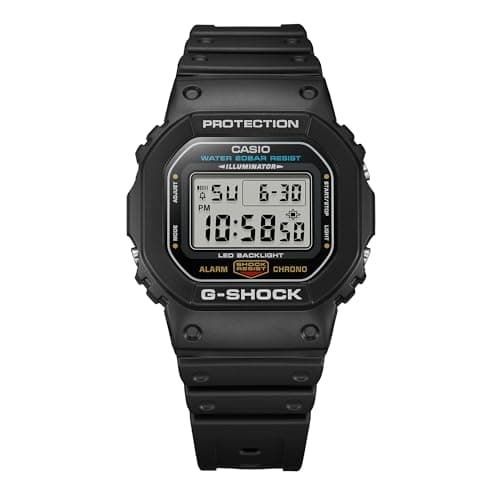
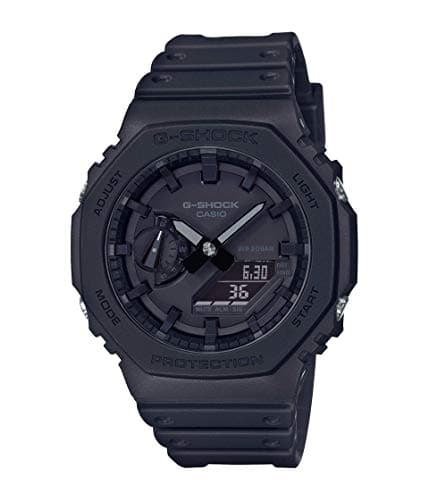
Casio publishes the DW-5600 at 48.9 x 42.8 x 13.4mm and about 52 grams. It publishes the GA-2100 at 48.5 x 45.4 x 11.8mm and about 51 grams. Read those carefully, because they cross over: the GA-2100 is the wider watch by 2.6mm and the thinner one by 1.6mm. The weights are within a gram of each other and the overall lengths are within half a millimeter, so neither covers more of your wrist lengthways than the other.
That 1.6mm of thickness is the whole reason the GA-2100 became a phenomenon. A G-Shock has always been a watch you wore on top of your sleeve; at 11.8mm the GA-2100 slides under a shirt cuff, and that is a genuinely new thing for the line rather than marketing. If you wear long sleeves to work, this is not a close contest.
The 2.6mm of width matters in the other direction and gets mentioned far less often. If your wrist is on the narrower side, the DW-5600 is the watch that looks deliberate and the GA-2100 is the one that starts to look like it is wearing you. Our watch size for your wrist guide has the measuring method; on a wrist under about 6.5 inches we would take the square.
Digital against analog-digital, and which you read faster
The DW-5600 is a pure digital watch. The GA-2100 is an analog-digital — hour and minute hands over a small digital window, running Casio's module 5611. This is the second real difference and for a lot of buyers it is more consequential than the dimensions.
A digital display gives you the exact time with no interpretation. That sounds trivial until you are checking a watch in bad light, with gloves on, or while doing something else, and it is the reason the square still gets recommended for working shifts — the point we make at more length on best watches for work and best watches for nurses. The GA-2100 hides its digital readout in a window small enough that the hands are what you actually read, and the hands are what make it look like a watch rather than a gadget.
There is a legibility cost to the octagon worth stating plainly: on the standard black GA-2100 the hands are black with luminous fill against a black dial, and in dim light they disappear until the lume catches up. The square's display is always the same contrast. If reading the time quickly is the job, take the DW-5600.
What the modules do, side by side
Both are more capable than their price suggests, and the split is not the one people expect. The GA-2100 carries world time across 31 time zones, a stopwatch, a countdown timer and five alarms, on a battery Casio rates at about three years. The DW-5600 carries a 1/100-second stopwatch, a countdown timer, a multi-function alarm and a full auto-calendar.
So the GA-2100 wins on travel features and the DW-5600 wins on stopwatch resolution. If you time things precisely — intervals, laps, anything where a hundredth matters — the square is the better instrument. If you cross time zones, the octagon is. Neither is a meaningful upgrade over the other for someone who just wants to know what time it is.
Which DW-5600 you are buying, and why it changes the battery
This is the trap in the square and it catches people out. The versions on sale are not the same watch. The long-running DW-5600E uses an electro-luminescent backlight and a battery Casio rates at roughly two years. The newer LED versions — including the DW-5600UE-1 this page is priced against — are rated at about five years and light the display more evenly. They usually cost a little more.
Our view: pay the difference for an LED version if it is small. A battery change on a G-Shock is cheap but it means sending it out or prising the back off yourself, and five years against two is the kind of dull improvement you appreciate later. The DW-5600 review goes through the version differences in detail.
The limitation they share, and why this site has to say it loudly
Neither watch has a lug width. Both use proprietary resin bands that attach to the case with screws rather than spring bars, which means nothing in the strap aftermarket this site is built around will fit either one. There are G-Shock-specific replacement bands and there is a cottage industry of adapter kits that convert the case to accept a 22mm or 24mm strap. They work, but they are a conversion rather than a strap change.
That matters because strap swapping is the cheapest way to make one watch feel like three, and it is the thing both of these watches cannot do. If that is the appeal, buy neither — the Casio Duro is the one Casio with proper 22mm lugs, which is a large part of why we like it, and the lug width chart lists the figure for everything else on this site.
Toughness: carbon against resin, and whether it matters
The GA-2100 is built with what Casio calls Carbon Core Guard — a carbon fiber reinforced case structure — and the DW-5600 uses the original resin bumper geometry that has protected the square since 1983. Both carry G-Shock's shock resistance and both are rated to 200 meters.
We are not going to rank these against each other, because we have found no independent drop-testing that separates them and Casio does not publish a figure you could compare. The honest position is that both are far tougher than any mechanical watch on this site and the difference between them is not something you will discover in normal use. The longer version of that argument is on dive watch vs G-Shock.
Both use mineral glass, not sapphire, and on the GA-2100 the analog hands sit close enough behind the crystal that an outside scratch lands directly in your sightline. If scratch resistance is what you care about, neither of these is the answer and watches with a sapphire crystal is the page to read instead.
Where the F-91W fits
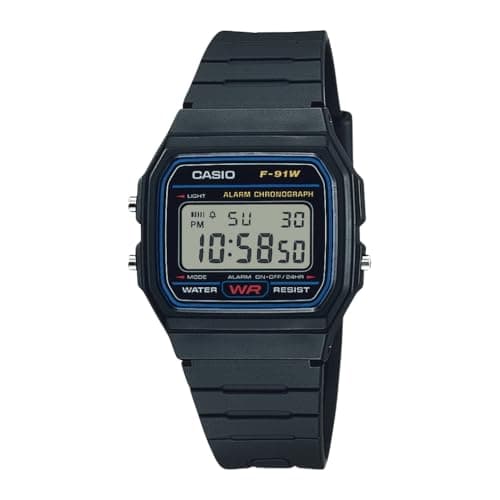
The F-91W is the question behind the question. It is 38.2 x 35.2mm, 8.5mm thick and 21 grams — less than half the weight of either G-Shock — with a 1/100-second stopwatch, a daily alarm, an auto-calendar good to 2099 and a battery Casio rates at around seven years. It costs roughly a quarter of what the GA-2100 does.
What it does not have is water resistance worth the name. Casio rates it to 30 meters, which means splashes and rain and nothing else, whatever the internet tells you about swimming in one. That single line is why it is ranked third here rather than first: both G-Shocks are 200m watches you can genuinely swim and shower in, and the F-91W is not. If the watch never gets wet, the F-91W does most of the same job for a fraction of the money and we would not argue with you. The rest of the cheap digital field is on best digital watches.
Our pick, stated plainly
For most people, the GA-2100. The 11.8mm case is the one genuine advance between these two watches, it reads as a watch rather than a gadget, and world time is of more use to more people than a hundredth of a second. We rank it first.
But we would take the DW-5600 ourselves in three situations: a wrist under about 6.5 inches, a job where the time has to be read instantly in poor light, or a budget that is genuinely tight — the square is consistently the cheaper watch. None of those is a consolation prize. The square has outlasted four decades of fashion by being the more honest instrument of the two.