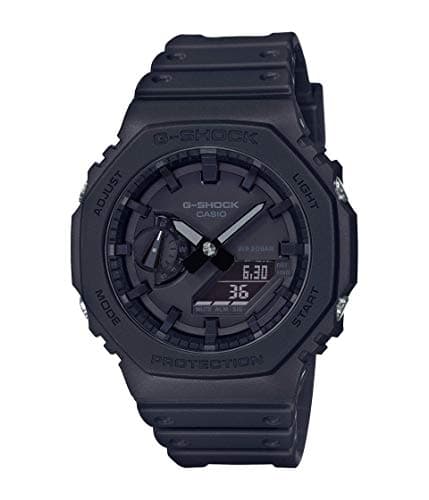
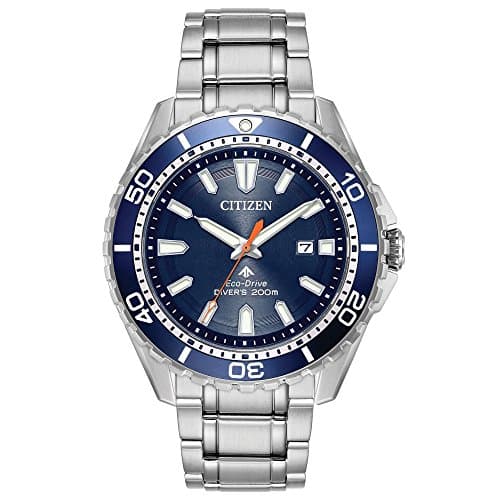
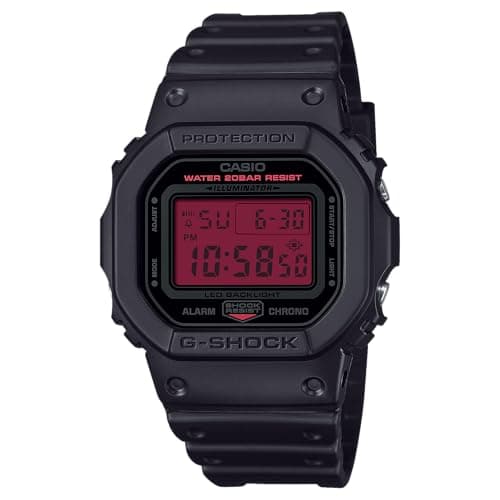
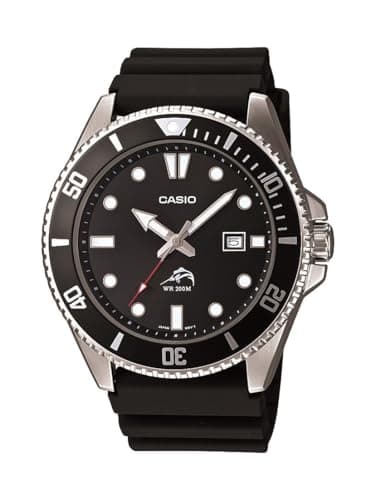
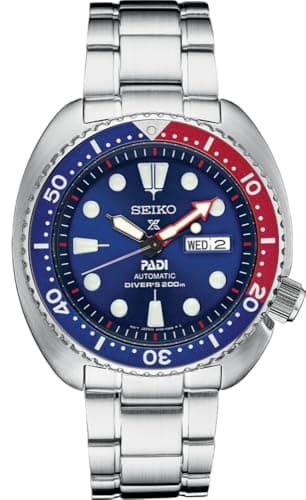
A dive watch and a G-Shock are the two watches people buy when they want something that will not break, and they are engineered against different threats. A dive watch is built to keep water out and to be readable in bad light at depth: a screw-down crown, a rotating bezel that counts elapsed minutes, big luminous markers, and — on a real ISO 6425 diver — a set of tests it has to pass. A G-Shock is built to survive impact: the module floats inside a resin case designed to absorb a fall, and water resistance to 200m comes almost as a side effect.
The confusion comes from the dial. Both say 200m. But 200m on a G-Shock means the case is sealed to that pressure; it does not have a rotating timing bezel, and most models have no lume beyond a backlight. 200m on a Seiko Prospex Turtle or a Citizen Promaster means the same pressure rating plus a bezel, a screw-down crown and the legibility standard — and none of the shock structure. Neither is the "tough watch." They are tough in different directions.
So the answer is a question: what are you going to do to it? Below we go through water, impact, legibility, the strap question, and price, and rank two real divers against two G-Shocks — plus the Casio Duro, which is the one watch that sits between the categories — at live prices. The short version: if you swim and dive, buy the diver; if you work with your hands, buy the G-Shock; and if you are choosing on toughness alone, the G-Shock wins and it is not close.
Water: the diver is built for it, the G-Shock is fine in it
A real dive watch is defined by ISO 6425, the standard our dive watch explainer goes through: a unidirectional rotating bezel with a minute scale, legibility at 25cm in the dark, a screw-down or otherwise secured crown, and pressure, condensation and shock tests. The Seiko Prospex Turtle is certified to it; the Citizen Promaster is built to comply with it. The bezel is the working part — it is how a diver reads elapsed time without a stopwatch, and how a swimmer, a cook or a parent times anything on land.
A G-Shock is rated 200m, which means it will go anywhere a recreational diver goes. What it lacks is the bezel and the diver's legibility. Casio does make dedicated dive-oriented G-Shocks with tide graphs, but the GA-2100 and DW-5600 here are general-purpose watches that happen to be sealed to depth. For swimming and snorkeling, either category is fine. For actual diving, the diver is the tool and the G-Shock is the backup.
Impact: the G-Shock is built for it, the diver is not
The G-Shock's whole reason for existing is the 1981 brief its engineer Kikuo Ibe set himself: a watch that survives a ten-meter fall, resists water to ten bar and runs ten years on a battery. The module is suspended inside the case so that an impact does not reach it, and the raised bezel keeps the crystal off whatever the watch lands on. The result is a watch you can drop off a ladder.
A mechanical dive watch is tough for a mechanical watch. ISO 6425 includes a shock test, and a Turtle will take knocks that would worry a dress watch. But an automatic movement is a precision instrument with a balance wheel and a hairspring, and a hard enough fall will hurt it in a way it will never hurt a quartz module in a resin cage. The Citizen Promaster Eco-Drive is the tougher of the two divers here because it is solar quartz rather than mechanical; the Turtle is the more capable diver.
Legibility: different jobs, different answers
A diver's dial is designed to be read at a glance in bad light: big hands, big markers, and — on the Seiko in particular — the best lume in affordable watches. A G-Shock's digital display is precise and busy; you read a number rather than a position, and in the dark you press a button. The GA-2100's analog dial with small hands is the least legible watch on this page in low light, and its owners know it. If reading the time fast in the dark matters, the diver wins.
Straps and lugs: the diver has them, most G-Shocks do not
Every diver here has 22mm lugs and standard spring bars. That means a dive strap, a tropic, a NATO or a steel bracelet goes on in a minute, and the aftermarket for Seiko divers is the largest in watches. The GA-2100 and DW-5600 have no lug width: fixed resin bands attach with screws, and changing them means Casio's own replacements or an adapter kit. If you like changing straps — and this site assumes you do — that is a real point against the G-Shock, and the reason our GA-2100 review spends as long on it as it does.
The watch in between: the Casio Duro
The Duro is a Casio, but it is not a G-Shock. It is a 44mm quartz diver with a 200m rating, a screw-down crown, a rotating bezel and real 22mm lugs, and it is the cheapest watch on this page by a wide margin. It has none of the G-Shock's shock structure, and its bezel and lume are basic, but it is the answer to "I want a diver's layout and a Casio's price." If the argument on this page has left you wanting both, the Duro is the compromise, and our Duro review is the case for it.
Price and ownership
The two G-Shocks here cost roughly a third of the Turtle and the Promaster, and they will run for years on a battery — the GA-2100 for about three, the DW-5600 similarly — then cost a few dollars to re-battery. The Promaster is solar and never needs one. The Turtle is an automatic that will want a service every five to ten years. Over a decade, the G-Shock is the cheapest to own, the Promaster the least trouble, and the Turtle the one that is still worth something.
The verdict
Buy a dive watch if you swim, snorkel or dive and want a bezel you can time with; if you want a watch you can put on a strap or a bracelet; or if you want a mechanical watch that reads as a watch. The Turtle is the pick if you want the ISO certification and the automatic; the Promaster if you want the set-and-forget solar version. Buy a G-Shock if you work with your hands, train hard, deploy, or simply want the watch that survives whatever happens next. The GA-2100 is the one that also wears well with a shirt; the DW-5600 is the original and the toughest thing on this page. And if you want a bezel and lugs for G-Shock money, the Duro.