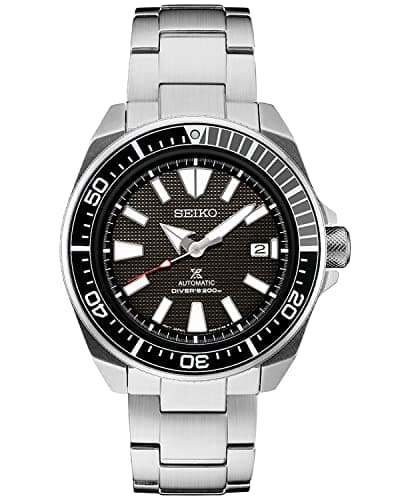
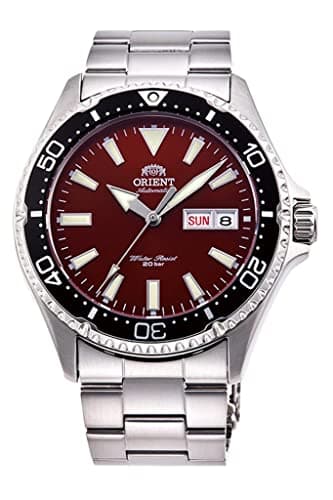
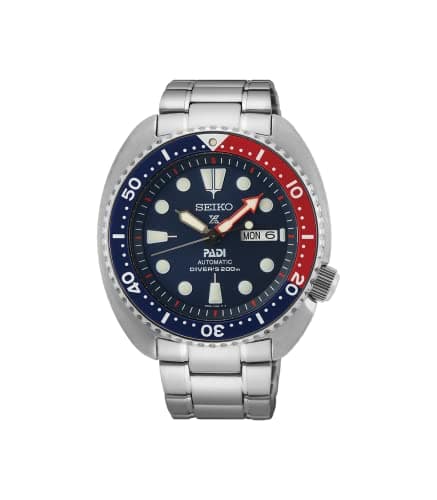
The Prospex Turtle is the watch that made the case that a real dive tool does not have to be expensive. It is certified to ISO 6425 — the actual standard, not the marketing word — with a screw-down crown, a 120-click unidirectional bezel, 200 meters of water resistance and Seiko's 4R36 automatic. The cushion case it comes in has been in and out of production since 1976 and has more devotees than any other affordable diver.
A note on what this review is and is not. We do not own this watch and we did not test it. What follows is built from Seiko's published specifications, the aggregated pattern of owner reports, and the arithmetic of comparing it against its direct rivals — the method set out on how we review. Where a figure could not be verified we say so rather than filling it in.
The verdict up front: the Turtle is the diver to buy if you want a watch that has actually cleared the dive standard and you have the wrist for it. The two watches most people cross-shop it against are ranked alongside it below — the Seiko Samurai, which is the same idea with sharper angles, and the Orient Kamasu, which is smaller, cheaper and has the sapphire crystal the Turtle does not.
ISO 6425 is the specification that separates it
Most affordable divers are rated to a number of meters and stop there. ISO 6425 is a formal standard a watch must clear before it can be marked "Diver's 200m", and it covers more than pressure: legibility of the time in total darkness at 25cm, a bezel that can be read in the dark, and resistance to thermal shock, magnetism and salt water, with the strap attachment tested for strength. The Turtle carries that marking. The Orient Kamasu, for all its sapphire, does not.
The cushion case is why it fits better than the number suggests
On paper the Turtle is 45mm across, which sounds like a lot of watch, and 48mm lug-to-lug, which is the figure to actually check. The cushion shape means the case is widest at the bezel and curves sharply down at the lugs, so the strap wraps early rather than sticking out. In practice it sits flatter than a conventional 45mm diver — though 48mm lug-to-lug is still too much for a wrist under about 6.5 inches, and no amount of case geometry changes that.
The 4R36, in plain terms
Seiko's 4R36 is the workhorse of affordable mechanical watches. It hacks, meaning the seconds hand stops when you pull the crown so you can set the time exactly, and it hand-winds, so you can start it without shaking it — the two things the old SKX's 7S26 could not do. It drives a day-date and carries roughly 41 hours of reserve. Seiko rates it at minus 35 to plus 45 seconds a day, which is honest rather than impressive; most examples settle well inside that.
Where it genuinely falls short
Two places. The crystal is Hardlex, Seiko's hardened mineral glass, not sapphire — it survives daily life but picks up hairlines over years, and the Orient Kamasu beats it here for less money. And the bracelet is the usual Seiko story: hollow end links and a stamped clasp on a watch whose case deserves better. Both are fixable for about twenty dollars with a 22mm strap; neither is fixable with wishing.
Turtle or Samurai?
They are the same proposition in two shapes. The Turtle is round, cushioned and vintage; the Samurai is faceted, angular and modern, and at 43.8mm across it is marginally the narrower watch, though retailers measure its lug-to-lug at about 48mm, so it wears about as long. The Samurai's 4R35 drops the day complication the Turtle's 4R36 has. Choose on the case, because nothing else meaningfully separates them.
Turtle or Orient Kamasu?
This is the real decision, and it splits cleanly. The Kamasu gives you a sapphire crystal and a far more wearable 41.8mm case with a 46.8mm lug-to-lug, usually for less money. The Turtle gives you ISO 6425 certification, Seiko's lume, a much larger aftermarket and a service network you can actually reach in the US. Buy the Orient for the specification, the Seiko for the certification and the ecosystem — and if the aftermarket is the draw, the best straps for Seiko watches is where it starts.