Lume is the luminous material on a watch's hands, markers and bezel pip. In every modern watch you are likely to buy, it is a photoluminescent pigment: it absorbs light, stores the energy, and releases it slowly as a visible glow. It is not radioactive, it does not generate light, and it cannot work without first being charged. That single mechanism explains almost every question people have about it.
The pigment used in good modern watches is strontium aluminate based, marketed under names like Super-LumiNova and, in Seiko's case, its own LumiBrite. Wikipedia's entry on Super-LumiNova describes the family as strontium aluminate–based, non-radioactive and non-toxic afterglow pigments that offer up to ten times the brightness of the older zinc sulfide materials. That tenfold figure is the whole reason lume on a modern affordable watch is dramatically better than on a 1980s one.
What came before was genuinely radioactive. Radium was used through the early twentieth century and is the reason vintage watch dials are handled carefully today; tritium replaced it as a far weaker emitter and is still used in a specific modern form described below. Everything on a normal shop shelf now is photoluminescent and inert.
Why your lume is dim by midnight
Because it is a battery for light, and a small one. The decay curve is steep at the start and long at the end: a well-charged dial is startlingly bright for the first few minutes, clearly readable for an hour or two, and faintly visible for hours after that. By the middle of the night it has given back most of what it stored.
That is not a fault, and it is the answer to the most common complaint. A watch charged under a desk lamp at 11pm will be legible at 1am and dim at 4am. A watch that spent the afternoon outdoors will be substantially brighter all night, because sunlight charges lume far faster and more fully than indoor light. If you want a bright dial at 3am in a tent, give the watch ten minutes of direct daylight before dark, or use a phone torch on it for thirty seconds.
The three different things people call lume
Photoluminescent pigment. The normal case, as above. Charges from light, glows, fades, repeats indefinitely. No power source, nothing to replace, works for the life of the watch.
Tritium gas tubes. Tiny sealed glass tubes containing tritium, coated internally with a phosphor. The gas continuously excites the phosphor, so the tubes glow constantly without ever being charged — and dimly but steadily for years, declining gradually with the isotope's half-life. Brighter than nothing at 4am, dimmer than fully charged pigment at 10pm. None of the watches on this site uses them.
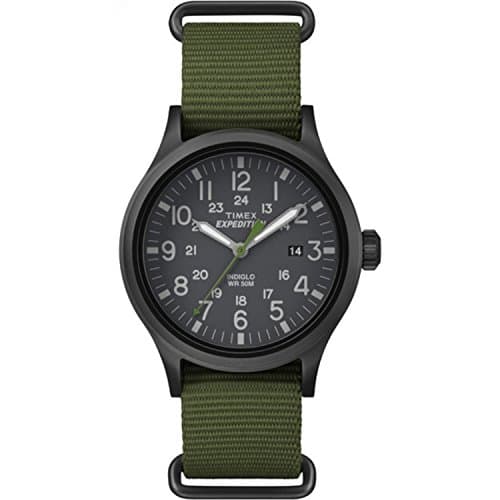
A backlight, which is not lume at all. Timex's Indiglo is an electroluminescent panel behind the dial that lights the whole face when you press a button. It is a light source rather than a stored glow, so it is equally bright at 4am as at 10pm — and it needs power and a press. The Timex Expedition on this page is here to represent that approach, which is genuinely the most useful one in the middle of the night and genuinely useless if you want to glance at the time without acting.
The short answer
Quick picks
#ad · Live prices from the Amazon Product API, as of October 6, 2026. Where we have no verified live price, we show none — we would rather leave a gap than print a number that has rotted.
Side by side
The spec table
Every published number that decides fit and function — including the lug width, so you know which strap fits before you buy.
In detail
The picks, in full
A real dive tool under $500
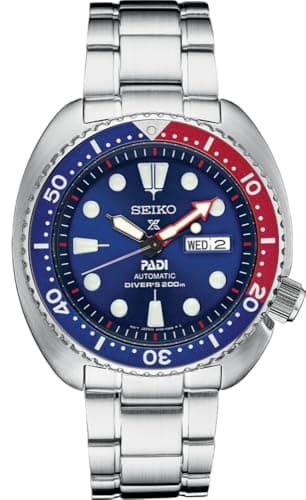
Seiko Prospex Turtle (SRPE)
45mm cushion22mm lug200m ISO4R36 automatic
A real ISO 6425 200m diver with a cult-favorite cushion case. The value benchmark.
- Legibility
- 9
- Build
- 8
- Movement
- 8
- Versatility
- 7
- Value
- 9
Pros
- +Certified to ISO 6425 with a screw-down crown — this is a genuine dive tool, not diver styling
- +The cushion case wears smaller than 45mm suggests thanks to the short, downturned lugs
- +Legendary Seiko dive lume
Cons
- −Still a big, tall watch — check the 48mm lug-to-lug against your wrist first
- −Hardlex, not sapphire, at this price
Skip this one if…
…you have a wrist under about 6.5 inches. The 48mm lug-to-lug is the number that matters here and it will overhang a smaller wrist — look at the 41.8mm Orient Kamasu instead.
Your first automatic
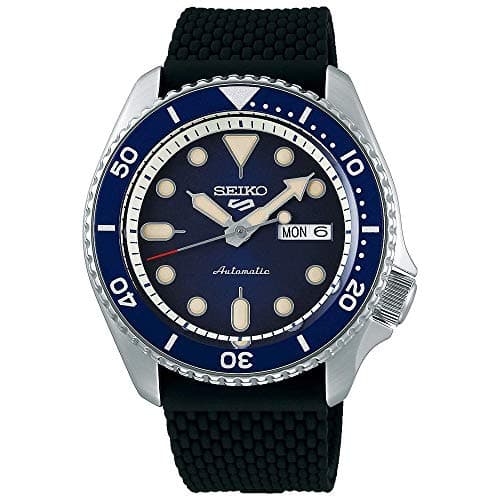
Seiko 5 Sports SRPD93
42.5mm22mm lug100m4R36 automatic
The default first automatic diver-style watch, and the direct heir to the beloved SKX.
- Legibility
- 9
- Build
- 8
- Movement
- 8
- Versatility
- 9
- Value
- 9
Pros
- +The 4R36 hacks and hand-winds — the two things the old SKX movement couldn't do
- +Genuinely great lume and the most recognizable dial in affordable watches
- +22mm lugs open onto the biggest strap aftermarket there is
Cons
- −100m water resistance, not the 200m of a true ISO diver — it is diver-styled, not a dive tool
- −Hardlex crystal scratches more easily than sapphire
Skip this one if…
…you actually dive or want a screw-down-crown 200m tool watch. The 100m rating and non-diver spec mean this is a desk diver — step up to the Turtle or a Prospex for the real thing.
A no-maintenance dive tool
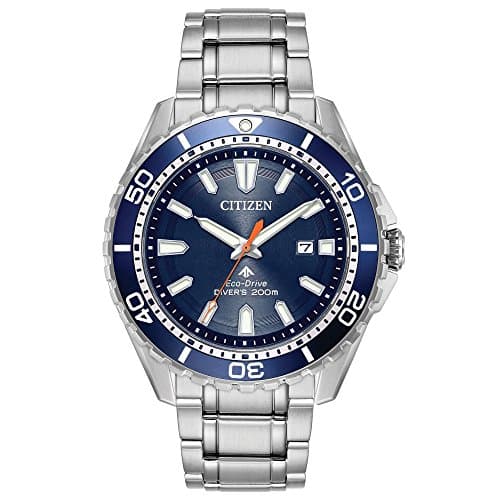
Citizen Promaster Dive Eco-Drive (BN0191)
45mm22mm lug200m ISOEco-Drive
An ISO-compliant 200m diver that never needs a battery or a wind. The set-and-forget diver.
- Legibility
- 9
- Build
- 8
- Movement
- 8
- Versatility
- 7
- Value
- 8
Pros
- +ISO-compliant 200m dive credentials with a screw-down crown and caseback
- +Eco-Drive runs on light — no battery to die mid-trip and no winding to remember
- +22mm lugs, so it shares the strap drawer with every Seiko diver on this site
Cons
- −45mm with a 48.8mm lug-to-lug — this is a big watch and it wears like one
- −Mineral crystal rather than sapphire at this price
Skip this one if…
…your wrist is under about 7 inches. The 48.8mm lug-to-lug is the number that decides it, and it will overhang — the Orient Kamasu is the smaller 200m answer.
The best value field watch
Timex Expedition Scout (40mm)
40mm20mm lug50mQuartz · INDIGLO
The default cheap field watch, and genuinely all the watch a lot of people need.
- Legibility
- 9
- Build
- 6
- Movement
- 6
- Versatility
- 9
- Value
- 10
Pros
- +Costs less than a strap for a nicer watch, and still nails the field-watch look
- +INDIGLO backlight is more useful in the dark than any luminous dial here
- +Quartz accuracy with a battery that lasts years
Cons
- −Basic case finishing and a strap most people upgrade quickly
- −Not a mechanical watch, if that's what you're after
Skip this one if…
…you want a watch to keep for decades and pass on. This is a superb tool at the price, but it is not an heirloom — the Hamilton is.
What makes lume good, beyond the material
Three things decide whether a dial is actually readable in the dark, and only the first is about the pigment.
How much of it there is. A thick application on large markers outperforms a better pigment applied thinly. This is why dive watches generally out-lume dress watches by an enormous margin: a dive dial is designed around big, heavily-filled markers, and ISO 6425 explicitly requires legibility in darkness at a distance.
Whether the important parts are lumed. Hands, hour markers and the bezel pip at 12 on a diver. A watch with lumed markers and bare hands is useless in the dark — you can see where the numbers are and not what time it is. The pip is the one that matters for timing with a bezel, because it is the reference point for everything the bezel does.
Contrast and colour. Green-emitting lume reads brightest to the human eye and is why most watches use it; blue looks better in photographs and is dimmer in practice. A matte black dial under lumed markers gives better perceived contrast than a light dial.
Which watches here do it best
Seiko's reputation in this area is the one piece of enthusiast folklore that is straightforwardly true at the price. The Prospex Turtle and the 5 Sports SRPD both carry big, generously-filled markers and hands, and in both cases we have rated the lume as a standout rather than a feature. The Turtle is the stronger of the two because it is a 200m ISO 6425 dive watch, and the dive standard forces the issue.
The Citizen Promaster Dive Eco-Drive is the counterpoint from the solar side: an ISO-compliant 200m diver, so it faces the same legibility requirement, with no battery to worry about. And the Timex Expedition is the fourth pick because its Indiglo backlight solves the problem by a completely different route — which is worth seeing laid out next to the other three rather than argued about in the abstract.
Things people worry about that are not problems
Is lume radioactive? Not in any watch you can buy new on a high street. Modern lume is a non-radioactive, non-toxic photoluminescent pigment. Radium dials are a historical object and a genuine handling caution for vintage watches; tritium tubes contain a very weak emitter fully sealed in glass and are regulated accordingly.
Does lume wear out? Photoluminescent pigment does not have a charge cycle limit the way a battery does — it will keep charging and glowing for the life of the watch. What does happen over decades is that the pigment can discolour and the binder can degrade, which is cosmetic rather than functional.
Can you recharge it with a UV torch? Yes, and quickly — UV is very efficient at exciting the pigment. It is a popular trick for photographs. Daylight does the same job over a longer period and with no equipment.
Should lume affect what you buy?
Only if you will use it, and more people do than expect to: checking the time at night without turning on a light is the single most common real use of a watch in 2026. If that matters to you, buy a diver or a field watch rather than a dress watch, check that the hands as well as the markers are lumed, and treat the dive-watch categories as the safe default — the dive roundup and the field roundup are where the well-lumed watches on this site live.
If you want guaranteed brightness at 4am with no charging at all, you want a backlight or tritium rather than better lume — the physics does not bend. And if you are hiking or camping, it is worth reading our hiking picks, where this exact trade-off decides one of the rankings.
How we picked
We do not run a testing lab
We compiled the published manufacturer specifications for every watch here — case size, lug-to-lug, lug width, water resistance, movement and crystal — did the wrist-fit and value math, and scored each pick against a published rubric. The scores are judgments from documented research — they are not measurements we took or wrist-time we logged, because we do not have these watches and we are not going to pretend we do. Where a spec could not be verified we wrote "data unavailable" rather than guessing.
Questions
Frequently asked
What is lume on a watch?+
The luminous material on the hands, hour markers and bezel pip. On any modern watch it is a photoluminescent pigment that absorbs light, stores the energy and releases it as a glow. It does not generate light and it cannot work without being charged first.
How does watch lume work?+
The pigment — strontium aluminate based in modern watches, marketed as Super-LumiNova or, for Seiko, LumiBrite — absorbs photons and re-emits them slowly. Charging is fastest in direct sunlight and much slower under indoor lighting, which is the main reason a dial some people find dim is simply undercharged.
Why does my watch lume fade so quickly?+
Because it is storing a finite amount of energy and giving it back on a steep curve: very bright for minutes, clearly readable for an hour or two, faintly visible for hours after that. It is working as designed. Ten minutes of daylight before dark makes a far bigger difference than any amount of indoor light.
Is watch lume radioactive?+
Not in anything sold new today. Modern lume is a non-radioactive, non-toxic photoluminescent pigment. Radium was used historically and is the reason vintage dials are handled with care; tritium gas tubes, used on some specialist watches, contain a very weak emitter fully sealed in glass.
What is the difference between lume and Indiglo?+
Lume is a stored glow that charges from light and fades. Indiglo is an electroluminescent panel behind the dial that lights the whole face when you press a button — a light source rather than a stored glow, so it is as bright at 4am as at 10pm, but it needs power and an action from you.
Which watches have the best lume?+
Dive watches, almost always, because the design brief and the ISO 6425 standard both demand legibility in darkness, which means big markers with a thick application. Seiko's reputation here is deserved at the price — the Prospex Turtle and the 5 Sports SRPD both have standout lume for what they cost.
Does watch lume wear out?+
Not functionally. Photoluminescent pigment has no charge-cycle limit and will keep working for the life of the watch. Over decades the pigment can discolour and the binder can degrade, which is a cosmetic change rather than a failure — it is also the look people pay for on 'faux patina' dials.
How do you charge watch lume fastest?+
Direct sunlight, or a UV torch for a few seconds. A phone torch held close for thirty seconds works well enough for a night. Ordinary room lighting charges it, just slowly and incompletely, which is why a watch worn indoors all day glows less than one worn outside.
Receipts
Sources
We do not run a testing lab, and we do not pretend to. Every spec above traces to a manufacturer listing or a named standard; where we could not verify something, we say so on the page rather than quietly leaving it out. Read our full method.