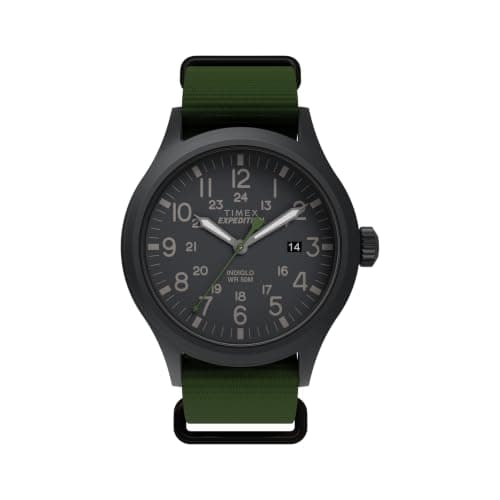
The Timex Expedition Scout is what a field watch looks like when nobody is trying to impress anyone. Forty millimeters, a matte dial with full Arabic numerals and a 24-hour inner ring, a 20mm lug width, 50 meters of water resistance, INDIGLO backlighting, and a price that has hovered around fifty dollars for years. It is not the best watch on this site. It is the one we recommend most often.
A note on what this review is and is not. We do not own this watch and we did not test it. What follows is built from Timex's published specifications, the aggregated pattern of owner reports and the arithmetic of comparing it to its siblings — the method set out on how we review. Where a figure could not be verified, we say so.
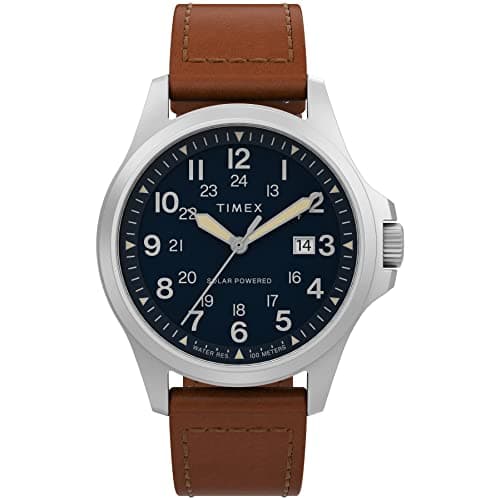
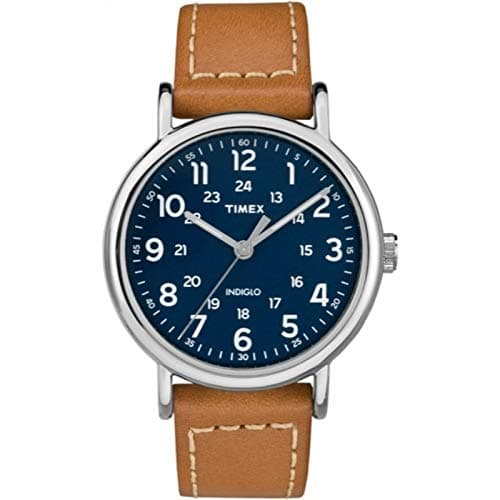
The verdict up front: buy it if you want a real field watch and do not want to think about it. The two Timexes worth comparing it against are ranked beside it below — the Expedition North Field Post Solar, which adds sapphire, solar and 100m for about four times the money, and the Weekender, which is cheaper still and is a different kind of object than most buyers expect.
INDIGLO is the feature nobody else has at this price
Most cheap watches use painted lume that glows for twenty minutes after a bright light and then stops. INDIGLO is an electroluminescent panel behind the dial: press the crown and the entire face lights up evenly, on demand, for as long as you hold it, at any hour of the night. It is a genuinely better solution to the problem than lume is, and it has been Timex's quiet advantage for thirty years.
The specification sheet, honestly read
40mm across, 20mm lug width, 50m water resistance, quartz, mineral crystal. Fifty meters means rain, handwashing and a swim you did not plan for, but we would not make a habit of laps in it. The mineral crystal will collect hairlines over a few years. Timex does not publish a lug-to-lug figure for the Scout, so the table above shows a dash rather than a guess — the 40mm diameter and short lugs put it comfortably in the range that suits most wrists.
Where the money went, and where it did not
Timex spent it on the dial, the case size and the movement — the three things that decide whether a watch is usable. It did not spend it on the crystal, the finishing or the supplied strap, and you can see all three. This is a coherent set of decisions rather than a set of corners cut at random, and it is why the Scout has outlasted a decade of more ambitious cheap watches.
Change the strap, and keep the old one
The supplied strap is the weakest part of the package on every Timex at this price. The 20mm lug width means the entire aftermarket fits, and a canvas or nylon strap for under twenty dollars — a third of the watch's price — genuinely changes how it wears. Our field watch strap guide covers the options.
Scout or Expedition North Field Post Solar?
The Expedition North is a substantially better watch and costs substantially more. It adds a sapphire crystal, which is the upgrade you notice most over years, solar charging, so there is never a battery, and 100m water resistance at 41mm. If the watch is going to be your only watch and worn hard, it is worth the difference. If it is a knock-around second watch, the Scout already does the job.
Scout or Weekender?
Not the same watch, despite the similar price. The Weekender is 30m water resistant, uses an acrylic crystal and takes slip-through straps rather than standard spring-bar ones. It is a fun, cheap platform for strap experimentation and a poor choice as a rugged everyday watch. If you want one Timex to actually use, buy the Scout. The full head-to-head, spec by spec, is Timex Expedition vs Weekender.