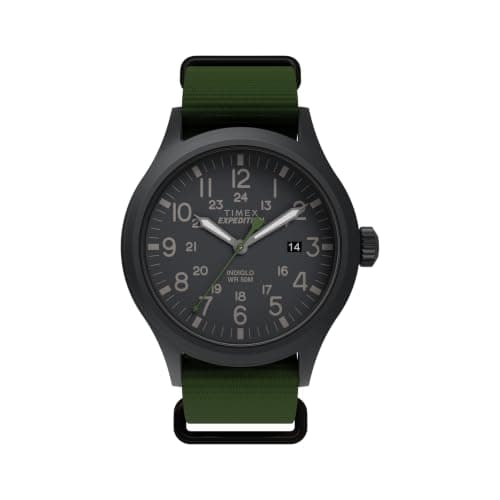
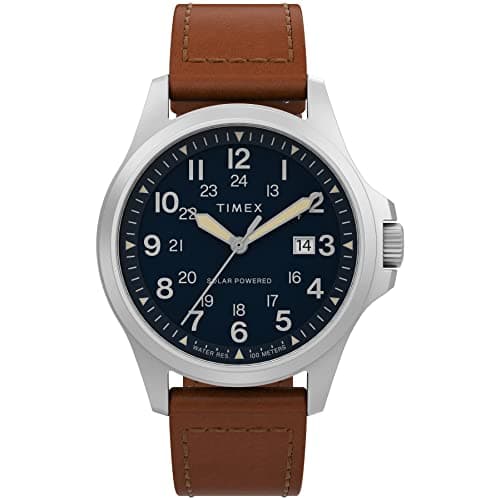
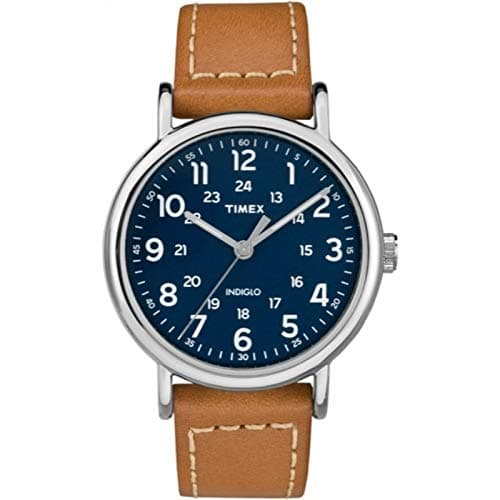
The Timex Weekender is the watch that has introduced more people to wearing a watch at all than almost anything else made this century. It is around fifty dollars, it is 40mm, it has Indiglo — the electroluminescent backlight that turns the entire dial into a lamp — and it ships on a strap you can change in seconds. As an idea, it is close to perfect.
It is also rated to 30 meters, which in practice means splashes and handwashing and nothing else. That is the honest limit of the watch and the reason we rank the Expedition Scout above it for anyone who wants one watch for everything. Both are excellent; they are for different people.
A note on method: we do not own these watches and we did not test them. What follows comes from Timex's published specifications, comparison against the direct alternatives, and the aggregated pattern of owner reports — the approach described on how we review. Where a figure could not be verified, it is marked rather than guessed.
What the Weekender actually is
A 40mm brass-and-steel-cased quartz watch with a plain, high-contrast dial, a 24-hour inner ring, Indiglo backlighting and a slip-through fabric or leather strap. It is not a field watch in the strict sense — it has no military lineage and no serious water resistance — but it wears the language of one, and it does so at a price that makes the question academic.
Indiglo is the feature, and it is genuinely good
Most watches at any price use luminous paint, which charges in light and fades over a few hours. Indiglo is an electroluminescent panel behind the dial: press the crown and the whole face glows evenly, on demand, for as long as you hold it, at any time of night regardless of how long the watch has been in the dark. It is a better solution to reading the time at 3am than lume is, and no watch above $300 on this site has it.
The 30m rating is the real limit
Thirty meters is a splash rating. It covers rain, handwashing and a spilled drink; it does not cover swimming, and it certainly does not cover diving. Watch-industry water-resistance numbers are static pressure tests, not depth ratings, which is why 30m does not mean thirty meters of swimming — a swimming stroke generates more pressure at the wrist than standing still in three feet of water does.
If you want a Timex you can swim in, the Expedition Scout is rated to 50m and costs about the same, and the Expedition North Field Post Solar is rated to 100m with a screw-down crown. Both are ranked here for exactly that reason.
The strap is half the value
The Weekender ships on a slip-through single-pass strap, and the whole product is designed around swapping it. At 20mm it takes the most abundant strap size there is, and a twenty-dollar nylon or leather strap changes the watch completely. Buying a Weekender and three straps for under a hundred dollars is, we would argue, the single best value proposition in watches — more of a "collection" feeling than most people get for ten times the money.
Where it falls short against the Expedition Scout
The Scout is the more sensible watch: 50m rather than 30m, a slightly tougher case, and a dial that reads a little more like a genuine field watch. It costs about the same. If you want one cheap watch to wear for everything, buy the Scout. Buy the Weekender if you like the cleaner dial, want Indiglo specifically, or are treating it as the base of a strap-swapping habit rather than a watch you will swim in.
Longevity, honestly
At this price nothing is serviceable in any meaningful sense. A battery change costs a few dollars; anything else and you replace the watch. The Weekender is not an heirloom and does not pretend to be — it is a well-designed disposable object, which is a legitimate category and the reason it has been recommended continuously for over a decade.
The watch almost everybody cross-shops against it is the Expedition Scout, and the two are not as similar as the photographs suggest. We put them side by side on Timex Expedition vs Weekender, which comes down to 50m against 30m, mineral against acrylic, and what the strap is for.