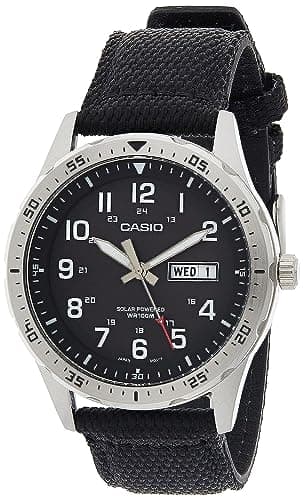
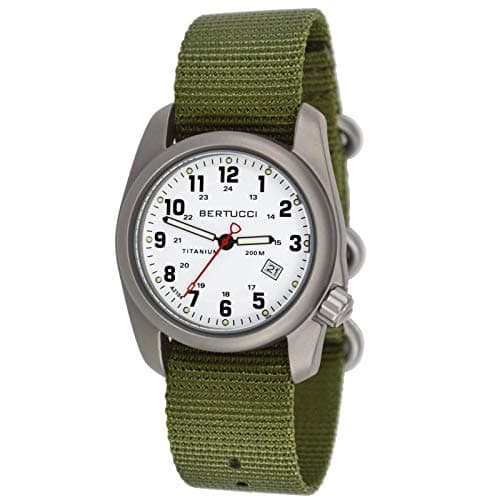
Let us deal with the obvious objection first. If what you want is GPS navigation, a breadcrumb trail, a barometric altimeter and a route you can upload, buy a GPS watch — nothing on this page does any of that, and no amount of ranking will change it. This page is for the other hiker: the one who navigates with a map, carries a phone with the radio off, and wants a watch that reads the time instantly, survives the trip and is never the thing that needs charging.
Judged that way, a field watch is close to the ideal hiking watch, and it is worth saying why. The category was designed for people walking long distances outdoors carrying things — that is literally its military origin — so the attributes it optimises for are the ones that matter: a high-contrast dial you can read in half a second, a case small and light enough to disappear under a sleeve, a strap that handles sweat, and a movement that does not need attention.
How this page is ranked
Weight first. A watch under a pack strap and a jacket cuff is noticed mostly by its mass, and over a long day it is the difference between forgetting the watch and resenting it. Titanium is the reason the Bertucci leads.
Power second, and this is the specification that genuinely separates the list. Solar means it charges while you walk. Hand-wound and automatic mean no cell exists to die. A conventional battery is fine on a weekend and a liability on a thru-hike, and the order below reflects that.
Water resistance third, because rain, stream crossings and sweat are constant — 100m is the sensible floor and the one watch here below it is flagged for it. Night legibility fourth: hiking means reading the time in a tent at 3am, which is a lume question and, on one pick here, a backlight question. And strap last, because it is the one thing you can change — though not on every watch here.
Why weight is the first criterion and not the fourth
Hikers count grams everywhere else and then strap on a 45mm steel diver. A titanium case is meaningfully lighter than the same case in steel, and the Bertucci A-2T is the lightest watch we rank: 40mm, full titanium, and a case that resists the sweat corrosion that pits cheap steel over a season of use. It is also unglamorous to a fault, which on a trail is a feature.
The compromise is its fixed lug bars. You cannot fit a standard 22mm strap to it — our field-watch strap guide does not apply to this watch. Read that two ways: a limitation if you like changing straps, and a genuine reliability benefit if you do not, because a fixed bar cannot shear and drop the watch into a creek.
Power: the specification that decides a long trip
On a day hike, nothing here matters. On a long trip, the power source is the whole argument.
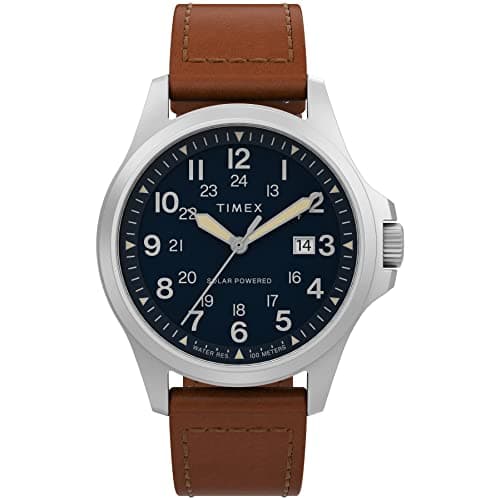
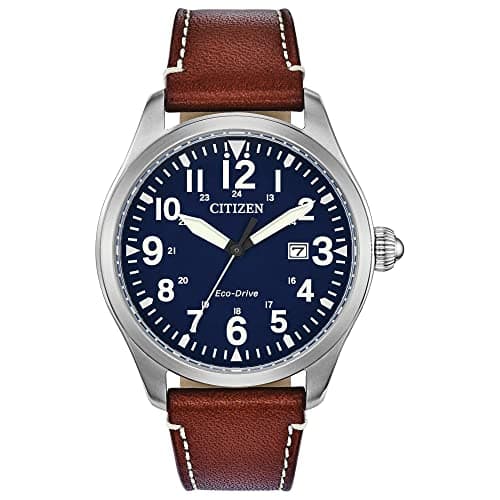
Solar is the best fit for hiking of any technology, because the one thing a hiker has in abundance is daylight. The Timex Expedition North is the standout: solar, a sapphire crystal (rare at this price and the right call for a watch that will meet rock), a screw-down crown and 100m. The Citizen Garrison and the Casio MTP-S120L do the same job at 42mm, both on 22mm lugs and both at 100m.
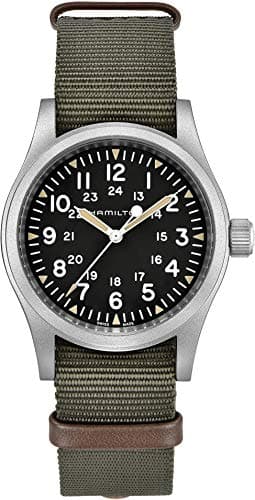
Hand-wound mechanical is the other answer, and the Hamilton Khaki Field Mechanical is the archetype: 38mm, no date, sapphire, and an 80-hour power reserve from one winding. Its honest weakness here is the 50m rating — the lowest on this page, and enough for rain and a stream crossing but not a specification we would take swimming. See water resistance explained for what 50m actually permits.
A standard quartz battery is not disqualifying, it is just one more thing with a finite life that you cannot replace at a trailhead. Watches that need no battery covers both routes out of the problem in detail.
Reading the time at 3am
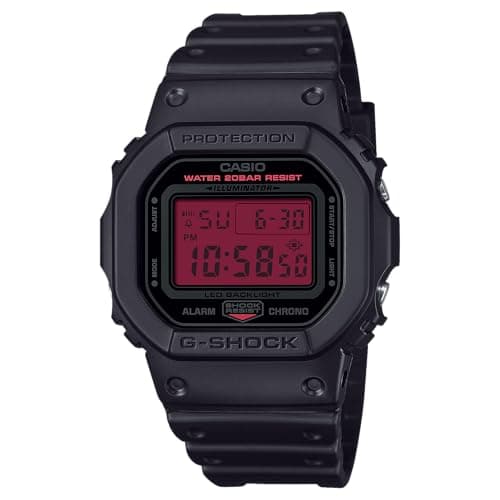
Lume is a photoluminescent pigment: it absorbs light and releases it, brightly for the first minutes and then dimly for hours. Inside a tent after dark it has had nothing to charge from since dusk, which is exactly when you want it — so a watch with a genuinely strong charge and a slow decay is worth more on a hike than anywhere else. The Casio G-Shock DW-5600 sidesteps the whole problem with an electric backlight, which is the one unambiguous functional advantage a digital has here.
The G-Shock is the pick for anyone who wants an alarm for a 4am start, a stopwatch, a 200m rating and total indifference to being dropped on granite. What it is not is a field watch in any traditional sense, and it will not take a standard strap. It is here because on a hike it genuinely out-functions every analog watch on the page, and leaving it off would be dishonest.
Straps: the part that gets sweaty
Four of the six watches here take standard straps — 20mm on the Timex, 22mm on the Citizen and the Casio MTP, 20mm on the Hamilton — and that is the cheapest upgrade available. For a trail, a nylon NATO is the right answer twice over: it washes, dries fast, and the single-pass construction keeps the watch on your wrist even if a spring bar fails. Leather is the wrong material for a hike and will not survive a season of sweat; our strap lifespan guide puts numbers on that.
So which one
Bertucci A-2T if weight is the thing and the watch lives outdoors. Timex Expedition North if you want the most complete specification — solar, sapphire, screw-down crown, 100m — in one watch. G-Shock DW-5600 if you want a backlight, an alarm and nothing to worry about. Hamilton Khaki Field Mechanical if you would rather wind a watch than charge one, and you accept 50m. Citizen Garrison or the Casio MTP-S120L for solar at two lower price points — with the Casio's 49mm lug-to-lug the figure to check against your wrist first.