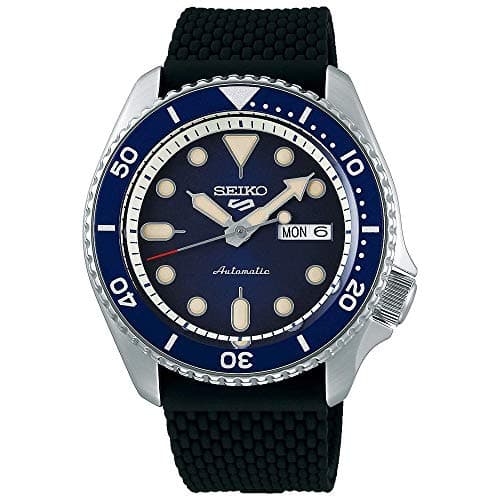
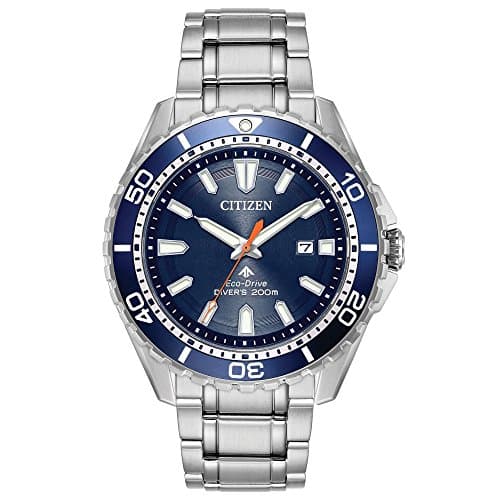
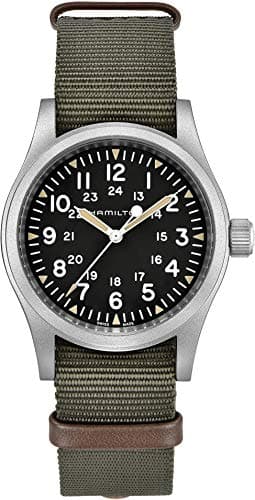
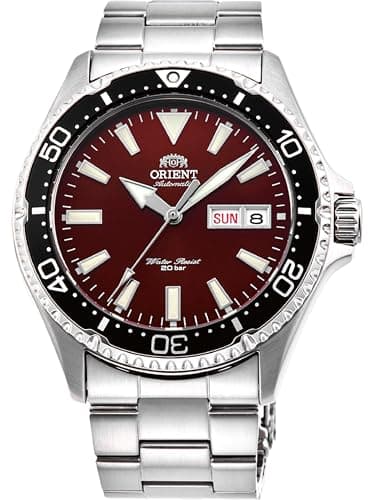
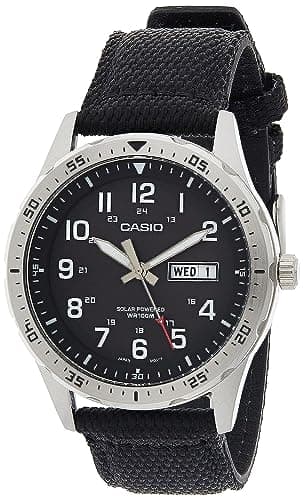
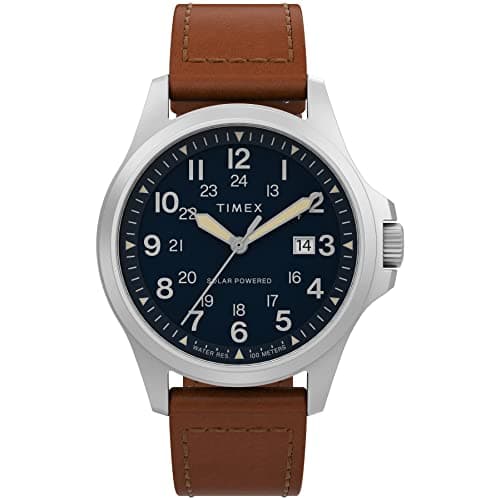
There are exactly two ways to own a watch you never change a battery in, and the difference between them matters more than any individual watch on this page. Solar watches still have a cell — a rechargeable one, charged by light through the dial, which is not user-replaceable and is not meant to be. Mechanical watches, automatic or hand-wound, have no electrical power source at all: a coiled mainspring drives the whole thing, wound either by your wrist moving or by your fingers.
Both genuinely solve the stated problem, so the honest question is what each one costs you. Solar costs nothing in daily life and everything in romance: it is a quartz watch, it keeps excellent time, and it will do so unattended for years. Mechanical costs you accuracy — expect seconds a day rather than seconds a month — and eventually a service, and gives you back a machine with no electronics in it at all. The six below are three of each.
How this page is ranked
How long it runs unattended is the first criterion, because it is the thing the question is actually asking. A solar watch sitting in daylight runs indefinitely; left in a drawer it has a power reserve measured in months. An automatic left off the wrist stops in a day or two. A hand-wound Hamilton with an 80-hour reserve runs for over three days from one winding and then stops until you wind it again. None of these needs a battery; only one of them needs nothing from you.
Then how good the watch is otherwise, judged the way we judge every watch here — crystal, water resistance, case size, legibility. A watch is not worth owning because of how it is powered. The ranking below deliberately alternates between the two technologies rather than putting all the solar watches first, because the right answer depends on which kind of owner you are, and the product cards say which is which.
Solar: a cell you never see
Citizen's Eco-Drive, Seiko's solar movements and Timex's solar quartz all work the same way — a photovoltaic layer under the dial converts light into energy stored in a rechargeable cell. Any light works, including indoor light; a watch worn normally never runs down. Left in a drawer, the stored charge typically lasts months rather than days.
The caveat people deserve to hear: the rechargeable cell is a component and components age. Over a very long horizon — the kind measured in a decade or more — a solar cell holds less charge than it did new, and replacing it is a service job rather than a five-dollar battery swap at a counter. That is still an enormously better deal than a battery every two years, and it is the trade the entire technology rests on. Citizen has built its brand on it, which we argue out in full on is Citizen a good watch brand.
Of the three solar watches here, the Timex Expedition North is the one we would buy first — sapphire and a screw-down crown at 100m is a specification Timex normally reserves for watches costing far more. The Citizen Promaster Dive Eco-Drive is the serious one: ISO-compliant at 200m, with a screw-down crown, in a 45mm case that needs a wrist. The Casio MTP-S120L is the cheap one, and the figure to check before you buy it is the 49mm lug-to-lug, which is long for a 42mm watch.
Mechanical: nothing to charge, something to do
An automatic winds itself from the motion of your wrist. Wear it daily and it simply runs; leave it two days and it stops, and you reset it. That is the whole bargain, and for most people it is a small price for a watch with no electronics in it. The Seiko 5 Sports SRPD93 is the default recommendation — its 4R36 movement hacks and hand-winds, which the old SKX movement could not — and the Orient Kamasu is the one that adds a sapphire crystal and a genuine 200m rating at a similar price.
A hand-wound watch does not wind itself, which sounds like a disadvantage and is mostly a different relationship. The Hamilton Khaki Field Mechanical has an 80-hour reserve from Hamilton's H-50 movement: wind it on Friday morning and it is still running on Monday. It is also the thinnest and smallest watch here at 38mm, because there is no winding rotor taking up space.
The real cost of mechanical is twofold. Accuracy: a good affordable automatic runs within a handful of seconds a day, where any quartz watch here runs within a handful of seconds a month. And service: a mechanical movement has lubricants that eventually need replacing, which is a real cost on a schedule measured in years. Neither is a battery, which is the question — but neither is free. Quartz vs automatic has the full comparison.
What about kinetic, and what about a dead solar watch?
Two questions worth answering directly. Kinetic and similar hybrid movements use wrist motion to charge a cell that then drives a quartz movement — same never-change-a-battery promise, by a third route. None of the watches ranked on this site uses one, so we have not included the category rather than writing about watches we have not specified.
A solar watch that has gone flat is not broken. Put it somewhere bright — a windowsill, not direct midday sun on a hot day — and leave it for several hours; most will restart on their own. If it does not, that is the point at which the cell may need replacing, and it is a watchmaker's job rather than a counter job.
So which one
You want to never think about it: the Timex Expedition North. Solar, sapphire, 100m, 41mm, and nothing to do. You want a real 200m dive tool with no battery: the Citizen Promaster Dive Eco-Drive. You want a mechanical watch and only one: the Seiko 5 Sports SRPD93. You want a mechanical watch with a sapphire crystal: the Orient Kamasu. You want the purest version of the idea: the Hamilton Khaki Field Mechanical, hand-wound, 80 hours, no cell of any kind. You want the cheapest: the Casio MTP-S120L.