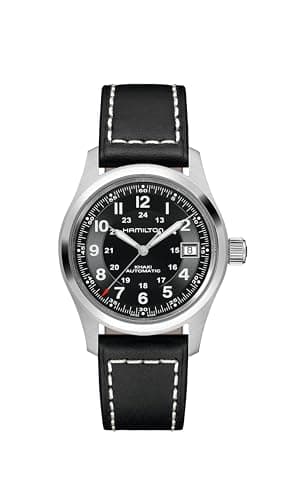
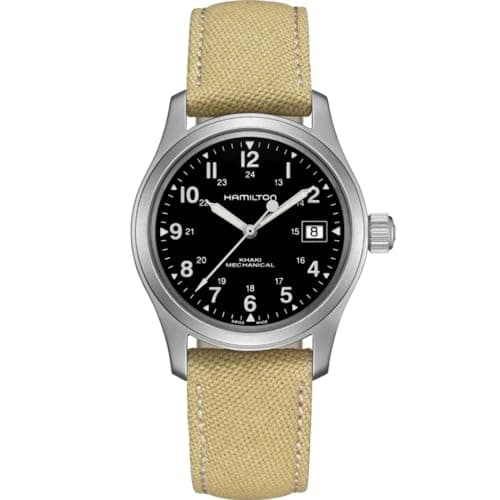
There is a reason the Hamilton Khaki Field is the single most-recommended watch on the internet for someone buying their first serious mechanical watch. It is 38mm — the historically correct field size — with a matte dial, huge legible numerals, a sapphire crystal, a Swiss movement with an 80-hour power reserve, and a design that has not needed changing since the 1940s because it was right the first time.
As with every review on this site, we do not own this watch and we did not test it. This is built from Hamilton's published specifications and the arithmetic of comparing it against its direct alternatives, per how we review. What we can tell you precisely is what the watch is, what it is not, and which version to buy.
The verdict: buy the Khaki Field Mechanical. It is thinner, cheaper and more tactile than the automatic, and the daily winding is a feature for most people who buy a watch like this rather than a chore. Buy the Automatic only if you know you will resent winding. And read the water-resistance section below before you buy either — it is the one specification that catches people out.
The 50m water resistance is the thing to understand
Both the Mechanical and the Automatic are rated to 50 meters. In practice that means rain, hand-washing, getting caught in a downpour — all fine. Swimming laps, showering daily, snorkelling — not what it is for. This is the single most common source of buyer regret with this watch, and it is worth being blunt about: if you want a Hamilton you can swim in, buy the 100m Khaki Field Murph or the 100m Khaki Field Titanium instead. If you want any watch you never think about around water, buy a diver.
Hand-wound versus automatic: the real differences
The Mechanical uses the H-50, a hand-wound movement. You wind it — roughly 20 crown turns — and it runs about 80 hours. Because there is no automatic rotor, the case is thinner, and it costs less. The Automatic uses the H-10: same 80-hour reserve, winds itself from wrist motion, sits a fraction thicker, costs more. Both have sapphire crystals, both are 38mm, both are 20mm lug, both are 50m. There is no "better" here, only a preference about whether you want to interact with the watch each morning.
How it actually wears
38mm with a 46.5mm lug-to-lug is close to universally wearable — it will sit flat on almost any adult wrist, which is why it gets recommended so freely. The matte dial and painted Arabic numerals give it the best pure legibility of any watch on this site. It is a plain object; that is the whole point. If you want something people comment on, this is the wrong watch.
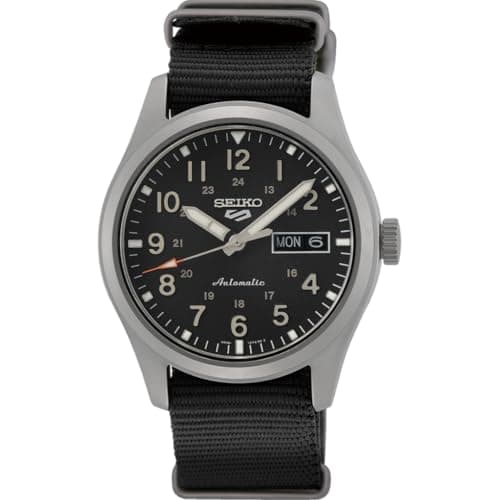
Against the Seiko 5 Sports Field
The Seiko undercuts the Hamilton substantially and answers back with 100m water resistance and a 4R36 automatic. What it gives up is the sapphire crystal (it uses Hardlex), the 80-hour reserve, and Swiss finishing. If water resistance is your priority and budget is tight, the Seiko is the sharper buy. If you want the object — the sapphire, the finishing, the heritage — the Hamilton is worth the gap, and it is the one you keep.
The strap it deserves
The Khaki Field is 20mm, and it is arguably the best strap-swapping watch made: it looks right on leather, on canvas, on a NATO and on a bracelet. A field watch and three straps is a complete rotation for less than the price of a second watch. Start with our field-watch strap guide, and use the lug width chart to confirm the width on your reference.
Two practical next steps. The strap is the cheapest way to change this watch, and the 20mm options are ranked on the best straps for the Khaki Field. And if you are still weighing it against the obvious Japanese alternative, that comparison is Hamilton Khaki Field vs Seiko 5.