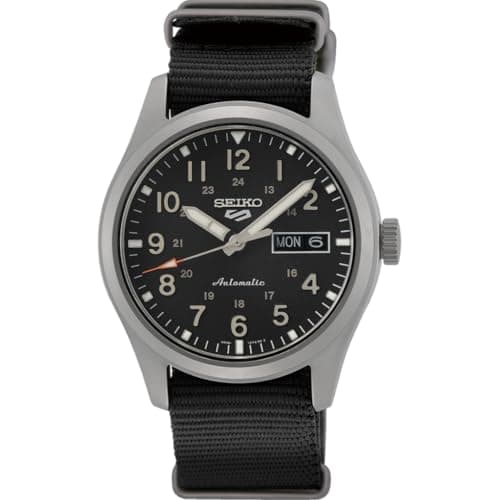
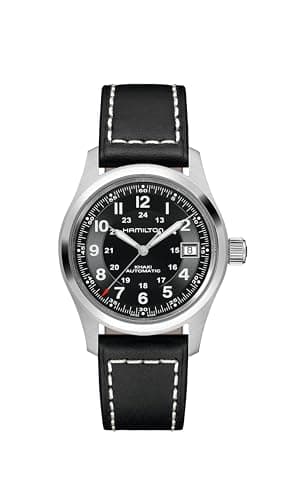
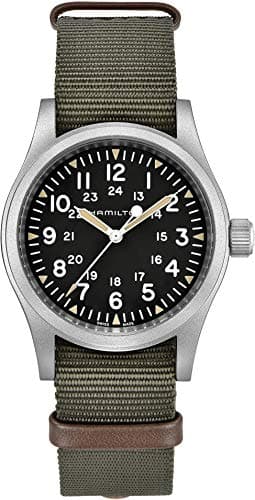
This is the comparison that most field-watch shopping collapses into. On one side the Hamilton Khaki Field, the direct descendant of the WWII-issue field watch and the watch enthusiasts hand to newcomers. On the other the Seiko 5, the automatic that costs a third as much and is wearing most of the same specification. The two are routinely presented as a budget-versus-quality choice, and that is only half right: on the one specification a field watch is most likely to be judged on in real life, the cheap one wins.
The four specifications that actually separate them
Crystal. Every Hamilton Khaki Field on this page uses sapphire. Every Seiko 5 uses Hardlex, Seiko's hardened mineral glass. That is the clearest quality gap between the two and the one you will eventually see, because grit is quartz and quartz scratches mineral glass — the argument in full is on sapphire vs mineral crystal.
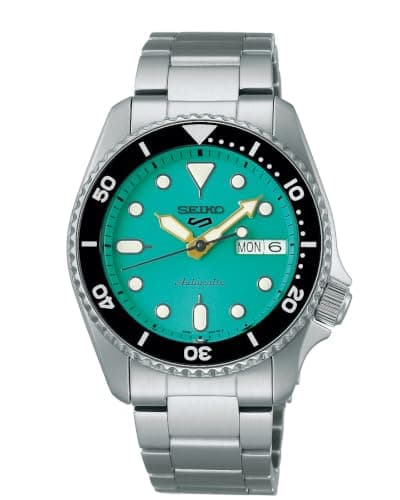
Water resistance. Here the order reverses. The hand-wound Khaki Field Mechanical is rated to 50m. The Seiko 5 Sports Field is rated to 100m, and so is the Seiko 5 Sports SRPK33. A 50m watch is fine for rain and hand-washing and is not a swimming watch; 100m is. If the watch is going to get wet, the cheap one is the correct one. See watch water resistance explained for why the number is a pressure test rather than a depth.
Movement. The Hamilton H-50 is hand-wound with an 80-hour reserve; the H-10 is the automatic version of the same thing. Seiko's 4R36 is an automatic that hacks and hand-winds, with a shorter reserve and a looser accuracy spec. The Hamilton is the better movement. The Seiko is the one that keeps running if you forget about it for a day, which is the difference laid out on manual vs automatic watches.
Size. Both Khaki Fields here are 38mm with a 46.5mm lug-to-lug. The Seiko 5 Sports Field is 39.4mm; the SRPK33 is 38mm with the shortest lug-to-lug on this site at 44.2mm. All four take 20mm straps, which means every strap decision on this site applies to all of them equally.
Where the Hamilton earns its money
Three places, and they are all real. The sapphire crystal is the durability upgrade most worth paying for on a watch you intend to keep. The 80-hour power reserve means a watch taken off on Friday is still running on Monday, which no Seiko 5 will do. And the case finishing, the dial printing and the hands are a visible step up when you look closely — Swiss assembly at a price where almost nothing else is.
The hand-wound H-50 is also, for a certain kind of owner, the entire point. You wind it every morning, it runs all day, and there is no rotor adding thickness. If that sounds like a chore rather than a ritual, the automatic H-10 version is the same watch with a rotor — the choice is laid out on Hamilton mechanical vs automatic.
Where the Seiko wins, and it is not only price
The 100m rating is the honest headline. A field watch lives on a wrist that washes up, gets rained on and occasionally goes in a lake, and the Seiko is rated for all of that where the hand-wound Hamilton is not. The 4R36 is also a movement with an enormous service network behind it: any watchmaker has seen one, parts are everywhere, and nobody is precious about it.
Then there is the money. At current prices the Seiko 5 Sports Field costs less than a third of the hand-wound Hamilton, and the gap is wider still against the automatic. For the difference you could buy the Seiko, a good field strap, a NATO and a 200m diver and still have change.
What about the other Seiko 5?
"Seiko 5" covers a lot of watches. The two on this page are the ones that compete with a Khaki Field: the Seiko 5 Sports Field, which is the field-dialled one, and the 38mm SRPK33, which is diver-styled but shares the 20mm lugs and the small case. The 42.5mm SRPD is a different proposition — closer to a diver than a field watch — and the discontinued 37mm SNK809 that the internet made famous now sells for several times what it did new, which takes it out of this comparison on value grounds alone.
If what you actually want is the smallest field watch that fits, the ranking is on what size field watch to buy, where lug-to-lug rather than case diameter decides the answer.
The verdict, by buyer
One good watch to keep: the Khaki Field Mechanical. Sapphire, Swiss, 38mm, 80 hours, and the dial that every other field watch is imitating. One watch to actually use: the Seiko 5 Sports Field — 100m, automatic, a third of the price, and nothing on it you will be careful with. You never want to wind anything: the Khaki Field Automatic. Small wrist, lowest overhang: the SRPK33 at 44.2mm lug-to-lug.
And if the honest answer is that you want a field watch under $500 and do not care which badge is on it, the whole field at that price is ranked on the best field watches under $500.