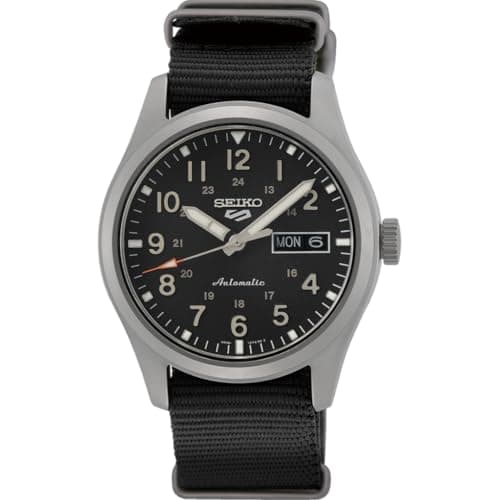
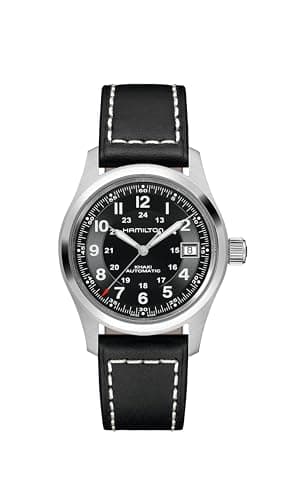
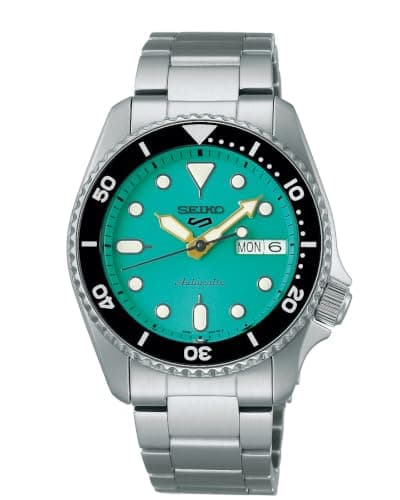
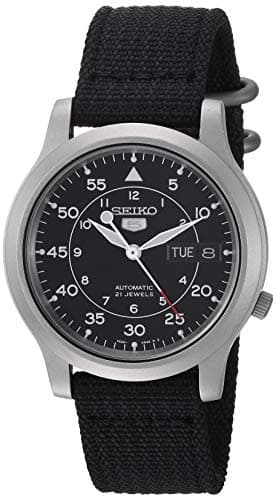
A quartz field watch is, objectively, the more sensible object: more accurate, cheaper, and it asks nothing of you. Almost nobody who wants a field watch wants that. The appeal of this category is a mechanical movement in a plain steel case doing an honest job — a machine you wind or wear, with no battery and no expiry date. This page is only the mechanical ones.
There are really three tiers here and the spec table makes them obvious. Swiss mechanical at the top (Hamilton, with sapphire crystals and 80-hour power reserves). Japanese automatic in the middle (Seiko's 4R36, which hacks and hand-winds and is arguably the best value movement in watches). And the old 7S26 at the bottom, in the Seiko SNK809 — a movement that neither hacks nor hand-winds, but which put more people into their first mechanical watch than anything else ever made.
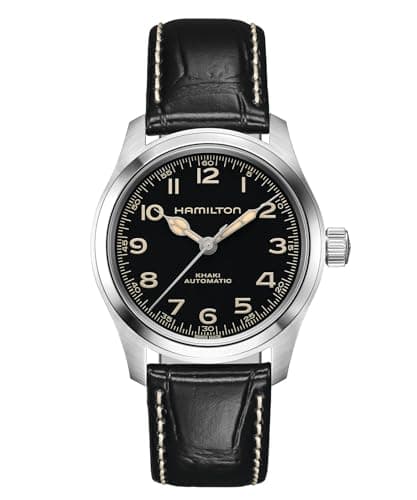
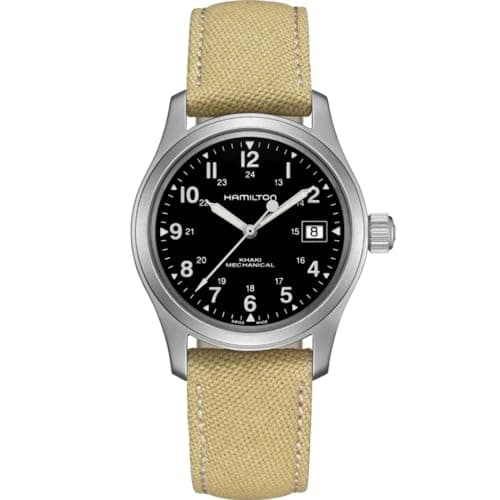
Our pick is the Hamilton Khaki Field Mechanical. If your budget will not stretch, the Seiko 5 Sports Fieldis the smart buy and matches the Khaki Field Automatic on water resistance at 100m — which is twice the hand-wound Mechanical's 50m, and for a watch meant to go outdoors that is not a small thing.
Hacking and hand-winding: what the words mean
Hacking means the seconds hand stops when you pull the crown out, so you can set the watch to the exact second. Hand-winding means you can wind the mainspring with the crown rather than shaking the watch to start it. Both are conveniences rather than necessities, and both are standard on the Hamilton H-10/H-50 and Seiko's 4R36. The old Seiko 7S26 in the SNK809 has neither — you shake it to start it and you cannot set the seconds precisely. That is the price of it being the cheapest real automatic here.
Power reserve is the spec you will feel
Hamilton's 80 hours versus Seiko's roughly 41 hours is the difference between a watch that survives a weekend in the drawer and one that does not. If you own several watches and rotate them, the longer reserve genuinely improves the experience. If this will be the only watch you own and it never comes off, it matters far less.
Accuracy expectations, stated honestly
Every mechanical watch here will drift. Seiko rates the 4R36 at roughly −35 to +45 seconds per day; in practice most run far better than that, but the specification is the promise. Swiss movements at this level are typically specified tighter. Any quartz watch beats all of them by an order of magnitude. If a few seconds a day would bother you, buy quartz — that is not a compromise, it is the correct answer to a different question.
Water resistance: the field watch's weak spot
Field watches are traditionally not swimming watches, and the ratings reflect it. The hand-wound Hamilton Khaki Field Mechanical is 50m. The Khaki Field Automatic and the Khaki Field Murph are both 100m, as are the Seiko 5 Sports Field and the SRPK33. The SNK809 is only 30m — genuinely keep that one dry. If the watch will get wet regularly, sort by that column before anything else.
Sizes, and the 18mm trap
Most watches here are 20mm lug, which is the field-watch standard and the easiest width to shop for. The exception is the Seiko SNK809, which is 18mm — a narrower, less-served size that limits your strap choices. It is not a dealbreaker at the price, but check the lug width column before you buy a strap, or use the lug width chart.
If the rotor itself is the open question — whether you want a watch that winds itself or one you wind yourself — that decision is laid out on manual vs automatic watches.
How we picked
We do not run a testing lab
We compiled the published manufacturer specifications for every watch here — case size, lug-to-lug, lug width, water resistance, movement and crystal — did the wrist-fit and value math, and scored each pick against a published rubric. The scores are judgments from documented research — they are not measurements we took or wrist-time we logged, because we do not have these watches and we are not going to pretend we do. Where a spec could not be verified we wrote "data unavailable" rather than guessing.