The field watch is the one most enthusiasts eventually admit they reach for most. It descends from the WWII service watch: a small case, a matte high-contrast dial, huge numerals and a long-wearing strap. It disappears on the wrist and does its job — which is exactly why it is the safest first watch to buy.
This is also the rare category where a $45 Timex and a $700 Hamilton are recognisably the same kind of object, because the design was perfected eighty years ago. So we have ranked on what actually separates them: the movement (quartz, automatic or hand-wound), the crystal (the part that scratches), the case size, and the finishing. The spec table lays it out, lug width included.
The Hamilton Khaki Field Mechanical is the benchmark — a 38mm hand-wound Swiss watch with a sapphire crystal and an 80-hour reserve — and it is the one we point newcomers to. But the Timex Expedition Scout genuinely is all the watch a lot of people need, for a fraction of the price.
The short answer
Quick picks
#ad · Live prices from the Amazon Product API, as of Jul 21, 2026. Where we have no verified live price, we show none — we would rather leave a gap than print a number that has rotted.
Side by side
The spec table
Every published number that decides fit and function — including the lug width, so you know which strap fits before you buy.
In detail
The picks, in full
The one field watch to own
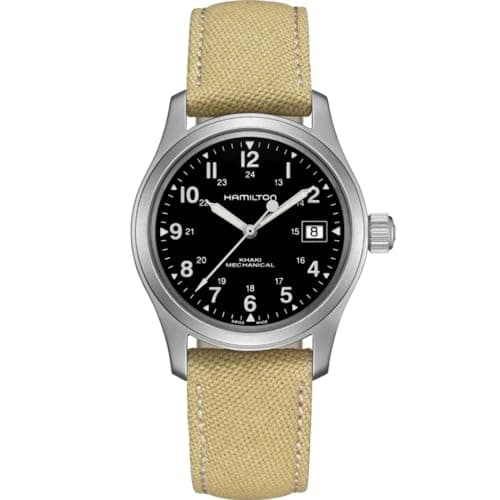
Hamilton Khaki Field Mechanical (38mm)
38mm20mm lug50mH-50 · 80h
The field watch enthusiasts point newcomers to. Swiss hand-wound, 38mm, near-perfect.
- Legibility
- 10
- Build
- 9
- Movement
- 8
- Versatility
- 9
- Value
- 8
Pros
- +A hand-wound Swiss mechanical with an 80-hour power reserve — the winding ritual is the point
- +Sapphire crystal and a correctly-sized 38mm case that suits almost any wrist
- +The direct descendant of the WWII-issue field watch, done properly
Cons
- −Only 50m water resistance — fine for rain and hand-washing, not for swimming
- −Hand-wound means you re-wind it every day or two; some people want automatic
Skip this one if…
…you'll resent winding a watch by hand each morning. The automatic H-10 version below removes that ritual for a little more money.
A set-and-forget field watch
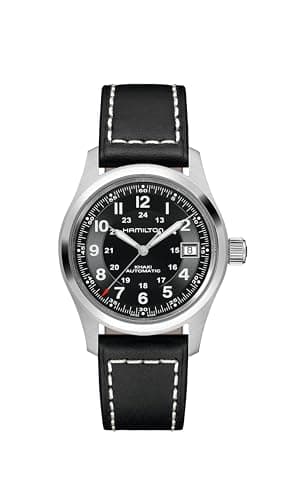
Hamilton Khaki Field Automatic (38mm)
38mm20mm lug50mH-10 · 80h auto
The Khaki Field for people who never want to wind a watch. Same brilliance, plus a rotor.
- Legibility
- 10
- Build
- 9
- Movement
- 9
- Versatility
- 9
- Value
- 8
Pros
- +The 80-hour automatic H-10 movement means it keeps running through a weekend off the wrist
- +Same 38mm case, sapphire crystal and field-correct dial as the mechanical
- +Genuine Swiss-made value at its price point
Cons
- −Sits a fraction thicker than the hand-wound version to fit the rotor
- −Costs more than the mechanical for the same look
Skip this one if…
…you actually enjoy the hand-winding ritual — the mechanical version is thinner, cheaper and more tactile if that's you.
An automatic field watch under the Hamilton
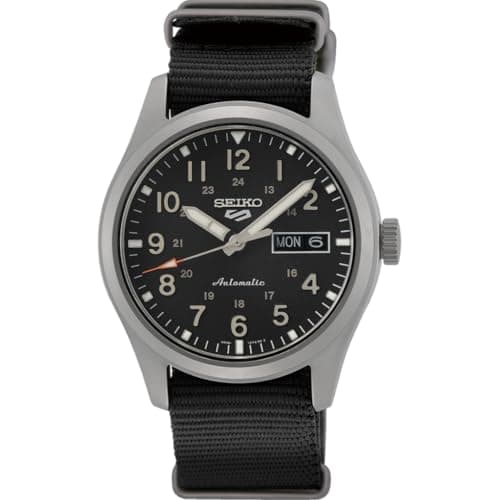
Seiko 5 Sports Field
39.4mm20mm lug100m4R36 automatic
Seiko's automatic take on the field watch — the mechanical middle ground under the Hamilton.
- Legibility
- 9
- Build
- 7
- Movement
- 8
- Versatility
- 8
- Value
- 8
Pros
- +A proper 4R36 automatic in a correctly-sized ~39mm field case
- +100m water resistance — more than most field watches, including the Hamilton's 50m
- +The reliable, serviceable Seiko movement enthusiasts trust
Cons
- −Hardlex, not sapphire
- −Finishing is a step below the Swiss Hamilton it sits under
Skip this one if…
…you can stretch to the Hamilton. For a bit more you get sapphire, Swiss finishing and an 80-hour reserve — the field-watch benchmark for a reason.
The best value field watch
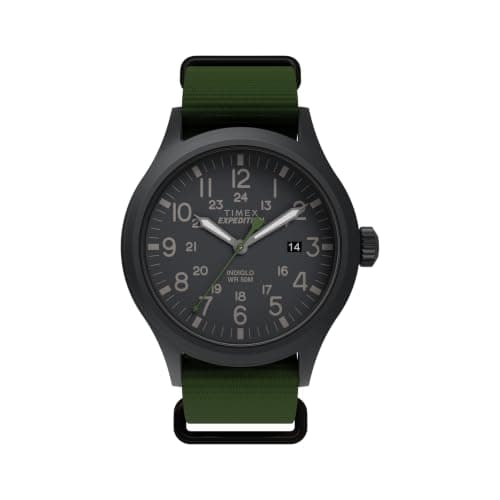
Timex Expedition Scout (40mm)
40mm20mm lug50mQuartz · INDIGLO
The default cheap field watch, and genuinely all the watch a lot of people need.
- Legibility
- 9
- Build
- 6
- Movement
- 6
- Versatility
- 9
- Value
- 10
Pros
- +Costs less than a strap for a nicer watch, and still nails the field-watch look
- +INDIGLO backlight is more useful in the dark than any luminous dial here
- +Quartz accuracy with a battery that lasts years
Cons
- −Basic case finishing and a strap most people upgrade quickly
- −Not a mechanical watch, if that's what you're after
Skip this one if…
…you want a watch to keep for decades and pass on. This is a superb tool at the price, but it is not an heirloom — the Hamilton is.
Small wrists & first mechanicals
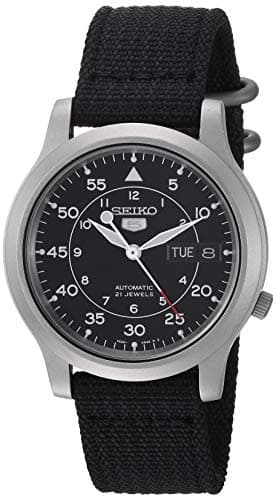
Seiko 5 SNK809
37mm18mm lug30m7S26 automatic
The tiny 37mm automatic that has been the internet's starter mechanical for 15 years.
- Legibility
- 8
- Build
- 6
- Movement
- 6
- Versatility
- 8
- Value
- 9
Pros
- +37mm case is a genuinely small, vintage-correct size that fits the slimmest wrists here
- +A real Seiko automatic movement at the lowest mechanical price on the site
- +The exhibition caseback lets you watch the rotor spin — a lovely first-automatic touch
Cons
- −The 7S26 does not hack or hand-wind, and it runs looser than the newer 4R36
- −Only 30m water resistance and an 18mm lug that limits strap choice
Skip this one if…
…you want to swim with it or want hacking seconds. It is a superb desk-and-daily first mechanical, not a tool watch.
Zero-maintenance field style
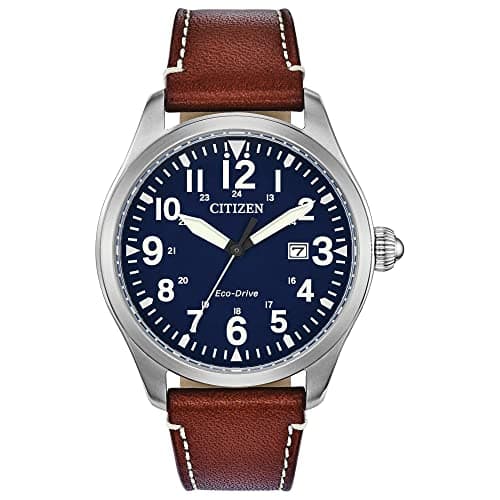
Citizen Eco-Drive Garrison
42mm22mm lug100mEco-Drive
The field watch that never needs a battery or a wind — light-powered and low-maintenance.
- Legibility
- 8
- Build
- 7
- Movement
- 8
- Versatility
- 8
- Value
- 8
Pros
- +Eco-Drive runs off any light — no battery changes, no winding, effectively ever
- +100m water resistance and a rugged, legible field dial
- +22mm lugs take the same straps as the divers on this site
Cons
- −42mm wears a touch larger than the classic field-watch size
- −Mineral crystal
Skip this one if…
…you want the mechanical experience. The whole appeal here is that it is quartz-simple and solar-powered — a feature to some buyers and a dealbreaker to others.
Trail and outdoor use
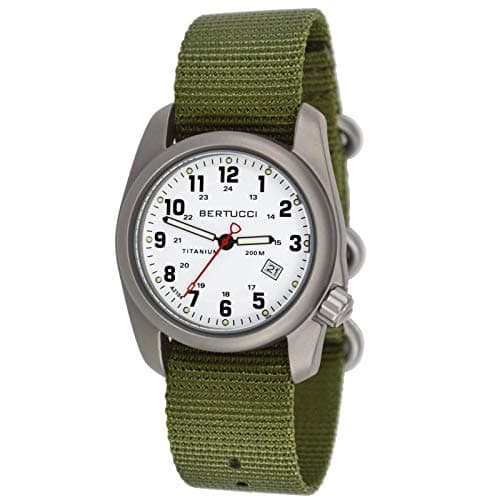
Bertucci A-2T (Titanium)
40mm titanium22mm lug100mQuartz
A featherweight all-titanium field watch built for people who actually go outside.
- Legibility
- 8
- Build
- 7
- Movement
- 6
- Versatility
- 7
- Value
- 8
Pros
- +Full titanium case is remarkably light and shrugs off scratches and sweat
- +Fixed lug bars and a proper nylon field strap out of the box
- +A genuine made-for-the-field brief, not a fashion take on one
Cons
- −The dial and finishing are utilitarian to a fault
- −Fixed lug bars limit quick strap swaps compared with spring-bar watches
Skip this one if…
…you want a dressier watch that can also go to the office. This is unapologetically a trail tool — lean into that or look at the Hamilton.
Cheap strap experimentation
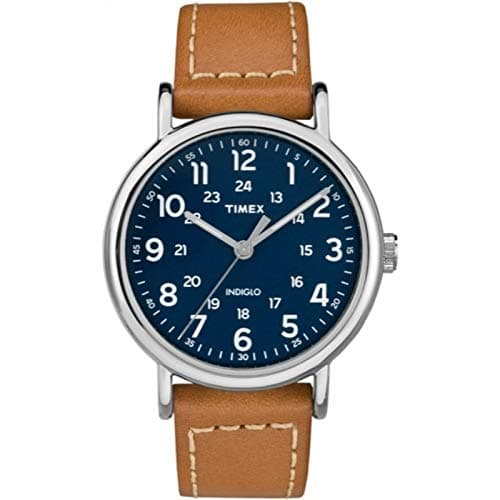
Timex Weekender (40mm)
40mm20mm slip-thru30mQuartz
The strap-swapper's starter watch — cheap, light, and built around changing straps.
- Legibility
- 8
- Build
- 5
- Movement
- 6
- Versatility
- 8
- Value
- 9
Pros
- +Uses slip-through straps, so swapping is genuinely a five-second job with no tools
- +About as cheap as a real analog watch gets
- +Light enough to forget you're wearing it
Cons
- −Only 30m water resistance — keep it away from the pool
- −Acrylic crystal scratches, though it also polishes out
Skip this one if…
…you want one watch to take seriously. This is a fun, disposable strap mule; the Expedition Scout is the more grown-up version for a little more.
Movement: what the extra money buys
Field watches come in three flavors. Quartz (the Timex Expedition, the solar Citizen Garrison) is accurate, cheap and maintenance-free. Automatic (the Seiko 5, the Hamilton auto) winds itself as you wear it. Hand-wound (the Hamilton Mechanical) is the enthusiast's choice — you wind it each morning, which is either a chore or a ritual depending on the person. None keeps better time than the cheap quartz; you pay up for the experience and the object.
Size is where field watches win
The historically correct field-watch diameter is about 36–40mm with short lugs, which is why this is the category that fits genuinely small wrists. The Hamilton is 38mm; the Seiko SNK809 is a tiny 37mm. If you have been told your wrist is too small for a watch, a field watch is the proof otherwise — check the lug-to-lug column, not just the diameter.
The field watch is a strap platform
The whole aesthetic is built around fabric and leather, so a single field watch plus three straps is a complete rotation: a NATO for the weekend, brown leather for the office, a green two-piece for the trail. Most field watches here use a 20mm lug; confirm yours in the table, then see our best NATO straps and best leather straps guides.
How we picked
We do not run a testing lab
We compiled the published manufacturer specifications for every watch here — case size, lug-to-lug, lug width, water resistance, movement and crystal — did the wrist-fit and value math, and scored each pick against a published rubric. The scores are judgments from documented research — they are notmeasurements we took or wrist-time we logged, because we do not have these watches and we are not going to pretend we do. Where a spec could not be verified we wrote "data unavailable" rather than guessing.
Questions
Frequently asked
What is the best field watch?+
The Hamilton Khaki Field Mechanical is the enthusiast benchmark — a 38mm hand-wound Swiss watch with a sapphire crystal and an 80-hour reserve. If you want automatic, the Hamilton auto version removes the daily wind. For pure value, the Timex Expedition Scout is genuinely all the watch many people need at a fraction of the price.
Are field watches good for small wrists?+
Yes — the field watch is the best category for smaller wrists. The correct historical size is around 36–40mm with short lugs, so the Hamilton (38mm) and the Seiko SNK809 (37mm) fit where a chunky diver would overhang. Always check the lug-to-lug figure in the spec table.
Should I buy a quartz or mechanical field watch?+
Quartz (Timex Expedition, solar Citizen) is more accurate, cheaper and maintenance-free — a superb tool. Mechanical (the Hamiltons, the Seiko 5) is the experience enthusiasts pay for and can be serviced indefinitely. Neither keeps better time in practice; choose based on whether you want a tool or an object.
What strap should I put on a field watch?+
Field watches were made for NATO and leather straps. Most here use a 20mm lug width — confirm in the spec table — then a single 20mm NATO plus a brown leather strap covers casual and dressier wear. See our best NATO straps and best leather straps guides.
Receipts
Sources
We do not run a testing lab, and we do not pretend to. Every spec above traces to a manufacturer listing or a named standard; where we could not verify something, we say so on the page rather than quietly leaving it out. Read our full method.