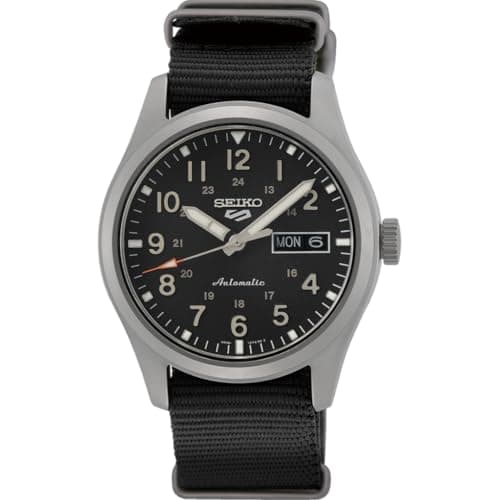
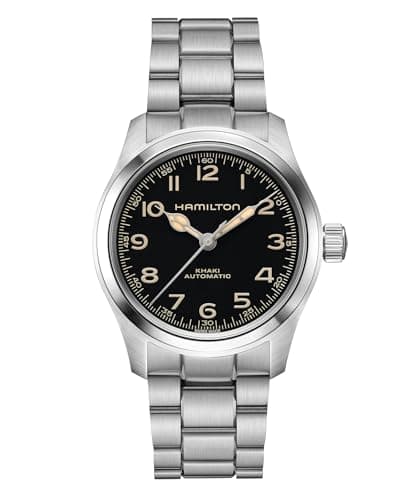
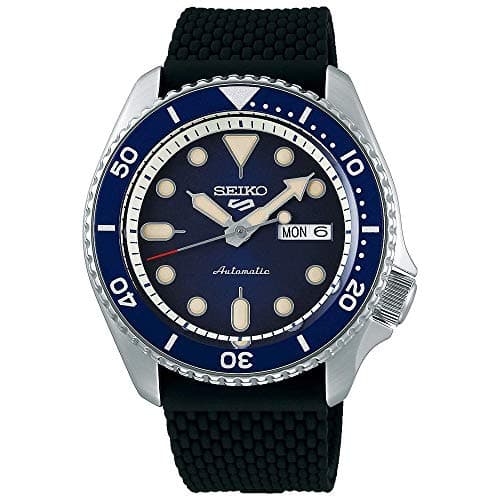
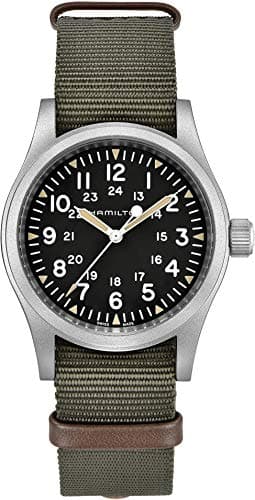
Seiko vs Hamilton is really one question asked by people shopping for a field watch: is the Hamilton Khaki Field worth roughly twice the price of a Seiko 5? The two brands barely compete anywhere else — Seiko makes divers and GMTs Hamilton does not, Hamilton makes dress and aviation pieces Seiko's affordable line does not — but in the 38 to 40mm field watch, they are the two answers everyone is choosing between.
The honest summary is that Hamilton makes the better watch and Seiko makes the better value, and the gap between those two statements is a few hundred dollars. The Khaki Field Mechanical gives you a sapphire crystal, an 80-hour hand-wound Swiss movement and a case that is essentially the modern definition of the category. The Seiko 5 Sports field gives you an automatic that hacks and hand-winds, a Hardlex crystal, 100m instead of 50m, at less than half the price.
Which of those is the right answer depends on whether you are buying a watch to wear for a decade or a watch to find out whether you like mechanical watches. Below we go through the movements, the crystals, the sizes, the service picture and the strap question — and rank the strongest two from each brand against each other at live prices.
Who they are
Hamilton was founded in Lancaster, Pennsylvania in 1892, made railroad and military watches for most of the twentieth century, ended American manufacture in 1969, and is today a Swiss brand within the Swatch Group — which means its movements come from ETA, the group's movement maker, under Hamilton's own H-series names. The Khaki Field descends directly from the watches Hamilton made for the US military.
Seiko is a Japanese manufacturer that makes everything in-house, from the movement to the crystal to the lume, and its Seiko 5 line has been the world's default affordable automatic since 1963. Our is Seiko a good watch brand page and its Hamilton twin, is Hamilton a good watch brand, cover each brand on its own.
Movements: 80 hours versus 41, and hand-wound versus automatic
The Khaki Field Mechanical uses Hamilton's H-50, a hand-wound movement with an 80-hour power reserve; the Khaki Field Auto and the Murph use the H-10, an automatic based on the ETA 2824 family and modified for the same 80 hours. The Seiko 5 field uses the 4R36, an in-house automatic with day and date, hacking and hand-winding, and about 41 hours.
The 80 hours is the practical difference. Take the Hamilton off on Friday evening and it is still running on Monday morning; the Seiko will have stopped by Sunday. Whether that matters depends on how many watches you own. The other difference is that the Khaki Field Mechanical is hand-wound — no rotor, so it is thinner, and you wind it every few days, which some people love and others find a chore. If you want a Hamilton automatic, the Murph and the Khaki Field Auto are the H-10 versions.
Crystal: sapphire versus Hardlex
Every Hamilton here has a sapphire crystal. Every Seiko 5 has Hardlex, Seiko's hardened mineral glass. Sapphire is near-impossible to scratch in normal wear; Hardlex will pick up fine marks over years, though it resists shattering slightly better. On a field watch that gets knocked against door frames, this is the single specification where the price difference is most visible, and it is the one Seiko owners most often wish they had.
Water resistance: Seiko wins, and it is not close
The Khaki Field Mechanical is rated 50m. The Seiko 5 field is rated 100m, and the diver-style SRPD is 100m with a rotating bezel. Neither has a screw-down crown, so neither is a dive watch, but 100m means the Seiko is fine in a pool and the 50m Hamilton is a watch you take off before you swim. The Murph and the Khaki Field Auto are 100m, which closes the gap if you go automatic.
Size and lug width
The Khaki Field Mechanical is 38mm with a 46.5mm lug-to-lug and 20mm lugs — one of the best-proportioned cases in affordable watches, and the reason it fits wrists from 6 to 7.5 inches. The Murph is the same 38mm. The Seiko 5 field is 39.4mm on 20mm lugs; the diver-style SRPD is 42.5mm on 22mm lugs, and noticeably the biggest watch on this page. If your wrist is small, the two 38mm Hamiltons and the Seiko field are the options, and our field watch size guide ranks fit across both brands.
Straps: both take 20mm, and the Hamilton comes on the worse one
The Khaki Field Mechanical ships on a NATO-style nylon strap that most owners replace in the first month, and the Seiko 5 field ships on a fabric strap or a bracelet depending on reference. Both take 20mm, which is the most-supported strap width there is; our 20mm strap roundup and the field-watch strap page cover the upgrades, and a good leather strap does more for the Hamilton than any other thirty dollars you will spend on it.
Service, resale and the long run
Hamilton's ETA-based movements are the most widely serviced mechanical calibers in the world; any independent watchmaker can work on an H-10 or H-50 and parts are plentiful. Seiko's 4R36 is equally serviceable and cheaper to replace outright than to service. On resale, the Hamilton holds a higher fraction of its price; the Seiko is cheap enough that resale barely enters into it. Over a ten-year horizon, the Hamilton is the watch more people are still wearing.
The verdict
Buy the Hamilton if this is the one field watch you intend to own: the sapphire, the 80 hours, the 38mm case and the pedigree are exactly what the extra money buys, and nothing near the price does the category better. Buy the Seiko if you want an automatic to find out whether you like mechanical watches, if 100m matters, or if the difference between the two prices is the difference between buying a watch and not. Both are honest recommendations. If a friend with no other requirements asked us, we would hand them the Khaki Field Mechanical and tell them to put it on a leather strap.