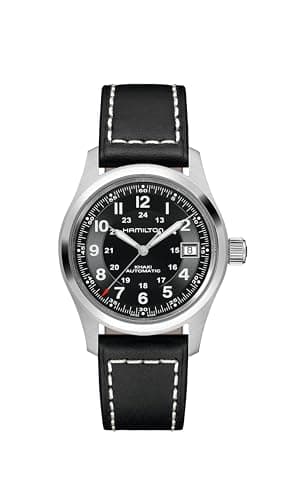
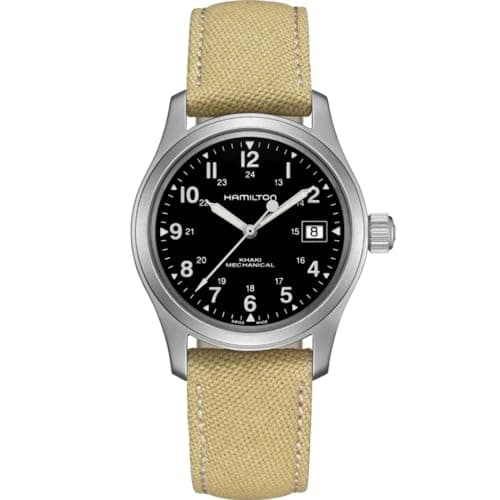
Hamilton makes the definitive modern field watch, and it makes it twice. The Khaki Field Mechanical is hand-wound: you turn the crown every morning and it runs. The Khaki Field Automatic has a rotor that winds it as you move. Same 38mm case language, same Swiss lineage, same military dial. Different watch to live with.
Almost every comparison of these two treats the automatic as the upgrade because it costs more. That is not quite right. The hand-wound version is thinner, more historically faithful and cheaper — and for a lot of people it is the better watch, not the compromise. What follows is the case for each.
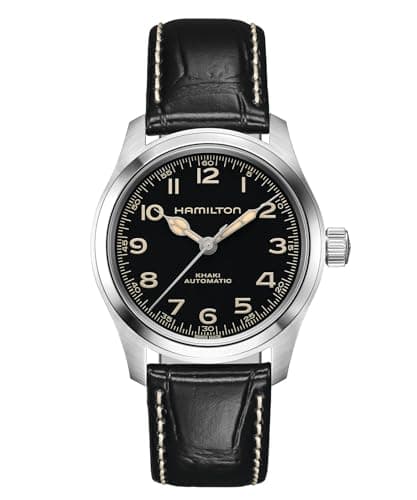
We have ranked a third Hamilton alongside them, the Khaki Field Murph, because it is the watch buyers most often cross-shop once they have decided they want a 38mm Hamilton and are willing to spend more.
The rotor changes the thickness
An automatic movement carries a weighted semicircular rotor that swings as your wrist moves, winding the mainspring. It has to live somewhere, and where it lives is on top of the movement — which makes an automatic watch thicker than the same watch hand-wound. On a field watch, worn under a sleeve and designed around being unobtrusive, that is a real difference rather than a specification footnote.
The daily habit, which is the actual decision
A hand-wound watch asks for roughly twenty turns of the crown each morning. Owners either love this or resent it, and there is not much middle ground. It is a thirty-second ritual that makes the watch feel like a thing you operate rather than a thing you wear, and for a lot of people that is the entire point of owning a mechanical watch at all.
An automatic asks for nothing as long as you wear it. Take it off for a long weekend and it stops; both Hamilton calibers here hold power reserves in the region of eighty hours, which is unusually generous and means a Friday-to-Monday break is survivable. If you own several watches and rotate them, the automatic will still need setting more often than you expect.
Accuracy: there is no difference worth caring about
Both are Swiss mechanical movements from the same family, running at the same rate, with comparable published tolerances. Neither hand-winding nor automatic winding makes a watch more accurate. Anyone who tells you the hand-wound is "purer" and therefore better timekeeping is describing an aesthetic preference in engineering language.
Price, and what the gap buys
The automatic sits meaningfully above the hand-wound. That gap buys you the rotor and the convenience it brings, and nothing else — same case size, same crystal, same water resistance, same dial. Whether that is good value depends entirely on how you feel about winding a watch, which is why we cannot answer it for you and will not pretend the more expensive one is automatically the better buy.
Where the Murph comes in
The Khaki Field Murph is the film-collaboration version: same 38mm size, an automatic movement, a distinctive dial with the second-hand detail the collaboration is known for, and a considerably higher price. It is a nicer object and a worse value, in the plainest terms. Buy it if you want it as an object; do not buy it expecting a functional upgrade over the standard automatic, because there is not one.
What all three share, including the weak spot
All three are 38mm with a 20mm lug width and sapphire crystals, and all three are rated to 50 meters — which is the one place a Hamilton Khaki Field is beaten outright by watches at a quarter of the price. Fifty meters covers rain and handwashing and is marginal for swimming. If your field watch needs to get properly wet, a solar Timex or a Citizen Eco-Drive is the honest answer, and we say so despite it being the less flattering conclusion.
The 20mm lug width is the good news: it is the most abundant strap size there is, and a canvas or leather strap suits these watches better than almost anything else on this site. Budget for one.
The specification both of these Hamiltons are really bought for is the 80-hour reserve shared by the H-10 and the H-50. Why that number, and not 41 hours, is the one you notice is set out on what power reserve means.