Power reserve is one of the few mechanical-watch specifications that changes what owning the watch is actually like. Everything else on a spec sheet — jewels, beat rate, the calibre name — describes the inside of a machine you will never see. The power reserve describes a Monday morning.
What the number measures
A mechanical watch is powered by a coiled strip of steel called the mainspring. Winding the crown tightens it; the movement then releases that energy at a controlled rate to drive the hands. The power reserve is the time from fully wound to stopped, with the watch sitting still. Nothing else. It does not measure accuracy, battery life or how long the watch will last in years.
On an automatic, a weighted rotor rewinds the mainspring as your wrist moves, so a watch worn daily never approaches its reserve limit. The reserve only matters once the watch is off your wrist — overnight, over a weekend, in a drawer. On a hand-wound watch, the reserve is the interval between winds, which is why hand-wound movements with short reserves become a daily chore and ones with long reserves do not. The difference between the two types is on manual vs automatic watches.
The weekend test
Here is the only practical test that matters, and it explains why 80 hours has become a selling point. Take the watch off on Friday evening and put it on again on Monday morning. That is roughly 60 hours.
A movement with around 40 hoursof reserve — Seiko's 4R36 holds about 41, Orient's F6922 roughly 40 — is stopped by Sunday lunchtime. You pick it up on Monday to a dead watch, and you reset the time and, if it has one, the date. A movement with 80 hours is still running, still correct, and you put it on and leave. Over a working year that is the difference between fifty small chores and none.
That is the whole argument. It is not about the watch being better made; it is about whether you own one watch or several. If you wear the same watch every day, a 40-hour reserve never comes up. If you rotate between three watches, every watch in the rotation is permanently stopped and the long reserve is the one that forgives you.
How a movement gets a longer reserve
Three ways, and the trade-offs are real. A bigger or longer mainspring, which needs space in the movement. A slower beat rate, which spends the stored energy more gradually — Hamilton's 80-hour H-10 and H-50 movements run at a lower frequency than the 28,800 vibrations an hour of many Swiss calibres, and Seiko's 4R36 sits at 21,600. Or two mainspring barrels, which is the expensive route and not something you will meet at the prices on this site. There is a mild trade-off against timekeeping stability at the very end of the reserve, when mainspring torque falls off, which is why some owners of long-reserve watches top them up rather than running them to zero.
Power reserve on quartz, solar and Eco-Drive
The phrase gets borrowed, and it means something different each time.
On a battery quartz watch there is no reserve to speak of — there is battery life, typically measured in years, and then the watch stops. On a solar or Eco-Drive watch, the equivalent figure is how long it runs in the dark from a full charge: Citizen publishes around six months for a typical Eco-Drive, and much longer on calibres with a power-save function. That is explained properly on what is Eco-Drive. A solar watch worn in daylight effectively has no reserve problem at all, which is the honest reason to buy one.
A power reserve indicator is not the same thing
Some watches display the remaining reserve on a sub-dial or a hand. That is a complication — a convenience — and it is separate from the reserve itself. A watch with an 80-hour reserve and no indicator still has 80 hours. None of the watches ranked here has an indicator, and we would not pay for one at these prices.
How much reserve do you actually need?
You wear one watch, every day: any reserve will do. 40 hours is invisible to you, and you should spend the money on the crystal or the water resistance instead. You own two or three watches: buy the long reserve. It is the specification you will notice most often, and 80 hours is the number that covers a weekend with room to spare. You wear a watch occasionally: consider not buying mechanical at all — a solar watch like a Citizen Eco-Drive is always right when you pick it up, which is the real answer for an occasional wearer.
What to do when it has stopped
Nothing is wrong with it. A stopped automatic is not a damaged automatic: wind it, set it, wear it. The one handling rule worth knowing is to avoid quick-setting the date while the movement is in its date-change window late at night. The full restart procedure is on do automatic watches need winding, which also explains why a watch winder solves a thirty-second problem.
The watches on this page
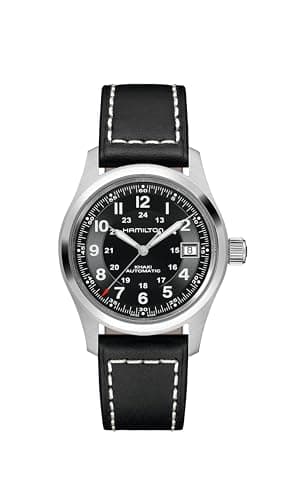
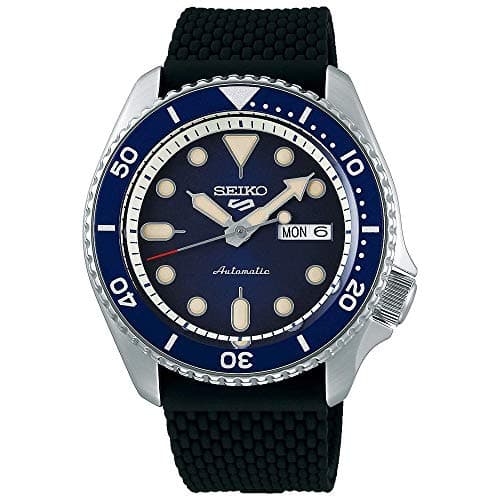
The two Hamiltons are here for the 80-hour reserve — hand-wound H-50 and automatic H-10, both Swiss, both sapphire, both 38mm. The Seiko and the Orient are here as the honest comparison point: roughly 40 hours each, both excellent watches, both stopped by Sunday. If the Hamiltons are the shortlist, the two pages that settle it are Hamilton mechanical vs automatic and Hamilton Khaki Field vs Seiko 5.
What we are not claiming
Every reserve figure here is the manufacturer's published number for the calibre named — Hamilton for the H-10 and H-50, Seiko for the 4R36, Orient for the F6922. We have not run these watches down on a bench and timed them, and we do not publish a figure we could not source. Our method is on how we review.