An automatic watch contains a weighted semicircular rotor mounted on a bearing. Your arm moves, the rotor swings under its own inertia, and a gear train converts that motion into winding torque on the mainspring. There is no battery and no motor. The whole system is powered by the fact that you are a person who moves.
That is why the answer to the question is conditional rather than yes or no. The watch needs its spring wound; whether it needs you to do the winding depends entirely on whether it is on a wrist. The mechanical background is on manual vs automatic watches.
How much movement is enough
Less than people assume, and more than a sedentary day at a keyboard sometimes provides. Ordinary walking, getting up, driving and gesturing wind an automatic comfortably. The cases where owners report a watch running down on the wrist are almost always a very still desk day, or a watch worn loose enough that the case moves with the arm rather than resisting it — which is also a fit problem, covered on how tight a watch should be.
If an automatic seems to lose time while you are wearing it, the first thing to try is not a service: wind it thirty turns by hand and wear it for a few days. A watch running at the bottom of its mainspring curve keeps worse time, which is the mechanism behind most complaints of this kind.
Power reserve decides everything
Reserve is how long the watch runs from fully wound with no further input, and it is the number that tells you how an automatic will behave in your life:
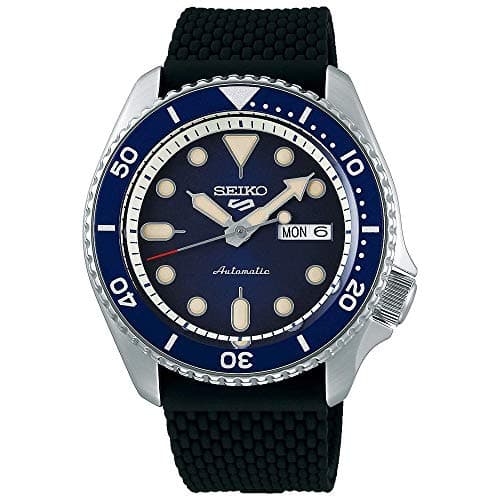
Around 41 hours — Seiko's 4R36, in the SRPD93 on this page. Worn today, running tomorrow, stopped the day after. A watch like this is always stopped on a Monday if you only wear it at weekends.
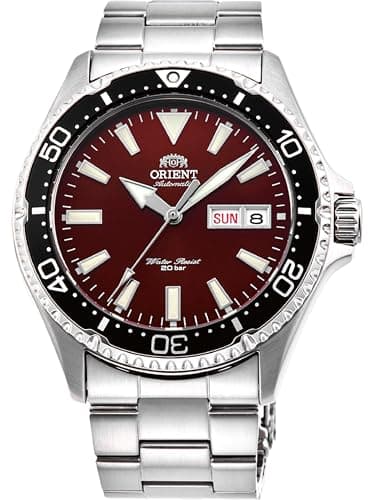
Around 40 hours — Orient's F6922 in the Kamasu. The same practical story.
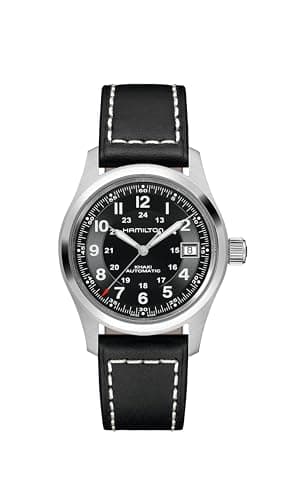
80 hours — Hamilton's H-10. Take it off on Friday evening and it is still running on Monday morning. That is what a long reserve buys you, and it is the single most useful specification on a mechanical watch nobody puts on the dial.
What happens when it stops
Nothing bad. A stopped automatic is a watch with an unwound mainspring, not a damaged one. Oils do not drain, parts do not seize, and leaving a mechanical watch stopped for months causes no harm — the lubricants age with time regardless of whether the watch is running. The only consequence is that you will have to reset the time and the date.
How to restart a stopped automatic, properly
Wind it first, if it can be wound. With the crown in its resting position, turn it forward twenty to thirty times. An automatic has a slipping clutch rather than a hard stop, so it cannot be over-wound — but there is nothing to gain past the point where the rotor would take over.
Then set the date, then the time. Advance the date to yesterday's date, then advance the time through a full 24 hours until the date flips and keep going to the correct AM or PM. Doing it that way means you cannot accidentally leave the watch twelve hours out, which is the most common setting mistake.
Avoid the date-change window. Between roughly 9pm and 3am the date mechanism is engaged and under load. Do not use the quickset date in that window — this is the one genuine mechanical risk in everyday handling of an automatic.
If it will not wind, shake it. Older movements such as Seiko's 7S26 have no hand-winding facility at all. Swing the watch gently from side to side for twenty or thirty seconds to spin the rotor, and it will start.
Do you need a watch winder?
Almost certainly not. A winder exists to keep an unworn automatic running so that you never reset a complicated calendar — a genuine convenience on a perpetual calendar or an annual calendar, and a solution to a thirty-second problem on a three-hand watch with a date.
For everything on this site, resetting the watch when you pick it up takes less time than thinking about the winder did. There is also a reasonable argument that running a watch continuously when it is not being worn simply adds wear for no benefit. If you own one automatic, skip it.
Does an automatic need to be worn every day?
No. It needs to be wound, by you or by your wrist, and nothing is harmed in between. The question people are usually really asking is whether rotating several watches damages them, and the answer is no — the watch that is off the wrist is simply stopped.
Where it does matter is convenience. If you own three automatics and wear each for a few days, two of them are always stopped and need resetting. That is the practical reason many owners keep one quartz or solar watch in the rotation, and the two routes out of winding entirely are laid out on watches that need no battery and solar vs automatic.
The low-maintenance escape route
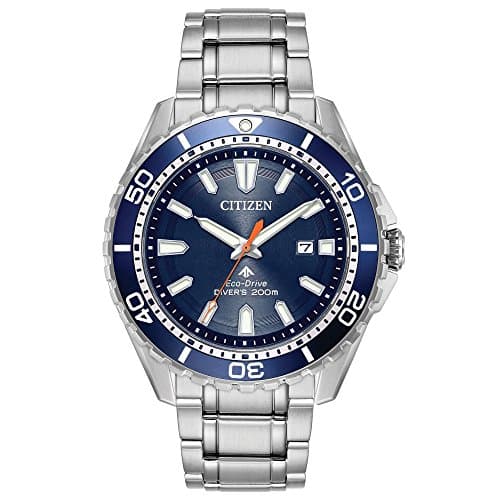
The Citizen Promaster Dive Eco-Drive on this page is here as the honest alternative rather than as a mechanical pick. It charges from any light, including indoor light, holds a reserve measured in months rather than hours, is ISO-compliant to 200m and has a screw-down crown. It will be running when you pick it up after a season in a drawer, which no automatic on this page will.
The trade is the experience. There is no rotor, no winding, nothing to feel through the crown — which to a lot of owners is the point of a mechanical watch in the first place. If that is you, buy the automatic and accept the resetting.
What we would do
One automatic worn most days: wind it when you first get it, then forget about it. A watch worn at weekends only: buy a long-reserve movement — the 80-hour Hamilton H-10 is the one on this page. Several watches in rotation: expect to reset them, and skip the winder. You never want to deal with any of it: buy solar.