A watch should be tight enough that it does not slide around or rotate on your wrist, and loose enough that you can slip one index finger between the strap and your skin. That is the whole rule. If two fingers fit, it is too loose and the watch will migrate to the underside of your wrist by lunch. If one does not, it is too tight, and you will have a red mark and a dent where the caseback sat by evening.
The complication is that your wrist is not one size. It is smallest first thing in the morning and grows through the day as fluid builds, expanding by something like three to five percent — more in heat, more after exercise, more on a flight. A watch fitted perfectly at breakfast is a notch too tight in the afternoon sun, and a strap with holes cut roughly eight millimeters apart cannot always offer a notch in between.
So "how tight" has two answers: the rule above, and then the strap or bracelet that lets you keep to it as the day goes on. Below: where the watch should sit, what a good fit looks and feels like, then the four straps and bracelets we recommend precisely because they adjust the way a wrist does — and how to size the one you already own.
What a correct fit looks like
Position. The watch sits just above the wrist bone — the bump on the outside of the wrist, the ulna — on the side toward the hand, so the case rests on the flat of the forearm and not on the bone. If it sits on the bone it will rock; if it slides down over the bone onto the hand it is too loose.
The one-finger test. With the strap fastened, slide your index finger under it at the underside of the wrist. It should go in with a little resistance and no spare room. That is the test at whatever time of day you are doing it; the fit will drift by a notch through the day, and that is normal.
No marks. Take the watch off after a few hours. A faint impression of the caseback is fine; a red ring, a deep dent, or pins-and-needles in the hand means it is too tight, full stop. A strap that leaves marks every day will also wear out faster at the hole you use, which is the other reason to loosen it.
The rotation test. Hold your arm down and shake your hand gently. The watch should stay on top of the wrist. If the dial swings round to the inside, the strap is a notch too loose or the watch is too heavy for the strap — which is the other half of the problem, and the reason the picks below are chosen by adjustment and not by looks.
The short answer
Quick picks
#ad · Live prices from the Amazon Product API, as of Sep 18, 2026. Where we have no verified live price, we show none — we would rather leave a gap than print a number that has rotted.
Side by side
The spec table
Every published number that decides fit and function — including the lug width, so you know which strap fits before you buy.
In detail
The picks, in full
The first perlon
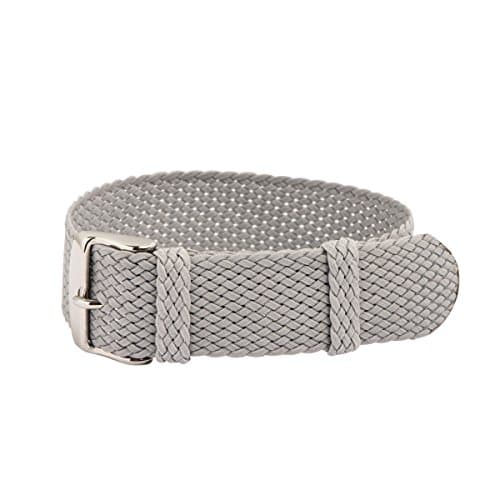
Clockwork Synergy Braided Perlon (22mm)
Braided nylon18–24mmOne-pieceInfinite adjust
The classic single-braid perlon at a classic price — the strap to buy first to find out whether the weave is for you.
- Comfort
- 9
- Build
- 7
- Versatility
- 8
- Value
- 9
Pros
- +A true open braid, so the buckle prong goes through the weave anywhere — there are no holes and no wrong size
- +Sold across the four widths this site's watches actually use, in more than a dozen colors
- +Light enough to forget, and it dries in minutes after a swim
Cons
- −A one-piece strap runs under the caseback, so the watch sits a little higher than on a two-piece
- −The single braid is thinner and stretches more than the double-braid version — fine for a field watch, a little slack under a heavy diver
Skip this one if…
…you are putting it on a heavy 200m automatic. The double-braided Clockwork Synergy or the Da Luca hold a heavier head steadier.
The all-round NATO pick
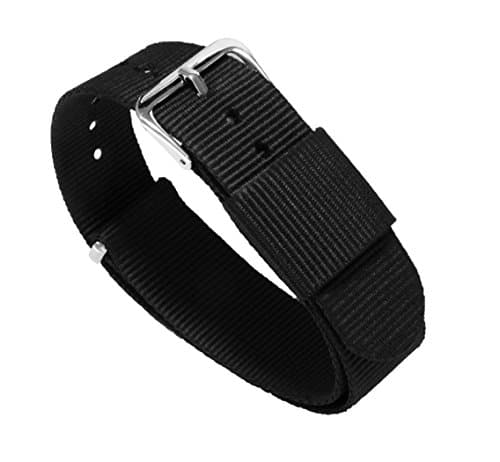
Barton Ballistic Nylon (NATO-style)
Ballistic nylon18–24mmPass-throughMany colors
The default affordable nylon strap — tough, comfortable, and in every width and color.
- Comfort
- 9
- Build
- 8
- Versatility
- 9
- Value
- 10
Pros
- +Genuinely tough weave that survives water, sweat and daily abuse
- +The single-pass NATO design keeps the watch on your wrist even if a spring bar fails
- +Available in 18, 20, 22 and 24mm and a huge range of colors
Cons
- −A NATO adds a little height to how the watch sits
- −The extra keeper and folded tail aren't to everyone's taste under a cuff
Skip this one if…
…you want a low-profile fit or a dressier look. A leather quick-release strap sits flatter and dresses a watch up.
Jubilee looks, no tools
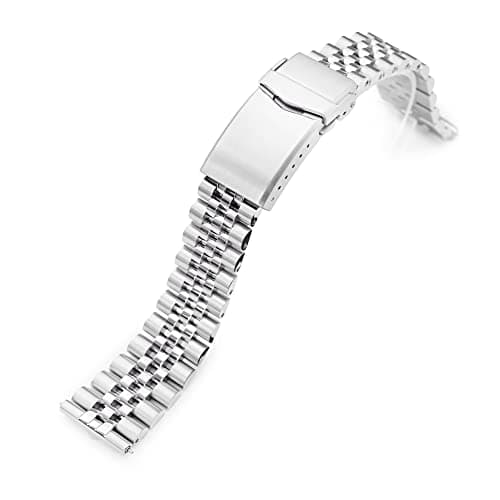
MiLTAT Super-JUB II QR
Jubilee-style 5-row18–20mmQuick releaseV-clasp
A five-row jubilee-style bracelet with quick-release bars — the dressiest pick here and the only premium one you can fit without a tool.
- Comfort
- 9
- Build
- 9
- Versatility
- 7
- Value
- 6
Pros
- +Five-row jubilee-style links articulate more than a three-row oyster, which is why this kind of bracelet drapes better on a smaller wrist
- +Integrated quick-release bars — rare on a link bracelet at any price, and the one feature that makes a solid-link band easy to try
- +Strapcode's published spec for the line is solid 316L links with screw-fixed adjustment and a V-clasp carrying six micro-adjustment holes
Cons
- −The most expensive pick here by a clear margin, and the jubilee look does not suit every tool watch
- −This quick-release line runs 18 to 20mm, so there is nothing in it for a 22mm diver
Skip this one if…
…your watch is a 22mm diver. This line stops at 20mm; the WOCCI or the Boyer covers the wider case.
The all-round leather pick
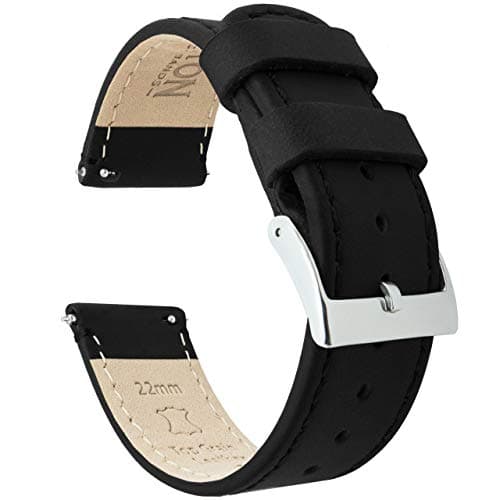
Barton Quick-Release Leather
Top-grain leather16–24mmQuick-releaseMany colors
The strap to buy first: top-grain leather, quick-release bars, tool-free swaps in seconds.
- Comfort
- 9
- Build
- 8
- Versatility
- 8
- Value
- 9
Pros
- +Quick-release bars mean you can swap it in seconds with no tools and no scratched lugs
- +Genuine top-grain leather that breaks in nicely and dresses a watch up instantly
- +Every common width and a big color range
Cons
- −Leather and water don't mix — this is not a pool strap
- −Like all leather, it will eventually wear out and need replacing
Skip this one if…
…you sweat heavily or swim in your watch often. Leather will suffer — go silicone or nylon for wet-weather duty.
Why a punched strap is the problem
A leather or rubber strap has holes at fixed intervals — typically seven to eight millimeters apart. Your wrist, by the numbers above, can change circumference by five or six millimeters between morning and evening on a hot day. That is most of a hole. The result is the situation every watch owner knows: one hole is slightly too tight, the next is slightly too loose, and the right answer is somewhere in the leather between them. You can punch an extra hole — a leather punch costs a few dollars and it is a five-minute job — but it only halves the problem.
The straps that follow your wrist
A perlon strap has no holes: the buckle prong goes through the braid anywhere, so it adjusts in increments of a millimeter or less, and you can let it out and take it in during the day without taking the watch off. That is why the Clockwork Synergy is the first pick on a page about fit, and why it is the strap we recommend for summer; our perlon roundup covers the construction in detail.
A NATO strap has holes, but they are closely spaced along a long nylon tail, and because the strap is a single pass-through the watch also cannot fall off if a spring bar fails. It is the second-best answer to the fit problem and the best answer to the security one. The Barton ballistic nylon is the default; our NATO roundup ranks the rest.
A steel bracelet is sized by removing links, which come out in increments of roughly eight to ten millimeters — worse than a strap. The fix is a clasp with micro-adjustment: a row of holes inside the clasp that moves the fit a couple of millimeters at a time. The MiLTAT Super-JUB II is here because Strapcode publishes six micro-adjustment holes for its clasp, which is the difference between a bracelet you can wear in July and one you cannot. Our bracelet roundup covers sizing links in full.
And a quick-release leather strap is here for a different reason: it is the strap most people wear most of the time, and quick-release bars mean you can swap it for a perlon or a NATO in ten seconds when the weather turns, rather than living with a hole that is wrong. The Barton is the one to buy first; the leather roundup has the rest.
How to size a bracelet properly
Remove links until the bracelet is just too tight with the clasp on its middle micro-adjustment setting, then move the clasp out one or two holes. That leaves room to go both ways as the day changes. Take the same number of links off each side so the clasp stays centered under the wrist. And size it in the afternoon, not the morning, or it will be too tight for half of every day.
When the watch is too heavy for the strap
Some fit problems are not about tightness. A heavy automatic diver on a thin single-layer nylon strap will rotate on the wrist no matter how it is fastened, because the head outweighs the strap's grip. The answer is a strap with more body — a double-braid perlon, a thicker NATO, a rubber strap or a bracelet — not a tighter one. If a watch keeps sliding round even when the one-finger test passes, that is the diagnosis.
Watches that are too big, not too tight
The other thing people mean by "does not fit" is a case whose lug-to-lug is longer than the flat of the wrist, so the lugs overhang and the strap angles down from them. No strap fixes that; the watch is too big. Our field watch size guide and small-wrist dive watch roundup rank watches by lug-to-lug, which is the number that decides it. And if the strap itself is the wrong width for the lugs, our how to measure a watch strap guide is where to start.
How we picked
We do not run a testing lab
We compiled the published manufacturer specifications for every watch here — case size, lug-to-lug, lug width, water resistance, movement and crystal — did the wrist-fit and value math, and scored each pick against a published rubric. The scores are judgments from documented research — they are not measurements we took or wrist-time we logged, because we do not have these watches and we are not going to pretend we do. Where a spec could not be verified we wrote "data unavailable" rather than guessing.
Questions
Frequently asked
How tight should a watch be on your wrist?+
Tight enough not to slide or rotate, loose enough to slip one index finger between the strap and your skin. Two fingers is too loose; no finger is too tight. The watch should sit just above the wrist bone on the side toward the hand, stay on top of the wrist when you shake your hand, and leave at most a faint impression when you take it off.
Should a watch leave a mark on your wrist?+
A faint impression of the caseback after a few hours is normal. A red ring, a deep dent, or tingling in the hand means it is too tight and should be let out a notch. A strap that leaves marks every day also wears out faster at the hole you use.
Why does my watch feel tighter in the afternoon?+
Because your wrist is bigger. Wrists are smallest in the morning and grow through the day as fluid builds — by roughly three to five percent, and more in heat, after exercise or on a flight. A watch fitted at breakfast can be a notch too tight by late afternoon. Straps that adjust finely, like a perlon or a NATO, or a bracelet with micro-adjustment, are the fix.
How tight should a watch bracelet be?+
Same rule: one finger under it, no sliding. Size it in the afternoon, when your wrist is largest, by removing links until it is just too tight with the clasp on its middle micro-adjustment setting, then move the clasp out a hole or two. Remove the same number of links from each side so the clasp stays centered. A clasp with micro-adjustment holes is what makes a bracelet wearable through a hot day.
Where should a watch sit on your wrist?+
Just above the wrist bone — the bump on the outside of the wrist — on the side toward the hand, so the case rests on the flat of the forearm rather than on the bone. Sitting on the bone makes it rock; sliding past the bone onto the hand means it is too loose. Most people wear it on the non-dominant wrist so the crown does not dig in when the hand bends.
What if my strap has no hole in the right place?+
Punch one — a leather punch is cheap and takes five minutes — or switch to a strap that does not use holes. A perlon adjusts anywhere along its braid; a NATO has closely spaced holes on a long tail; a bracelet with micro-adjustment moves a couple of millimeters at a time. Quick-release bars let you swap between them in seconds.
Receipts
Sources
We do not run a testing lab, and we do not pretend to. Every spec above traces to a manufacturer listing or a named standard; where we could not verify something, we say so on the page rather than quietly leaving it out. Read our full method.