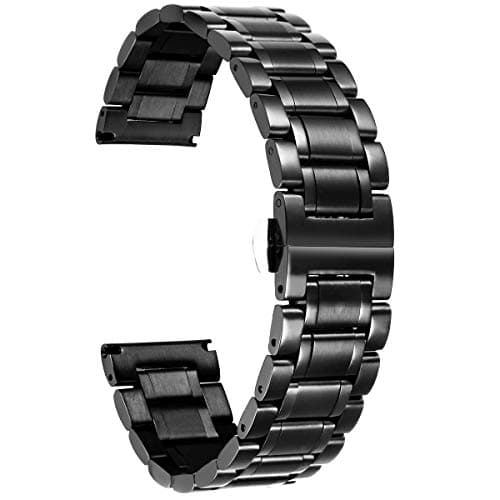
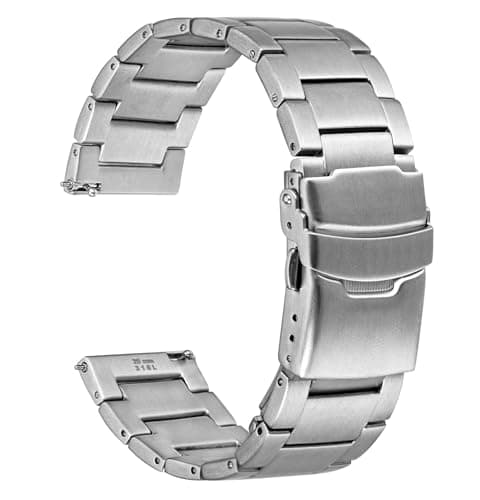
A steel bracelet is the single biggest change you can make to a watch without changing the watch. Take an affordable diver off its rubber strap, put it on a solid-link bracelet with a machined clasp, and the whole object moves up a price bracket — because a bracelet is the part of a watch that manufacturers cut first when they need to hit a number, and therefore the part that is most worth replacing.
It is also the strap type that is returned most. Nearly always for the same reason: the buyer matched the lug width, which is necessary, and ignored the end links, which is the part that decides whether the bracelet looks like it belongs to the watch. Get that wrong and a perfectly good 22mm bracelet sits on a 22mm diver with a crescent of daylight at each lug.
So this page ranks on four things, in this order. End link type — straight (universal, fits anything of that width) or curved and fitted (cut for one named case). Clasp — a plain fold-over, a double-locking deployant, or a diver's clasp with an extension. Link adjustment — screws or friction pins, which decides whether sizing it at the kitchen table is a ten-minute job or an hour of swearing. And taper, the amount the bracelet narrows from lug to clasp, which is most of what makes a bracelet feel elegant rather than like a piece of plumbing. The spec table lists material, widths, quick-release and best-fit for every pick.
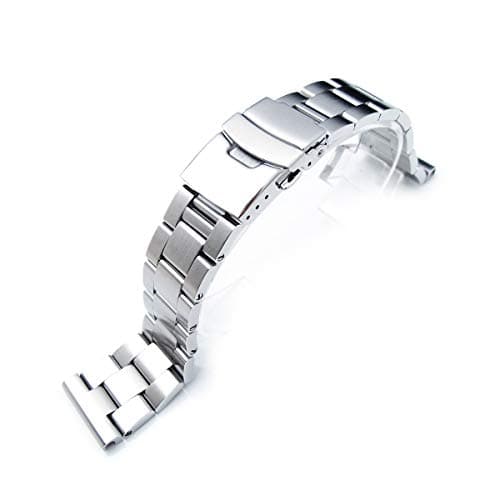
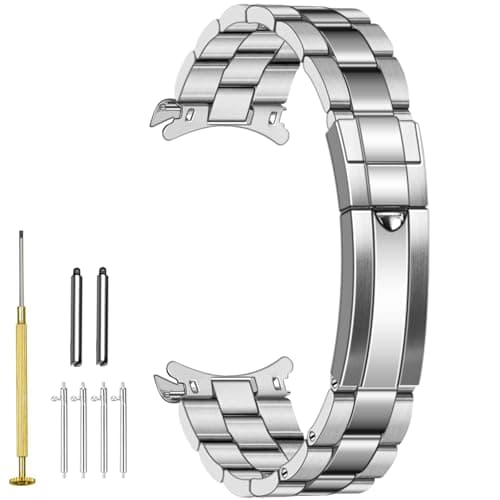
The short version: the WOCCI Heavy-Duty 316L is the one to buy first — a stated steel grade and a double-locking clasp for under thirty dollars. The MiLTAT Super-O Boyer is the upgrade if you want screw-fixed solid links and a diver's clasp. And the BINLUN is under twenty dollars in anything from 12 to 24mm, which makes trying a bracelet a decision rather than a commitment.
One scope note before the picks: this page is about solid-link bracelets. Woven steel — Milanese and shark mesh — is a different construction with different rules, and it has its own ranking at best mesh and Milanese straps.
Straight end or fitted end — the decision that decides everything
Every bracelet on this page attaches at the same two points: the spring bar holes in your watch's lugs. What differs is the shape of the piece that meets the case, and there are only two answers.
A straight end link is flat where it meets the case. Strapcode describes this style as "ideal for typical lug watches with various lug-width," and notes that straight-end bands have become more common precisely because owners want a bracelet they can move between several watches. The trade-off is cosmetic: most watch cases curve slightly between the lugs, so a flat end leaves a small gap. On a field watch or a dress watch with flat lugs you will not notice. On a diver with a rounded case you will.
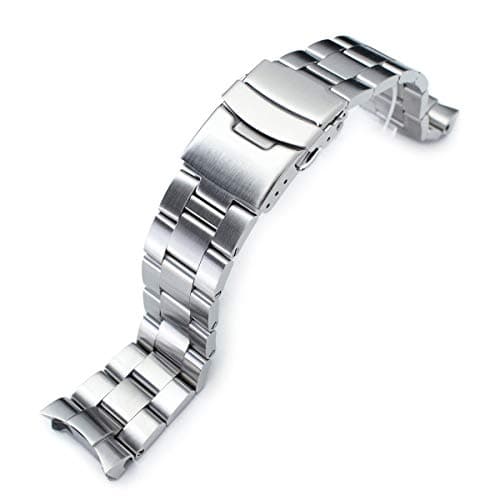
A curved or fitted end link is cut to the profile of one specific case — which is why the MiLTAT Super-O here is sold as a bracelet for the Seiko SKX007, SKX009 and 7002 rather than as a 22mm bracelet. Strapcode calls these "custom made for hot Prospex watch models." When it matches, the join is seamless and the watch looks factory. When it does not, the curve fights the case and the result is worse than a straight end would have been.
The practical rule: buy a fitted bracelet only when the listing names your exact reference. A listing that says "curved end, fits most divers" — like the budget YISIWERA here — means curved in a general way, not cut for your case. That is a reasonable compromise at that price, and we have ranked it as one, but it is not the same thing.
Oyster, jubilee, engineer: what the styles actually mean
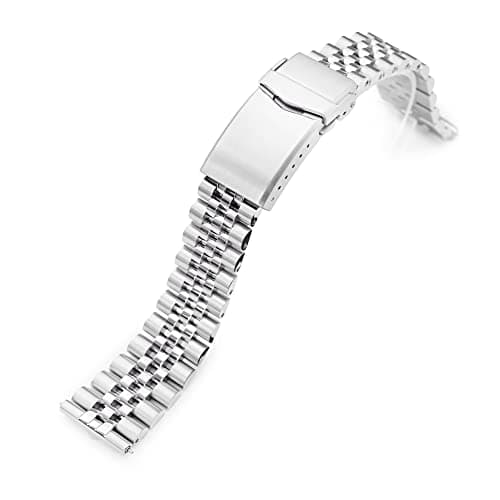
Bracelet names in this category are all borrowed from Rolex, so it is worth knowing what they describe. An oyster is a three-row link: one wide center link between two narrower outer links, flat and sporty. A jubilee is five-row — three smaller center links between two outers — which Rolex introduced in 1945 for the Datejust, and its extra articulation is why it feels softer and drapes better at the same weight. The President, introduced in 1956 with the Day-Date, uses semi-circular three-piece links and is made by Rolex only in gold or platinum; everything sold as a "president bracelet" in steel is a style homage.
Engineer styles are the third family — rounded, beaded or oval links, usually heavier, associated with 1960s and 70s tool watches. The choice between them is almost purely aesthetic, with one practical caveat worth knowing: more rows means more articulation, which means a bracelet that curves around a small wrist more willingly. If your wrist is under about 6.5 inches, that is a real argument for the five-row MiLTAT Super-JUB II over a three-row oyster.
The clasp is where the money goes
The links on a twenty-dollar bracelet and a sixty-dollar bracelet are more alike than different. The clasp is not, and it is the part you touch every day.
The cheapest bracelets use a plain fold-over clasp: one hinged flap that snaps shut. It works, and it pops open if you knock it hard. A double-locking deployant, which the WOCCI has, adds a second catch over the first, so two independent things have to fail before the watch leaves your wrist. A diver's clasp — the MiLTAT Boyer's push-button double flip-lock — adds push-buttons so it opens deliberately rather than by fingernail, and often a folding extension designed to go over a wetsuit.
The other thing to look for is micro-adjustment: a row of holes inside the clasp that lets you move the spring bar one notch at a time. Strapcode's published spec for the Super-JUB II V-clasp lists six micro-adjustment holes. This matters more than it sounds, because links come out in fixed increments of roughly 8 to 10mm, and wrists swell in heat. Without micro-adjustment you are choosing between one link too tight and one link too loose — the bracelet version of the problem punched leather straps have.
Screws or pins: how you will actually size it
A bracelet arrives longer than your wrist and you remove links until it fits. There are two systems for holding those links together and the difference matters far more to a first-time buyer than anything about the steel.
Friction pins (sometimes with a separate retaining collar) are hammered out with a pin pusher. They are what most budget bracelets use, the collars are tiny enough to lose in carpet, and reinstalling them is the step where people give up and go to a jeweler. Screw links undo with a small flathead screwdriver. Strapcode states that on its bands "all solid links including end links are structured by screw fix adjustable details instead of common pins" — that is the single clearest reason the MiLTAT picks here cost what they do, and the YISIWERA is ranked above the cheaper BINLUN partly because its listing states screw-in links too.
Whichever you buy, work over a tray or a towel, count the links you remove, keep them, and take the same number off each side of the clasp so the clasp stays centered under your wrist. Our guide to changing a watch strap covers getting the bracelet on and off the watch; sizing it is the separate job described here.
Taper, thickness and weight
Taper is the difference between the width at the lugs and the width at the clasp, and it is the most underrated number in this category. The MiLTAT Boyer is 22mm at the lugs and 18mm at the buckle; the Super-O for the SKX runs 22mm down to a 20mm clasp. A bracelet with no taper at all wears like a band of steel strapped to your arm; a well tapered one narrows under the wrist where you cannot see it and feels considerably lighter than it weighs.
Thickness is the other figure worth checking when a listing gives it — Strapcode publishes 3.2mm for the Boyer line. Anything much thinner tends to rattle; anything much thicker starts to catch on cuffs. And weight is the honest warning: a solid-link steel bracelet can easily add 60 to 80 grams to a watch. On a heavy automatic diver that feels correct. On a light quartz field watch it changes the character of the watch entirely, and not everyone likes it.
What a bracelet is bad at
Three honest limitations, none of which are fixed by spending more. First, hair pinch. Any link bracelet can catch wrist hair where the links hinge, and a cheaper bracelet with looser tolerances does it more. Wearing it a notch looser helps; nothing else does.
Second, sizing is permanent-ish. Unlike a NATO strap, which fits any wrist in seconds, a bracelet is cut to one wrist and stays there. If you plan to swap between watches constantly, a bracelet is the wrong tool and fabric is the right one.
Third, salt and grit. Steel does not mind seawater, but the clasp mechanism and the gaps between links collect salt and sand, and a gritty clasp wears fast. Rinse it in fresh water after the sea. If the watch lives in the water, a dedicated dive strap is the lower-maintenance answer and a bracelet is the dry-land option.
Which bracelet for which watch
For an affordable 22mm diver — a Seiko 5 Sports, a Prospex Turtle, an Orient Kamasu, a Casio Duro — the WOCCI in 22mm is the sensible first buy and the MiLTAT Boyer is the upgrade. For a Seiko SKX007 or SKX009 specifically, the fitted MiLTAT Super-O is the only pick here that will sit flush, and it is worth the premium if that is the watch you own.
For a 20mm field or everyday watch — a Hamilton Khaki Field, a Timex Expedition Scout, a Seiko 5 Field — the Super-JUB II QR in 20mm is the dressier answer and the quick-release bars mean you can put the fabric strap back on in ten seconds. For a small or vintage case below 18mm, the BINLUN is the only bracelet here that goes that narrow, down to 12mm.
And if you do not know your watch's lug width, establish that before you buy anything. A bracelet is sold per width and there is no adjusting it afterwards. Our lug width chart lists the figure for dozens of popular models, and how to measure a watch strap covers doing it yourself with a ruler.