The verdict
Our pick: MiLTAT Super-O Boyer Straight End
To remove watch links, first work out how the bracelet is held together: look at the side of a link. A small slotted head means screw links (undo with a watchmaker's screwdriver). A smooth pin with tiny arrows on the inside of the bracelet means friction pins (push out in the direction of the arrows). A pin with a visible collar means a push-pin design (press with a pin pusher).
Then obey the one rule that decides whether the result looks right: remove links from both sides of the clasp, as evenly as you can, so the clasp stays centred on the underside of your wrist. Our pick if you want a bracelet built for this job is the MiLTAT Super-O Boyer, whose links are screw-fixed rather than pinned.
Sizing a steel bracelet is the one watch job most owners pay someone else to do, and it is genuinely easy once you know which of three fastening systems you are looking at. It is also the job where the damage is most visible if it goes wrong: a slipped screwdriver leaves a bright scratch across a brushed link, and a friction pin reinserted the wrong way round will work loose and drop your watch.
This page covers all three systems and the sizing logic. It does not cover changing a strap — that is how to change a watch strap — or measuring for a new one, which is how to measure a watch strap.
Identify the fastening first
Screw links. You will see a small slotted screw head on the outside edge of the link. These are the best kind: they come apart cleanly, go back together cleanly, and can be re-tightened if they loosen. The MiLTAT bracelets in our registry use them, and it is a genuine quality tell — screw-fixed links indicate a bracelet built to be adjusted.
Friction pins. A plain pin, usually with small arrows stamped on the inside of the bracelet showing the direction to push. These are held by friction alone, which is why they must be reinserted the same way round they came out. Most budget bracelets use them.
Push pins with collars. A pin with a small sleeve or collar inside the link, common on Casio and Seiko bracelets. The pin presses out with a pin pusher and the collar sometimes falls out with it — losing that collar is the most common way this job goes wrong, so work over a tray or a towel.
The tools, and what to use instead
A link removal tool (a small vice with a threaded pin pusher) costs very little and makes the job trivial on pinned bracelets. A set of watchmaker's screwdrivers in 1.2mm to 1.6mm is what you need for screw links; a normal electronics screwdriver is too wide and will chew the slot.
The paperclip-and-table method you will find online does work on friction pins and it is also how most scratched bracelets got scratched. If the bracelet came with the watch and you care about it, buy the tool. For a bracelet with quick-release bars like the BINLUN or the MiLTAT Super-JUB, at least the strap-to-case part of the job needs no tool at all — see the quick-release roundup.
Sizing: the rule that matters
Remove links symmetrically. Taking four links off one side of the clasp leaves the clasp sitting under the side of your wrist where it digs in; taking two from each side keeps it centred. Where a bracelet needs an odd number removed, put the extra one on the 12 o'clock side — the half above the clasp — because that is the side that gets covered by the watch head rather than by a cuff.
Aim for a fit where the watch can rotate slightly but does not slide down your wrist, and size it in the evening rather than first thing: wrists swell during the day, and a bracelet sized at 7am is a tight bracelet at 7pm. The fit test is on how tight a watch should be.
The short answer
Quick picks
| # | Watch | Key specs | Best for | Score | Price |
|---|
| 01 | MiLTAT Super-O Boyer Straight EndScrew-fixed solid links, 316L throughout and a push-button diver's clasp — the universal-fit bracelet that makes an affordable watch look expensive. | - 316L, screw links
- 22mm → 18mm taper
- Straight end
- Diver's clasp
| The build-quality upgrade | | $55.99·Amazon |
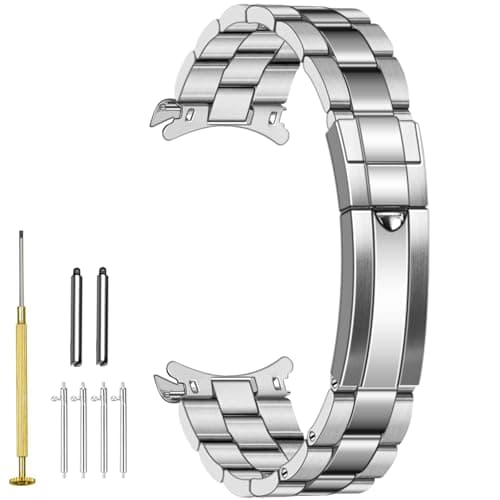
| 02 | | - Curved ends
- 22mm
- Screw-in links
- Diving buckle
| A fitted look on a budget | | $24.29·Amazon |
| 03 | | - 316L stainless
- 20–22mm
- Double-lock clasp
- Straight end
| The all-round pick | | $28.99·Amazon |
| 04 | BINLUN Quick-Release Steel BraceletUnder twenty dollars, quick-release bars and widths from 12 to 24mm — the cheapest honest way to find out whether you want a bracelet at all. | - 12–24mm
- Quick release
- Straight & curved ends
- Six finishes
| The cheapest one worth buying | | $22.99·Amazon |
#ad · Live prices from the Amazon Product API, as of October 11, 2026. Where we have no verified live price, we show none — we would rather leave a gap than print a number that has rotted. Specs are the published manufacturer or live-listing figures, as of the same date; a dash means we could not verify one.
Side by side
The spec table
Every published number that decides fit and function — including the lug width, so you know which strap fits before you buy.
In detail
The picks, in full
The build-quality upgrade
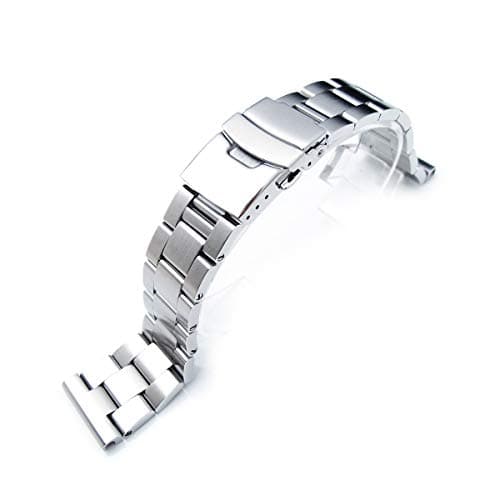
MiLTAT Super-O Boyer Straight End
316L, screw links22mm → 18mm taperStraight endDiver's clasp
Screw-fixed solid links, 316L throughout and a push-button diver's clasp — the universal-fit bracelet that makes an affordable watch look expensive.
- Comfort
- 8
- Build
- 9
- Versatility
- 9
- Value
- 7
Pros
- +Every link, including the end links, is solid 316L and adjusted with screws rather than friction pins — the single biggest quality tell on a bracelet
- +Strapcode publishes the full dimensions for this line: 3.2mm thick, 180mm long, 115mm minimum after adjustment, tapering from 22mm to an 18mm buckle
- +A push-button double flip-lock diver's clasp, which stays shut and opens without a fingernail
Cons
- −Roughly twice the price of the budget bracelets here, and the difference is in the hardware rather than anything visible from across a room
- −No quick-release bars — this is a bracelet you fit once with a tool and then leave on
Skip this one if…
…you swap straps every week. A screw-link bracelet is sized once with a screwdriver; a NATO takes ten seconds.
A fitted look on a budget
YISIWERA Curved-End Oyster Bracelet
Curved ends22mmScrew-in linksDiving buckle
Curved end links, screw-in links and a diving buckle for under thirty dollars — the budget route to a fitted-looking bracelet.
- Comfort
- 7
- Build
- 7
- Versatility
- 6
- Value
- 8
Pros
- +Curved end links at roughly a quarter of what the fitted MiLTAT bracelets cost
- +Screw-in links rather than friction pins, which is unusual at this price and makes sizing far less fiddly
- +The listing includes an adjustable diving buckle, so there is on-the-wrist length adjustment built in
Cons
- −A generic curved end is curved, not cut to a named case — expect it to sit close on a 22mm Seiko-style diver rather than perfectly flush
- −Finish consistency at this price is a lottery, and the clasp is where it usually shows first
Skip this one if…
…you want a guaranteed flush fit on an SKX. Only a bracelet cut for that case does that, and this is not one.
The all-round pick
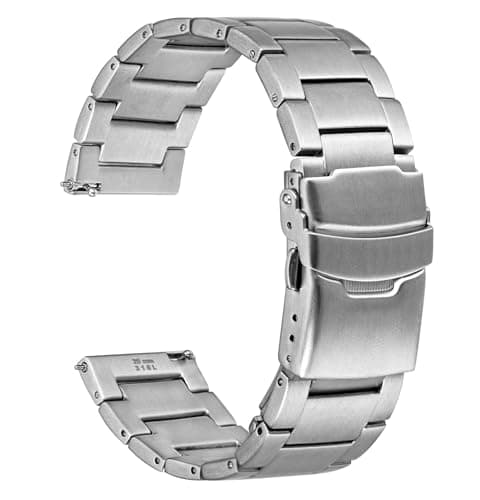
WOCCI Heavy-Duty 316L Steel Bracelet
316L stainless20–22mmDouble-lock claspStraight end
316L steel and a double-locking deployant clasp for under thirty dollars — the bracelet to buy before you spend more.
- Comfort
- 8
- Build
- 8
- Versatility
- 8
- Value
- 9
Pros
- +The listing specifies 316L stainless, the same corrosion-resistant grade watch cases are made from — most bracelets at this price do not state a grade at all
- +A double-locking deployant clasp, which is the security feature that separates a real bracelet from a cheap folding band
- +Straight end links, so it fits any watch at the right lug width rather than one specific model
Cons
- −Sold in 20mm and 22mm only — nothing for an 18mm field case or a small dress watch
- −The listing does not advertise quick-release bars, so plan on a spring-bar tool for the first fit
Skip this one if…
…you want the end links to hug a curved case. A straight end leaves a small gap at the lugs on a diver; a fitted bracelet closes it.
The cheapest one worth buying
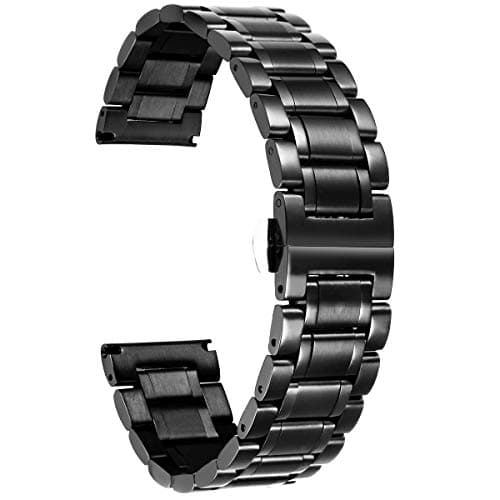
BINLUN Quick-Release Steel Bracelet
12–24mmQuick releaseStraight & curved endsSix finishes
Under twenty dollars, quick-release bars and widths from 12 to 24mm — the cheapest honest way to find out whether you want a bracelet at all.
- Comfort
- 7
- Build
- 6
- Versatility
- 9
- Value
- 9
Pros
- +The widest width range on this page by a distance — 12mm to 24mm, and the only option here for a small vintage case
- +Quick-release bars, so it goes on without a spring-bar tool
- +Listed with straight or curved end pieces and in six finishes, so one listing covers most watches
Cons
- −It is a budget bracelet and feels like one next to the MiLTAT picks — thinner links, a lighter clasp, softer edges
- −A single variation listing covering this many widths and colors means checking your selection carefully at checkout
Skip this one if…
…you are replacing a factory bracelet you liked. This is a step down from most OEM steel; the Boyer or the WOCCI is the step up.
Step by step
Remove links from a watch bracelet
- 1
Work out how long the bracelet needs to be
Put the watch on and close the clasp, then pinch out the slack and count the links you need gone. Do this in the evening rather than first thing - wrists swell during the day, and a bracelet sized in the morning will be tight by dinner.
- 2
Identify the fastening type
Look at the side of a link. A small slotted head means screw links. A plain pin with arrows stamped on the inside of the bracelet means friction pins, which must go back in the same way round. A pin with a visible collar inside the link is a push-pin design. The method differs for each.
- 3
Decide which links to remove, and from both sides
Split the removal as evenly as possible between the two sides of the clasp so it stays centred under your wrist. If the number is odd, take the extra link from the 12 o'clock side. Lay the bracelet out and mark the links with a piece of tape before you start.
- 4
Remove the links
For screw links, hold the bracelet flat and turn the screw counter-clockwise with a correctly sized watchmaker's screwdriver, supporting the link so the blade cannot slip across the finish. For friction pins, use a link tool or pin pusher to drive the pin out in the direction of the arrows. For push pins, press the pin out and catch the collar - work over a tray so nothing rolls away.
- 5
Rejoin the bracelet
Bring the two cut ends together and reinsert the pin or screw. A friction pin goes back the opposite way to how it came out. A screw link should be snug, not forced; a drop of mild thread-lock on the screw stops it backing out over time if you have had one loosen before.
- 6
Fine-tune at the clasp and keep the spares
Use the clasp's micro-adjustment holes to take up the last few millimetres - most clasps have several, and moving the bar one hole is easier than removing another link. Bag the removed links with their pins and collars and keep them with the watch; they are specific to that bracelet and wrists change.
The clasp micro-adjustment you may not need to remove links at all for
Before you take anything apart, check the clasp. Most decent clasps carry several micro-adjustment holes — the MiLTAT Super-JUB II's published spec lists six — and moving the spring bar one hole along changes the circumference by a few millimetres. If the bracelet is only slightly loose, that is the whole job, with no tools and no risk.
Dive-extension clasps and sliding clasps work the same way. This is also the adjustment to use for daily swelling rather than re-sizing the bracelet twice a year.
Keep the links you remove
Put them in a labelled bag with the pins and collars and keep it with the watch box. A bracelet is worth noticeably more complete, the links are specific to that bracelet, and wrists change. This is the single most commonly regretted omission in watch ownership and it costs nothing to avoid.
When a bracelet is the wrong answer
A steel bracelet is heavy, warm in summer, and the hardest band to clean — the gaps between links trap everything, and the method is on how to clean a watch strap. If sizing it is turning into a project, consider whether the watch wants a strap instead. Our strap rankings start there, and mesh is the halfway house: the look of steel with a sliding clasp that adjusts without tools.
If you are buying a bracelet, buy one built to be sized
The four picks above are ordered by how pleasant this job is on each. The MiLTAT Super-O Boyer uses screw-fixed solid links throughout, which is the best case: undo, remove, reassemble, and re-tighten later if anything works loose. The YISIWERA curved-end bracelet also uses screw-in links, which is unusual at its price and the main reason it is here rather than a cheaper pinned alternative.
The WOCCI heavy-duty bracelet is 316L steel with a double-locking deployant clasp, and its listing does not advertise quick-release bars — so plan on a spring-bar tool for the first fit. The BINLUN quick-release bracelet is the cheapest honest way to find out whether you want a bracelet at all, and its quick-release bars mean the watch-to-bracelet part needs no tool. The full field is ranked on the best watch bracelets.
Three mistakes to avoid
Reinserting a friction pin backwards. It will not hold. The arrows stamped inside the bracelet show the push-out direction; the pin goes back in against them.
Losing the collar. On push-pin bracelets the tiny sleeve inside the link is what holds the pin. Work over a tray.
Levering with a knife or a nail. This is how brushed links get a bright scratch across them, and the scratch is permanent on a brushed finish. A proper tool costs less than the repair does.
How we picked
We do not run a testing lab
We compiled the published manufacturer specifications for every watch here — case size, lug-to-lug, lug width, water resistance, movement and crystal — did the wrist-fit and value math, and scored each pick against a published rubric. The scores are judgments from documented research — they are not measurements we took or wrist-time we logged, because we do not have these watches and we are not going to pretend we do. Where a spec could not be verified we wrote "data unavailable" rather than guessing.
Questions
Frequently asked
How do you remove links from a watch band?+
Identify the fastening first. Screw links undo with a watchmaker's screwdriver. Friction pins push out in the direction of the arrows stamped inside the bracelet, using a link tool or pin pusher. Push pins with collars press out and the collar must be kept. Then remove links evenly from both sides of the clasp so it stays centred.
Can you remove watch links without a tool?+
On friction-pin bracelets, people do it with a paperclip or a pushpin, and that is also how most scratched bracelets got scratched. A link removal tool costs very little and removes the risk. Screw links genuinely need a correctly sized watchmaker's screwdriver - an electronics driver is too wide and will damage the slot.
Which side of the clasp should you remove links from?+
Both, as evenly as you can, so the clasp sits centred on the underside of your wrist. If you must remove an odd number, take the extra one from the 12 o'clock side - the half nearest the watch head.
How tight should a bracelet be?+
Tight enough that the watch does not slide down your wrist, loose enough that it can rotate slightly and you can get a fingertip under it. Size it in the evening, because wrists swell through the day.
What are the arrows on the inside of a watch bracelet?+
They show the direction to push a friction pin out. The pin is held by friction and is tapered to suit that direction, so it has to be reinserted against the arrows - putting it back the wrong way round is why pins work loose.
Should I keep the links I remove?+
Yes, with their pins and collars, in a labelled bag kept with the watch. The links are specific to that bracelet, a complete bracelet is worth more, and wrists change over the years.
Are screw links better than pinned links?+
Yes, for sizing and for durability. Screws come apart and go back together cleanly and can be re-tightened; friction pins can only be pushed in and out so many times before they stop holding well. Screw-fixed links are one of the clearest signs of a bracelet built to be adjusted.
Receipts
Sources
We do not run a testing lab, and we do not pretend to. Every spec above traces to a manufacturer listing or a named standard; where we could not verify something, we say so on the page rather than quietly leaving it out. Read our full method.