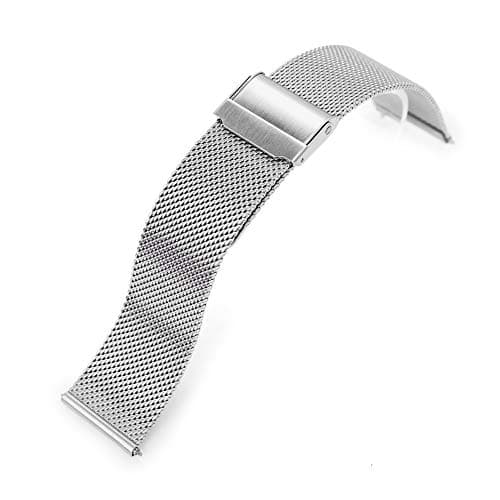
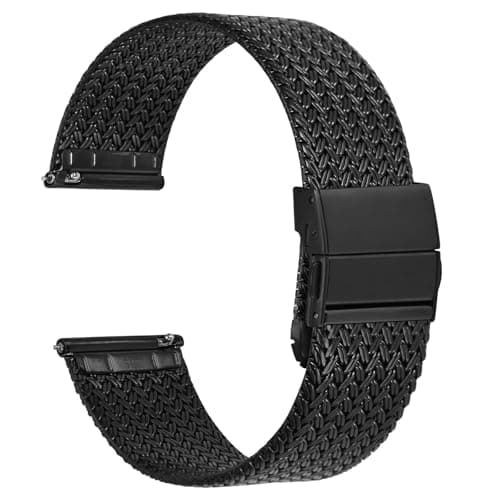
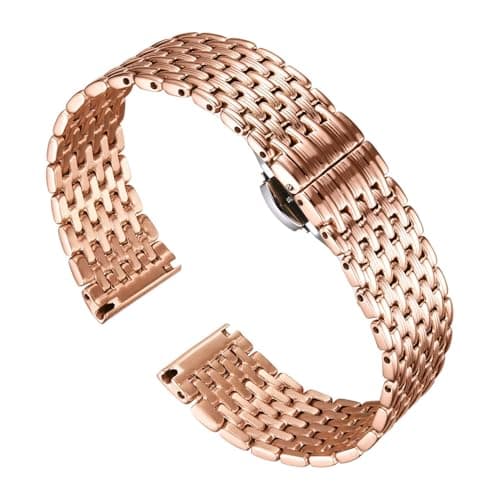
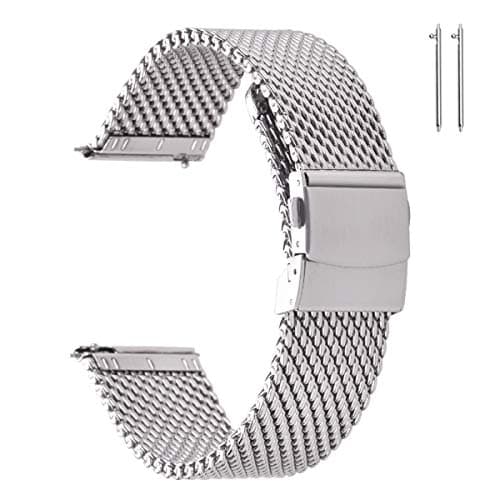
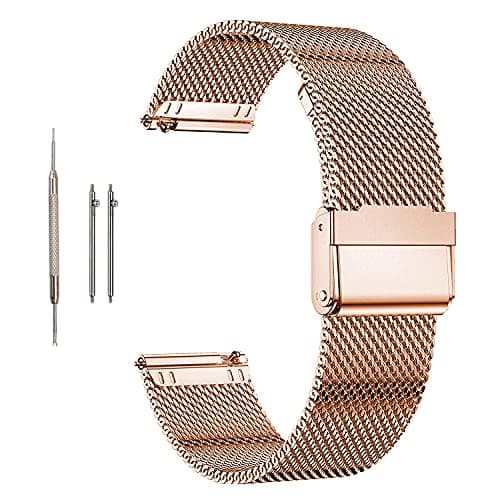
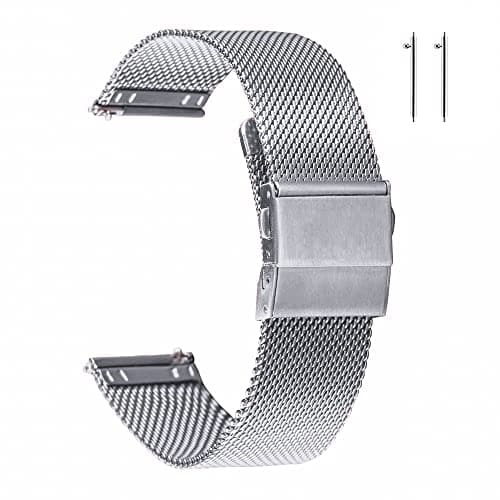
Mesh is the strap that changes a watch the most for the least money. Take a plain three-hand watch off its nylon strap, put it on a fine steel mesh, and it reads like a different and considerably more expensive object — because a woven steel bracelet is the one strap material that looks like it came from the factory rather than from a drawer.
It is also the strap type most likely to be bought wrong. "Mesh" covers two genuinely different things: the fine, dense Milanese weave that is smooth enough to feel like fabric, and the coarse, heavy shark mesh that Omega put on the Seamaster 600 Ploprof in the 1970s and that looks wrong on anything that is not a dive watch. Buy the second when you wanted the first and the watch will look like it is wearing borrowed armor.
So this page ranks both, and says plainly which is which. We ranked on four things: weave (how fine and dense it is, which decides comfort), clasp (a slider, a folding clasp or a hidden butterfly — the part that decides whether the strap is a pleasure or a chore), width range (mesh is sold per width and the ranges are narrower than nylon or leather), and whether it has quick-release bars. The spec table lists all four for every pick.
The short version: the EACHE Quick-Release Mesh is the one to buy first — fine weave, quick-release bars, 18 to 22mm, under twenty dollars. The MiLTAT Classic Superfine is the upgrade if you want the weave that actually feels like silk. And the Moran is under fifteen dollars, which makes trying mesh a decision rather than a commitment.
What mesh actually is, and where "Milanese" comes from
A mesh bracelet is woven from steel wire rather than assembled from links. The technique is old — Milan's goldsmiths were weaving mesh from hand-wound wire coils during the Renaissance, which is where the name comes from, and the same weave was being fitted to watches by the 19th century. The German firm Staib, founded in Pforzheim in 1922, is the maker that industrialized it: it still weaves the steel "blankets" that are cut, pressed and clasped into the mesh bracelets other watchmakers sell.
What matters to a buyer is the consequence of that construction. Because mesh is woven rather than linked, it has no pins to work loose, it drapes over the wrist instead of hinging in segments, and it can be cut to length rather than resized by removing links. That is why a good mesh strap disappears on the wrist in a way a cheap link bracelet never does.
Milanese versus shark mesh — the choice that actually matters
Milanese mesh uses thin wire in a dense, tight weave. The surface is almost smooth to the touch, it is thin enough to go under a cuff, and it suits dress watches, field watches and anything under about 40mm. Shark mesh is the opposite: a coarse, heavy weave of much thicker wire, created for Omega's Seamaster 600 Ploprof, where the point was a bracelet that would survive at depth rather than one that felt nice. It is bold, industrial and correct on a 200m diver — and out of place on almost everything else.
Four of the six straps here are Milanese-style fine weaves. The EACHE Heavy Duty is the coarse one, and we ranked it fifth not because it is worse but because far fewer people want it. If your watch is a 200m diver, move it up the list; if your watch is a dress or field watch, ignore it entirely.
The clasp is what you are really paying for
Every mesh strap here is woven steel, and the difference in the weave between a ten-dollar strap and a forty-dollar one is real but modest. The clasp is where the money goes, and there are three kinds.
A sliding clasp is the budget standard: a plate that grips the mesh anywhere along its length, so the strap is infinitely adjustable and you never have to cut anything. It works, but it sits slightly proud and can slip on the cheapest examples. A folding clasp, which the WOCCI has, adds a hinged deployant over the slider — more secure, more comfortable, slightly bulkier. A butterfly clasp, which the BINLUN uses, folds from both sides and hides completely under the wrist, which is what makes a mesh strap look formal. Butterfly clasps are the least convenient to adjust and the best-looking; sliders are the reverse.
Sizing: mesh is adjusted, not punched
This is the practical advantage of mesh over leather and rubber, and it is worth spelling out. A leather strap has punched holes, so your wrist either falls on a hole or between two. A mesh strap with a sliding clasp adjusts continuously — you position the clasp exactly where your wrist wants it and lock it. There is no in-between size and no "one hole too tight, one hole too loose" problem, which for a lot of people is the single best reason to own one.
The one caveat is length. Mesh straps ship long and are designed to be shortened, either by repositioning the clasp or, on some designs, by trimming the excess. If a strap arrives much too long for a small wrist, that is expected behavior rather than a fault — check the listing for how that particular clasp adjusts before you buy.
Quick-release matters more on mesh than on anything else
Fitting a strap without quick-release bars means compressing a spring bar with a tool while holding the strap in place. On nylon and leather that is fiddly. On mesh it is worse, because a steel weave has no give and the ends are unforgiving of a slipped tool — which is exactly how lugs get scratched. Four of the six straps here have quick-release bars — the EACHE Quick-Release, the MiLTAT, the WOCCI and the budget Moran — and on this material we would treat that as close to a requirement unless you are confident with a spring-bar tool. Our guide to changing a watch strap covers both methods.
What mesh is bad at
Three honest limitations. First, hair pinch: any woven or linked metal bracelet can catch wrist hair, and mesh is no exception — a well-made fine weave is far less prone to it than a coarse one, but it is a real reason some people never get on with the material. Second, salt and grit: the weave traps what a smooth rubber strap sheds, so a mesh strap that goes in the sea needs rinsing in fresh water, and one that goes in sand needs it more. Third, weight: mesh is steel, so it adds noticeably more mass than nylon and slightly more than leather. On a light quartz field watch that changes the balance of the watch entirely.
None of those are dealbreakers, and none are fixed by spending more. If you want a strap for swimming and the beach specifically, a silicone strap is the lower-maintenance answer; keep the mesh for dry days.
Which mesh for which watch
For a dive watch at 40 to 44mm: 22mm, and either the WOCCI Elite for a folding clasp or the EACHE Heavy Duty if you want the shark-mesh look. For a field watch at 38 to 40mm: 20mm, and the EACHE Quick-Release is the obvious buy. For a dress watch under 38mm: the BINLUN, which is thin, polished, and goes down to 12mm. For a watch you are not sure about: the Moran, at under fifteen dollars.
If you do not know your watch's lug width, that is the number to establish before you buy anything — mesh is sold per width and there is no adjusting it afterwards. Our lug width chart lists the figure for dozens of popular models, and how to measure a watch strap covers doing it yourself with a ruler.