The verdict
Our pick: StrapHabit Tropical FKM Quick-Release (22mm)
A spring bar is specified by two numbers: length, which matches your lug width, and diameter, which is the thickness of the tube. Buy the bar length that equals your lug width — 20mm lugs take a 20mm bar — and for diameter, 1.8mm is the sensible default for a sports watch or a diver and 1.5mm is typical on dress watches and thinner cases.
The practical shortcut: buy a strap with integrated quick-release bars and the question disappears. The StrapHabit Tropical FKM and the Barton Quick-Release Leather both ship with their own, which is why they are the picks below rather than any particular bar.
A spring bar is a small steel tube with a spring inside and a plunger at each end. Compress the ends, drop it into the holes drilled in the inside faces of the lugs, let go, and the spring pushes the tips into those holes. It is the entire mechanism holding your watch to your wrist, it costs about a dollar, and it is the part most likely to fail on any watch on this site.
Which makes the sizing worth getting right. This page is about the bar; the strap width question is on the watch lug width chart, and the fitting technique is on how to change a watch strap.
Length: the same number as your lug width
Spring bars are sold by the lug width they fit, so a 20mm lug width takes a 20mm bar. The bar's overall length is slightly greater than 20mm — the tips have to reach into the lug holes — but you do not need to care, because the industry already accounts for it in the labelling.
Two things can trip you up. First, measure the lug width rather than assuming it from case diameter; the method is on how to measure a watch strap. Second, odd widths exist — the Orient Bambino is 21mm — and odd-width bars are harder to find than odd-width straps, which is covered on the best 21mm watch straps.
Diameter: the number nobody tells you
Diameter is the thickness of the bar's tube, and it has to be sized to the hole drilled in the lug. The common sizes are 1.5mm and 1.8mm, with thicker bars used on dive watches and heavier cases.
A bar that is too thin for the lug hole will sit loose, and a loose bar is a bar whose tips can creep out of the holes under load. A bar that is too thick simply will not seat. If you are replacing a bar and you still have the old one, match it; if not, 1.8mm is the right default for a diver or a tool watch and 1.5mm for a dress watch.
Tip diameter is a separate figure again — the thin pin at each end that enters the lug hole. It matters in exactly one well-known case, which is next.
Why Seiko bars are different
Seiko drills its dive-watch lug holes for a thicker spring-bar tip than the industry standard, which is why a generic bar can feel loose in an SKX or an SRPD and why owners buy "Seiko fat bars" specifically. The symptom is a strap that seems fitted but moves more than it should; the fix is a bar made for the case.
This is also why some strap makers publish their tip diameter. StrapHabit states 0.8mm tips on its quick-release bars, against the 0.7mm that is typical — thick enough to sit properly in a Seiko lug hole and still fit a standard one. The Seiko-specific strap rankings are on the best straps for a Seiko.
The short answer
Quick picks
| # | Watch | Key specs | Best for | Score | Price |
|---|
| 01 | | - FKM rubber
- 18–24mm
- Tapered
- Quick release
| The tropic to buy | | $39.95·Amazon |
| 02 | | - Top-grain leather
- 16–24mm
- Quick-release
- Many colors
| The all-round leather pick | | $32.99·Amazon |
| 03 | MiLTAT Super-O Boyer Straight EndScrew-fixed solid links, 316L throughout and a push-button diver's clasp — the universal-fit bracelet that makes an affordable watch look expensive. | - 316L, screw links
- 22mm → 18mm taper
- Straight end
- Diver's clasp
| The build-quality upgrade | | $55.99·Amazon |
#ad · Live prices from the Amazon Product API, as of October 11, 2026. Where we have no verified live price, we show none — we would rather leave a gap than print a number that has rotted. Specs are the published manufacturer or live-listing figures, as of the same date; a dash means we could not verify one.
Side by side
The spec table
Every published number that decides fit and function — including the lug width, so you know which strap fits before you buy.
In detail
The picks, in full
The tropic to buy
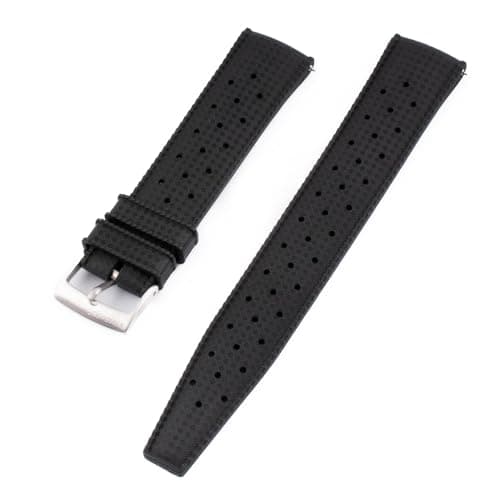
StrapHabit Tropical FKM Quick-Release (22mm)
FKM rubber18–24mmTaperedQuick release
The best-documented tropic on Amazon: FKM, a stated 22-to-20mm taper, 3–5mm thick, 316L hardware, quick release. The one to buy.
- Comfort
- 8
- Build
- 9
- Versatility
- 9
- Value
- 7
Pros
- +The maker publishes the numbers most rubber straps hide: 3–5mm thick, 78/130mm lengths, 22mm tapering to a 20mm buckle, 316L steel hardware
- +Genuine FKM, which does not take on odor or go tacky the way silicone can, and shrugs off sunscreen and salt
- +The full diamond-weave and perforated pattern of the 1960s original, in seven widths and a dozen colors
Cons
- −Roughly twice the price of the no-name FKM tropics below, and the compound is nominally the same
- −FKM is firmer than silicone out of the box; it relaxes with wear, but the first week is stiffer than a Barton Elite
Skip this one if…
…you want a strap that feels soft on day one. A silicone strap is softer immediately; FKM is the one that is still fine in year three.
The all-round leather pick
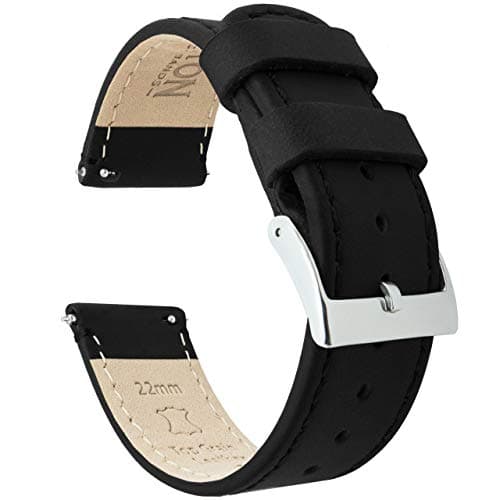
Barton Quick-Release Leather
Top-grain leather16–24mmQuick-releaseMany colors
The strap to buy first: top-grain leather, quick-release bars, tool-free swaps in seconds.
- Comfort
- 9
- Build
- 8
- Versatility
- 8
- Value
- 9
Pros
- +Quick-release bars mean you can swap it in seconds with no tools and no scratched lugs
- +Genuine top-grain leather that breaks in nicely and dresses a watch up instantly
- +Every common width and a big color range
Cons
- −Leather and water don't mix — this is not a pool strap
- −Like all leather, it will eventually wear out and need replacing
Skip this one if…
…you sweat heavily or swim in your watch often. Leather will suffer — go silicone or nylon for wet-weather duty.
The build-quality upgrade
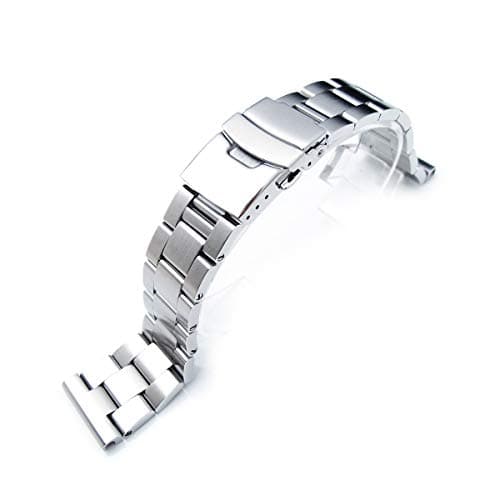
MiLTAT Super-O Boyer Straight End
316L, screw links22mm → 18mm taperStraight endDiver's clasp
Screw-fixed solid links, 316L throughout and a push-button diver's clasp — the universal-fit bracelet that makes an affordable watch look expensive.
- Comfort
- 8
- Build
- 9
- Versatility
- 9
- Value
- 7
Pros
- +Every link, including the end links, is solid 316L and adjusted with screws rather than friction pins — the single biggest quality tell on a bracelet
- +Strapcode publishes the full dimensions for this line: 3.2mm thick, 180mm long, 115mm minimum after adjustment, tapering from 22mm to an 18mm buckle
- +A push-button double flip-lock diver's clasp, which stays shut and opens without a fingernail
Cons
- −Roughly twice the price of the budget bracelets here, and the difference is in the hardware rather than anything visible from across a room
- −No quick-release bars — this is a bracelet you fit once with a tool and then leave on
Skip this one if…
…you swap straps every week. A screw-link bracelet is sized once with a screwdriver; a NATO takes ten seconds.
Shouldered, shoulderless and curved bars
Shouldered bars are the standard: the tube steps down to a thinner tip, and the shoulder stops the bar sliding sideways. These are what you want for almost every watch with drilled lug holes.
Shoulderless bars have the same diameter along their whole length and are used where the strap end has to pass over the bar — one-piece NATO and perlon straps, and fitted end-link bracelets that need the extra clearance.
Curved bars exist for integrated-looking cases where a straight bar would not let the strap sit flush. They are model-specific; if your watch needs one, the strap maker will say so.
Quick-release bars: the reason this is a short page
A quick-release spring bar has a small lever on the tube. Pull the lever and the tip retracts, so the strap comes off with a fingernail and goes on the same way, and no tool goes near your lugs. The bars are built into the strap, so you are not buying bars separately or matching diameters at all.
That is the entire case for them, and it is a strong one: the most common way a watch gets damaged during a strap change is a spring-bar tool slipping across a brushed lug. Every quick-release strap on this site ships with its own bars; the field is ranked on the best quick-release straps.
When to replace a spring bar
Whenever a watch has been dropped by one. A bar that has failed once is a bar to bin, and so is its partner.
When the strap moves and it should not. A tiny amount of play is normal; a bar that feels like it is rattling in the lug hole is either too thin for the case or has a weakened spring.
After salt water. Spring bars are the part of a watch most exposed to salt and the one with a spring inside it. Rinse the watch, and replace the bars occasionally if it swims in the sea — bars cost a dollar and the watch does not.
When the strap is heavy. A steel bracelet puts far more load on a bar than a nylon strap does. The MiLTAT Boyer bracelet in our registry calls for 2.5mm spring bars for exactly that reason, which is a fair illustration that heavier bands need heavier hardware — the bracelet field is on the best watch bracelets and sizing one is on how to remove watch links.
The failure mode worth knowing about
A spring bar does not usually snap. It fails by one tip creeping out of its lug hole — from a weak spring, a worn tip, or a bar that was never the right diameter — and then the strap releases on one side and the watch swings off your wrist.
A single-pass NATO is the only strap design that survives that: the strap runs under the caseback, so if one bar lets go the watch is still attached. That is the real engineering argument for a NATO rather than a style preference, and it is why the NATO rankings keep mentioning it.
What to buy
Replacing bars on a watch you own: match the old bar's diameter and buy the length that equals your lug width — and buy a multi-pack, because they are cheap and you will drop one. Buying a new strap: buy quick-release and the question is settled. A Seiko diver: buy bars made for Seiko's thicker lug holes, or a strap whose maker publishes a 0.8mm tip. Fitting a steel bracelet: use the heavier bars the bracelet specifies, not the ones from your nylon strap.
How we picked
We do not run a testing lab
We compiled the published manufacturer specifications for every watch here — case size, lug-to-lug, lug width, water resistance, movement and crystal — did the wrist-fit and value math, and scored each pick against a published rubric. The scores are judgments from documented research — they are not measurements we took or wrist-time we logged, because we do not have these watches and we are not going to pretend we do. Where a spec could not be verified we wrote "data unavailable" rather than guessing.
Questions
Frequently asked
What size spring bar do I need?+
Buy the length that matches your lug width - 20mm lugs take a 20mm bar - and match the diameter to the lug hole, which is usually 1.5mm on dress watches and 1.8mm on sports watches and divers. If you still have the old bar, match it.
What size spring bar for 20mm lugs?+
A 20mm spring bar. The bar's overall length is slightly more than 20mm so the tips can reach into the lug holes, but bars are sold by the lug width they fit, so you simply buy 20mm.
What size are Seiko spring bars?+
Seiko drills its dive-watch lug holes for a thicker spring-bar tip than the industry standard, which is why generic bars can feel loose in an SKX or SRPD and why 'Seiko fat bars' are sold separately. Some makers, such as StrapHabit, publish a 0.8mm tip against the usual 0.7mm so the bar suits both.
What is the difference between shouldered and shoulderless spring bars?+
A shouldered bar steps down to a thinner tip, and the shoulder stops it sliding sideways - that is the standard choice. A shoulderless bar is the same diameter along its length and is used where the strap passes over the bar, as on a one-piece NATO or perlon strap.
How often should spring bars be replaced?+
Whenever one has failed (replace both), whenever the strap has play it should not have, and periodically on a watch that swims in salt water. They cost about a dollar each; the watch they hold on does not.
Do quick-release straps need spring bars?+
They have them built in. A quick-release bar is a spring bar with a small lever that retracts the tip, so the strap fits with a fingernail and no tool goes near your lugs. You are not buying or sizing bars separately at all.
Why did my watch fall off its strap?+
Almost always one spring bar tip creeping out of its lug hole, from a weak spring, a worn tip or a bar of the wrong diameter. A single-pass NATO is the one strap design that keeps the watch attached when that happens, because the strap runs under the caseback.
Receipts
Sources
We do not run a testing lab, and we do not pretend to. Every spec above traces to a manufacturer listing or a named standard; where we could not verify something, we say so on the page rather than quietly leaving it out. Read our full method.