A quick-release watch band is an ordinary strap fitted with a special spring bar: instead of needing a tool to compress it, the bar carries a tiny lever on its underside that retracts the pin when you slide it with a fingernail. That is the entire innovation, it costs the maker almost nothing, and it is the single biggest difference between a watch you change straps on and a watch you do not.
The honest case for caring about it is behavioural rather than technical. Fitting a conventional strap means finding a spring-bar tool, wedging the forked tip between the lug and the bar, and accepting a reasonable chance of scratching the case the first few times. Most people do that once and leave the strap on for years. With a quick-release band you will swap it on a whim, which is the only way a strap drawer ever earns its keep.
How this page is ranked
Quick release is a feature, not a material, so this page deliberately ranks one strap per material rather than six leather straps. Within that, four things decide the order.
Whether the bars are actually included. "Quick release" in a listing can mean the strap ships with the bars fitted, or merely that it is compatible with bars you buy separately. Every strap below ships with them, and where a maker qualifies that — the Archer's bars are on many but not all versions of that strap — the product card says so rather than smoothing it over.
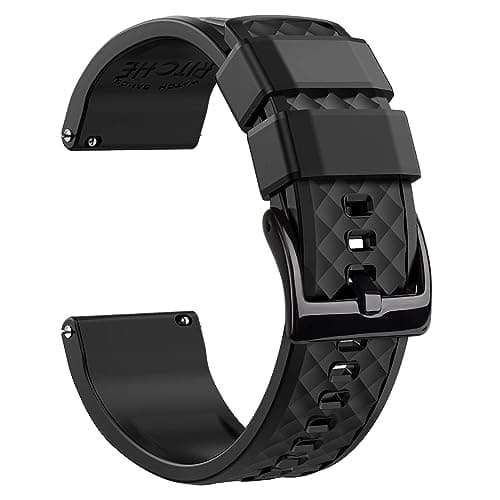
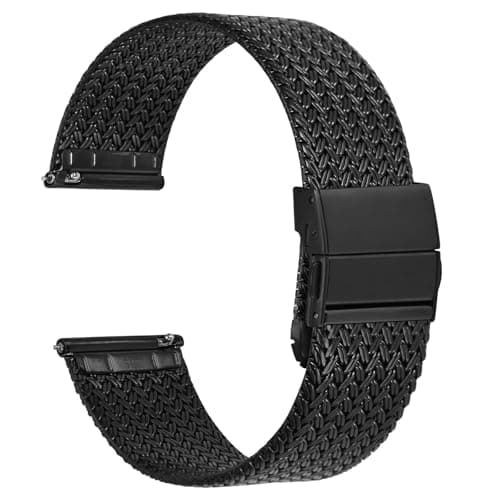
Width coverage. A quick-release strap is only useful if it exists in your lug width. The spread below runs from 14mm (the WOCCI mesh) to 24mm (the Barton leather, the Ritche silicone and the StrapHabit tropic), and the one genuinely narrow range here is the MiLTAT bracelet at 18 to 20mm.
Hardware and compound quality, because a quick-release bar on a bad strap is still a bad strap. And spring-bar tip diameter, which is the detail almost nobody mentions and the one that matters if you own a Seiko — covered in full below the picks.
The Seiko catch: standard tips in fat-bar lug holes
Most quick-release bars use tips around 0.7mm in diameter, which is what a standard lug hole expects. Several Seiko divers — the Prospex and 5 Sports families this site writes about most — use noticeably thicker spring bars, and their lug holes are sized for them. Fit a standard-tip quick-release bar into a hole cut for a fat bar and the pin can sit loose, which is the one real failure mode on an otherwise excellent mechanism.
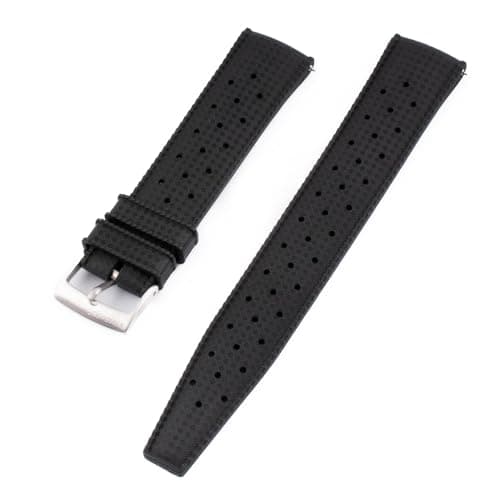
Two of the straps on this page address it directly, because their maker publishes the figure. StrapHabit states that its quick-release bars use 0.8mm tips that fit both standard and Seiko fat-bar lug holes, on the tropic and waffle rubber straps and on the sailcloth hybrid. If your watch is a Seiko diver, that one line is worth more than any amount of leather grading — and we have collected the rest of the Seiko fitment problems on the best straps for Seiko watches.
The strap type that does not need quick release at all
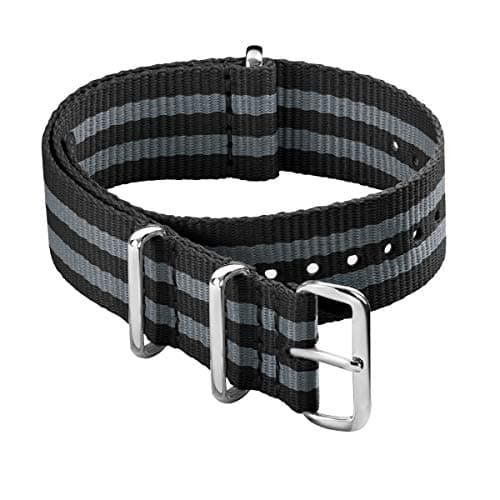
A NATO strap threads underneath the caseback in one continuous pass, so it goes on and off over the existing spring bars with no tool and no special hardware. That is why the Barton ballistic nylon and the other pass-through straps on this site are described as "pass-through" rather than quick-release: they are already tool-free by design, and the single-pass construction has the side benefit of keeping the watch on your wrist even if one spring bar fails.
The Archer on this page is the middle case worth understanding. It is a two-piece seatbelt-weave nylon strap on quick-release bars, which means it looks neater under a cuff than a NATO and swaps just as fast — but it does not have the single-pass fail-safe. Neater, not safer.
Quick release does not rescue a wrong width
This is the mistake the feature encourages. Because the strap goes on in seconds, it is tempting to order by eye. The bar still has to span the lugs exactly, so a 22mm strap will not go into a 20mm gap and a 20mm strap in 22mm lugs will rattle. Measure the gap between the lugs first — it takes a minute — or look your model up in the lug width chart. Several of the straps here are also sold in odd widths through sibling listings, which is the only decent way to put a strap on a 19 or 21mm watch.
The other limit is watches that cannot take a standard bar at all. Integrated-bracelet designs, G-Shocks with proprietary resin bands and watches with fixed lug bars — the Bertucci A-2T is the example on this site — are outside this page entirely. No quick-release strap fits them, at any width.
Where the mechanism costs you something
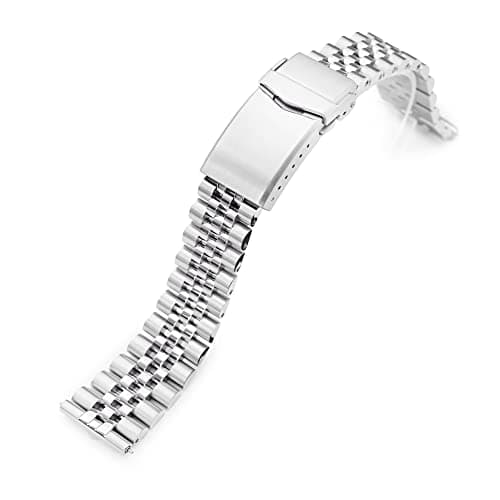
Two honest trade-offs. First, on a solid-link steel bracelet the bar is doing more work: the MiLTAT Super-JUB II QR is the only premium bracelet we know of with quick release integrated, and its maker charges for it. The cheaper route to the same convenience is the BINLUN quick-release bracelet, with the predictable step down in link and clasp quality.
Second, if a watch is going to be dived, worked in or thrown around, a band fitted on conventional bars and then left alone is the more conservative arrangement. Quick release is a convenience feature for a watch whose strap you intend to change; it is not a strength upgrade, and nothing here claims it is. For a watch that will live on one band, buy on the band and ignore the bar.
So which one
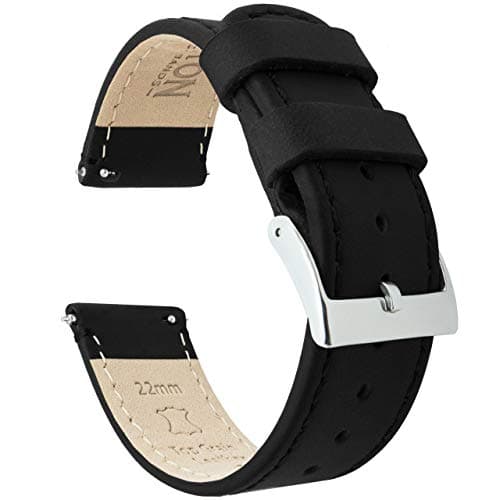
Barton leather if you own one watch and want the biggest visual change for the least money. Ritche silicone if the watch gets wet, sweated in or swum in. Archer nylon for a two-piece fabric strap that reads dressier than a NATO. StrapHabit tropic if the watch is a diver and you want FKM rubber with fat-bar-compatible tips. WOCCI mesh to make a plain watch look like it came from the factory that way. And the MiLTAT Super-JUB II QR if you want a real solid-link bracelet you can still fit without a screwdriver.