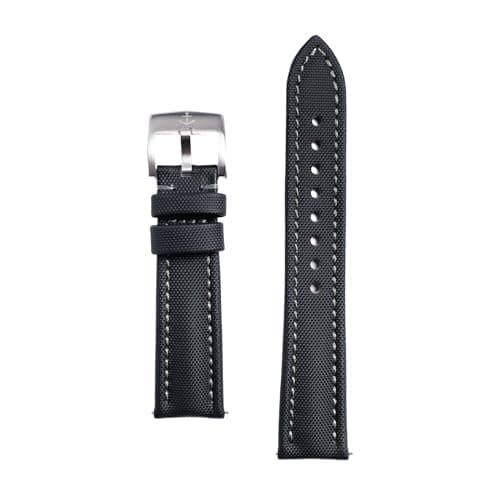
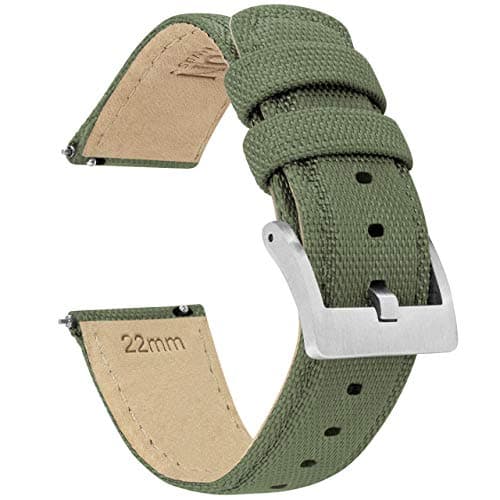
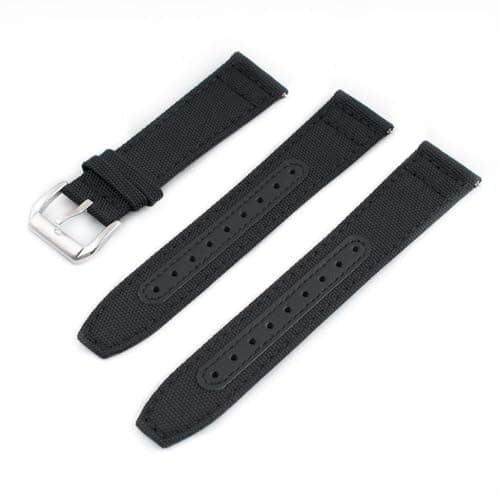
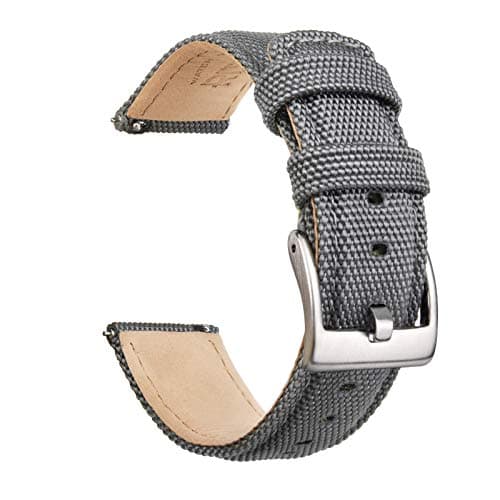
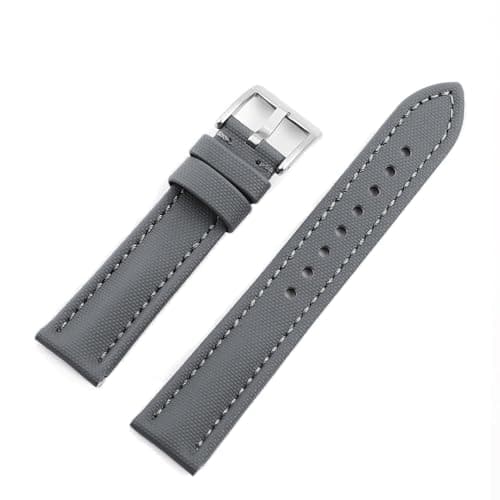
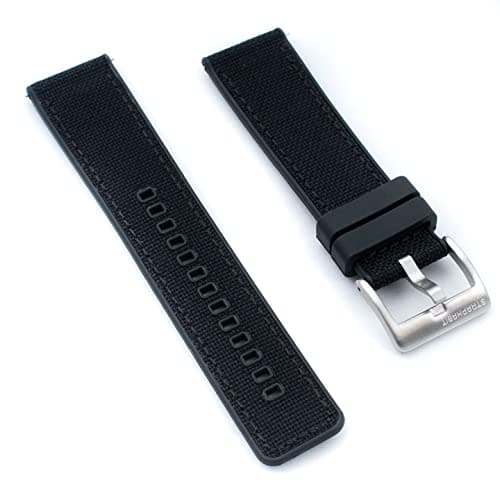
A sailcloth strap is a two-piece strap with a stiff, tightly woven fabric face — the texture of a yacht sail — usually with contrast stitching down each edge and a lining underneath. It is the strap that makes a steel diver look like it belongs on a boat rather than in a tool box — the look the first Fifty Fathoms shipped with, and the one enthusiasts now put on steel divers at every price. On Amazon it costs between seventeen and fifty dollars.
The catch, and the reason this page exists, is that "sailcloth" on Amazon describes two different straps that look identical in the photograph. One has a rubber lining — FKM or natural rubber — under the cloth, and that strap can be swum in, sweated in and rinsed under a tap. The other has a leather lining, and that strap is a leather strap with a fabric face: it will do everything our leather picks do and it will suffer in water exactly the same way. Neither is wrong. Buying the second when you wanted the first is.
So this page ranks on lining before anything else, then on whether the face is a real weave or a pattern embossed into a synthetic, then on quick release and hardware, then on width range. Every strap here was verified as a live, in-stock Amazon listing on the day of writing; every thickness, taper and hole count in the text comes from the maker's own published page and is cited below, and where a maker publishes nothing we say so rather than guess.
The short version: the StrapHabit Hybrid — woven sailcloth on an FKM rubber back — is the sailcloth to buy if your watch gets wet, and it is the only one here that ships with spring bars for Seiko's fat lug holes. The Anchor Strap Co Classic is the premium version of the same idea on natural rubber, with the best buckle on the page. The Barton is the dry-land sailcloth: leather-lined, tapered, made in odd widths, and the right one for a field watch that never sees a pool. And the Ritche and Onthelevel are the twenty-dollar way to find out whether the style is for you.
Where sailcloth comes from
The modern sailcloth strap traces to the Blancpain Fifty Fathoms of 1953, the watch specified by two officers of the French Navy's combat swimmers and built by Blancpain's then-CEO Jean-Jacques Fiechter, which shipped on a textile-reinforced rubber-canvas hybrid rather than leather or steel. That is the ancestor of every rubber-lined sailcloth on this page: a fabric face for grip and look, rubber underneath for the water. The name is a look rather than a material — almost no aftermarket strap is cut from actual sail. Helvetus, which makes them, puts it plainly: most are "purpose-woven technical fabrics that mimic the look of yacht sail canvas without being the same material," and the common faces are woven nylon, recycled polyester weave, cotton-canvas blends, and — increasingly — rubber with a sailcloth pattern molded or embossed into it.
Lining is the whole decision
The cloth on top is water-resistant on every strap here; it is the lining that decides whether the strap is. A leather lining absorbs sweat and pool water, and once it does the strap will stiffen, darken and eventually smell, exactly as a leather strap does — our summer strap roundup explains why sunscreen makes that worse. A rubber lining does none of that. Helvetus' own guide is honest about the trade: the leather-lined straps are the more comfortable and the more traditional, but "sailcloth is water-resistant rather than fully waterproof," and for real water exposure FKM is better.
Two of the six straps here are rubber-lined and they sit at the top of the ranking for that reason alone. The StrapHabit Hybrid puts a woven sailcloth face on FKM, the fluoroelastomer that shrugs off UV, salt and chemicals; StrapHabit publishes the full dimensions — 2.3mm thick across the strap and 4.2mm only at the spring bars, 80 and 120mm long, thirteen holes, two rubber keepers. The Anchor Strap Co Classic uses natural caoutchouc rubber, which is softer against the skin than FKM and, per the maker, "ready for everyday exposure to sweat, rain, or splash." Note the wording on both: StrapHabit says outright that for frequent water use a fully rubber strap is still the better choice, and Anchor says water-resistant, not waterproof. A rubber-lined sailcloth is a strap you can swim in and a strap you can dive in is a tropic.
The other four are leather-lined — Barton and StrapHabit say so in the title or the spec, Onthelevel says "leather back lining" in the listing, and Ritche says nothing about the lining at all, so we treat it as a dry strap. On a field watch that lives on a wrist and not in a pool, that is the better strap: thinner, lower on the wrist, and cheaper.
Woven or embossed
The second thing to check is whether the face is a cloth at all. Barton's is a "premium nylon sailcloth" weave, StrapHabit's a woven sailcloth, Onthelevel's an Oxford weave; up close they read as fabric, with the slight fuzz and the visible warp that the real thing has. The Anchor Strap Co's is "embossed synthetic sailcloth" — the pattern is pressed into a synthetic sheet — and the maker says so on its own product page, which is to its credit. Embossed faces are more uniform, wipe clean, and never fray; woven faces look and feel like the sail the style is named for and can fuzz at the edges after a year or two. ZULUDIVER, which builds its own sailcloth straps from a rubber face over neoprene and cotton, makes the same trade in the other direction and is equally open about it. Neither is a fake; know which one you are paying for.
Quick release and hardware
Five of the six straps here ship with quick-release spring bars, and the StrapHabit Hybrid ships with bars for both standard lug holes and Seiko's fat ones — which matters if the strap is going on a Turtle, a Samurai or a Seiko 5, whose stock bars are thicker than the quick-release bars most straps include. The Anchor is the exception: the maker offers quick release as an option on its own site, but the Amazon title we verified does not mention it, so assume a spring-bar tool. Our guide to changing a watch strap covers both.
On hardware, the price gap is visible. Barton, Ritche and the Anchor all specify a brushed 316L stainless tang buckle, and the Anchor's is a custom design with a matching deployant sold separately at real money. The cheaper straps use a stamped buckle that does the job and looks like it. Barton also publishes a 2mm taper from the head to the buckle, which is the detail that makes a strap sit like an original rather than an aftermarket part; Ritche publishes a 4mm thickness with a taper; the others publish neither.
Width: check the lugs, then the listing
Sailcloth is sold per width like every other strap, and the widths in the listings we verified are 20 and 22mm for both StrapHabits and the Anchor; 18 to 24mm including the odd sizes for the Barton variation listing; and 18, 20 and 22mm for the Ritche and the Onthelevel. Most of the divers on this site take 22mm and most of the field watches 20mm — our lug width chart has the figure for dozens of models. Unlike a perlon or a NATO, a sailcloth is stiff and does not compress, so the width has to be exact.
Which sailcloth for which watch
For a 200m automatic diver that gets wet — a Seiko Turtle, a Seiko 5 Sports, an Orient Kamasu — the StrapHabit Hybrid, in 22mm, with the fat-bar spring bars it ships with. For the same watch worn to dinner, the Anchor Strap Co Classic in black or navy, and budget for the deployant if you like it. For a field watch — a Khaki Field, a Timex Expedition, a Seiko 5 field — the Barton, in whichever of its nine colors matches the dial, and in 20mm or one of the odd widths nobody else makes. For a diver you never swim in and want to dress down rather than up, the leather-lined StrapHabit in gray or khaki. And if you have never worn the style and want to find out for twenty dollars, the Ritche in 20mm or the Onthelevel in whichever width you need.
Care is the same as the lining: rubber-lined, rinse under the tap and wipe dry; leather-lined, keep it out of the water and let it air after a hot day. The face on both can be wiped with a damp cloth. Do not machine-wash any of them — the Barton canvas strap on our field-watch strap page is the one that tolerates that, and it is a different construction.