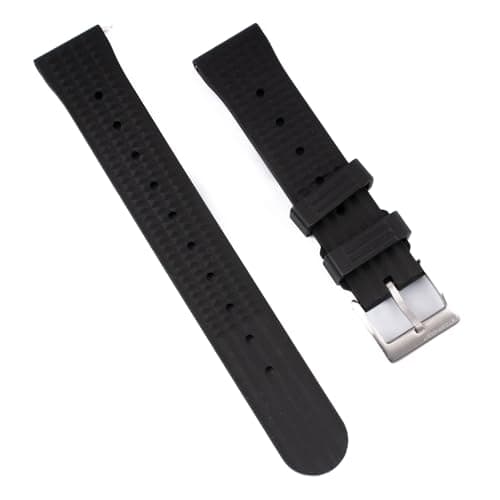
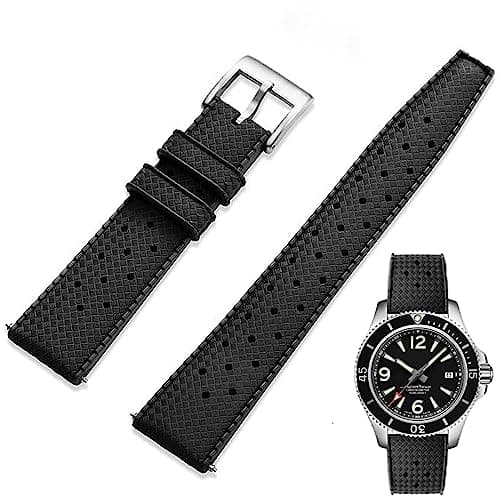
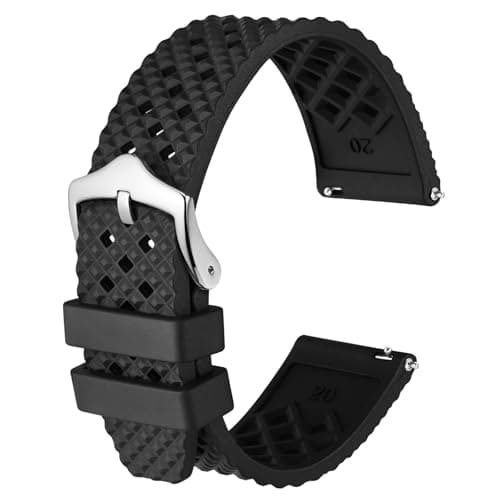
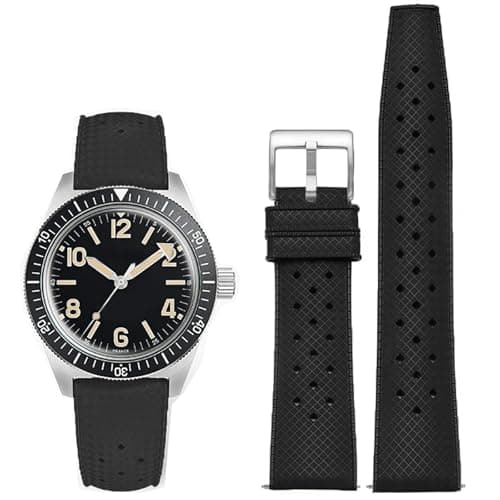
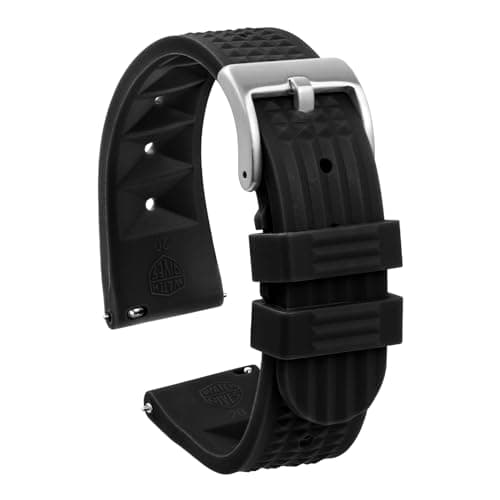
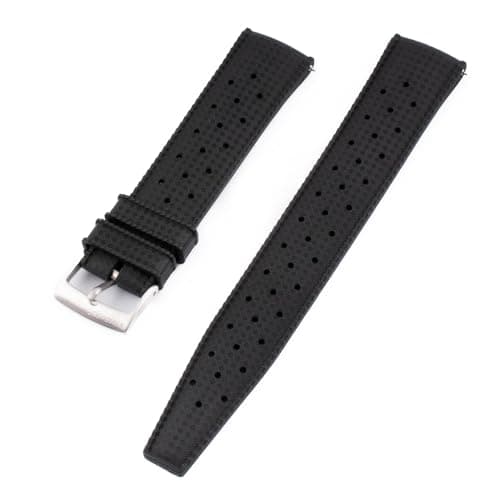
A tropic strap is a perforated rubber strap with a diamond basket-weave surface, and it is the oldest dive-strap pattern still in production: the Swiss company Tropic supplied them to dive-watch brands through the 1960s, and Seiko's first diver, the 1965 62MAS, shipped on one. The waffle is Seiko's own answer from two years later — a raised grid "reminiscent to a waffle iron plate" that it fitted to the 6105 and its siblings.
Both patterns are back, and both now come in FKM — fluoroelastomer rubber, the compound that does not take on odor, does not go tacky in heat, and shrugs off sunscreen and salt the way silicone does not. That is the good news. The complication is that "tropic-style" is a shape anyone can mold, and a large share of the listings selling it are vague about the rubber. So this page ranks on four things, in this order. Stated compound — does the listing or the maker say FKM, or just "rubber"? Published dimensions — thickness, lengths and taper, because a 5mm strap and a 3mm strap are different objects on the wrist. Quick release and spring-bar fit — including whether the bars fit Seiko's fat lug holes, which is where Seiko owners get burned. And widths.
The short version: the StrapHabit Tropical is the strap to buy. It is the only tropic on Amazon whose maker publishes the numbers — FKM, 3 to 5mm thick, 78/130mm, 22mm tapering to 20mm, 316L hardware — and it costs forty dollars. The StrapHabit Waffle is the same documentation in the Seiko pattern, with quick-release tips its maker says fit fat-bar lugs. Below that, the Niziruoup and ANBEER state FKM at half the price without the dimensions, and the watchdives waffle is a ten-dollar strap whose listing says rubber and nothing more — ranked, honestly, as exactly that.
One scope note: this page is about the two vintage patterns. If you are choosing between rubber compounds in general, our FKM vs silicone page is the argument, and best rubber straps ranks the plain ones.
Tropic or waffle: which pattern for which watch
The tropic is the thinner, lighter pattern: a flat strap with a fine crosshatch surface and rows of perforations that vent heat and drain water. It was the generic dive strap of the 1960s — Tropic-branded straps came on watches from several makers — and it suits almost anything with a bezel, from a 38mm skin diver to a 42mm Promaster. On this site's watches, it is the right pattern for a Citizen Promaster, an Orient Kamasu, a Casio Duro, or any diver you also wear with a shirt.
The waffle is thicker and specifically Seiko. Seiko fitted its own waffle strap to the 6215, the early 6159 and the 6105 from 1967, and the pattern reads as vintage Seiko to anyone who knows it. It is the correct strap for a Prospex Turtle, a Samurai, or a Seiko 5 Sports SRPD, and it looks heavy on a slim case because it is: the StrapHabit version runs up to 5.5mm at the lugs.
FKM, and why "rubber" is not an answer
FKM is a fluoroelastomer — the same family of synthetic rubber used for seals that have to survive fuel and heat. On a wrist, the properties that matter are that it does not absorb sweat or odor, does not soften or get sticky in heat, and is not degraded by sunscreen, insect repellent or salt water. Silicone, by contrast, is softer out of the box, attracts lint, and can hold a smell; standard vulcanized rubber sits in between and hardens with age. StrapHabit describes its FKM as offering "increased durability, chemical and heat resistance" over traditional rubber, which is the standard claim for the compound.
The practical rule for this category: if a listing does not say FKM, assume it is not. A strap sold as "soft rubber" is probably silicone or a silicone blend, which is not a bad strap — it is what most of the picks on our rubber roundup are — but it is not the compound the price of a premium tropic is paying for. Three of the six straps here name FKM in their live listing; the StrapHabit Waffle's Amazon title says "rubber" but the maker's own page states FKM; and the watchdives says rubber and nothing else. The spec table records each exactly as stated.
The numbers that make a strap wearable
Three dimensions decide how a rubber strap feels, and most listings publish none of them. Thickness: StrapHabit gives 3–5mm for the tropic and 3.5–5.5mm for the waffle, which is the honest range for the patterns — thick at the lugs so the strap does not fold, tapering toward the buckle. Length: 78/130mm for the tropic and 80/130mm for the waffle, not including the buckle, which fits roughly a 6 to 8 inch wrist. Taper: the StrapHabit tropic is 22mm at the lugs and 20mm at the buckle, and that 2mm is most of what makes a rubber strap feel like a strap rather than a slab.
We can only rank what is published, which is why the two StrapHabit straps sit first and second. The Niziruoup, Nizonlaie and ANBEER may well be the same thickness — the molds for this pattern are close to standardized — but their listings do not say, so we do not either.
Quick release and the Seiko fat-bar problem
Every strap here has quick-release or "fast release" spring bars, so it goes on without a tool. The catch is specific to Seiko owners: Seiko's divers use thicker "fat" spring bars with larger lug holes, and a standard quick-release bar with thin tips can sit loose in them. StrapHabit states its waffle uses 0.8mm tips "compatible with all watches with standard or Seiko fat lug holes." None of the other listings make a claim either way, so if you own a Turtle or a Samurai and want to buy one of the cheaper straps, plan on fitting your own fat bars — our guide to changing a watch strap covers it.
Width, and the 22mm default
Nearly every affordable diver on this site takes a 22mm strap — the Seiko 5 Sports, the Turtle, the Kamasu, the Duro all do — so every strap here is verified in 22mm and that is the listing we link. The StrapHabit tropic runs 18 to 24mm; the Niziruoup and Nizonlaie run 18, 20 and 22mm; the StrapHabit waffle 20 and 22mm; the ANBEER and watchdives were verified in 22mm only. If your watch is a 20mm field watch, the tropic is still a good strap on it — a Timex Expedition North on a gray tropic is a genuinely good look — but check the width exists before you buy. Our lug width chart has the figure for most popular models.
What a tropic is bad at
Two honest limits. First, the perforations collect grit. Sand and dried salt lodge in the diamond pattern and the holes; rinse the strap in fresh water after the sea or the strap will start to look gray. Second, FKM is firm at first. A silicone strap is softer on day one; an FKM tropic takes a week or two of wear to relax, and people who return them usually return them in that first week. It is worth persisting. If you want soft immediately and do not care about odor or longevity, the Barton Elite silicone is the answer and it is not on this page for a reason.