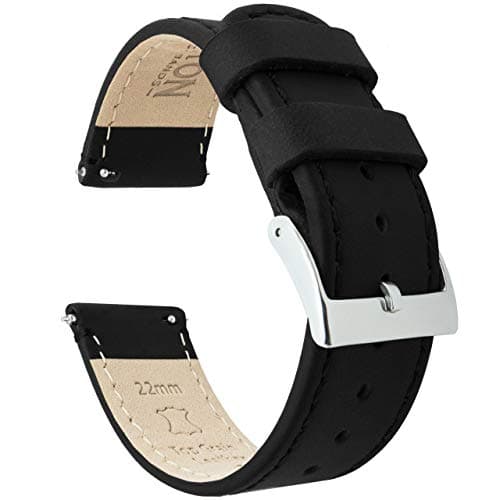
Strap colour is the cheapest decision in watches and the one people get stuck on longest, because the advice online is either “match your shoes” — a rule written for 1950s dress watches — or a wall of photographs with no reasoning attached. Here is how we actually decide it, in the order the decisions matter.
Rule one: the strap serves the dial, not the outfit
A watch is a small object seen as one unit. The strap is most of its surface area, so the strap is what sets the watch's character: the same watch on black leather reads formal, on olive canvas reads outdoorsy, and on a grey nylon reads casual. Pick the character you want the watch to have, then pick a colour that supports the dial rather than fighting it. That is why mid-brown wins so often — it is warm enough to flatter almost any dial colour, and it is not trying to match anything.
The dial-by-dial answer
Black dial. The most forgiving dial there is. Brown leather for warmth and contrast, black leather for a deliberately formal look, grey or black nylon for casual, steel mesh if you want the watch to read like a bracelet watch. Essentially nothing clashes.
Blue dial. Mid-brown and tan leather are the classic pairings and the reason tan-on-blue is the most photographed combination in watches. Navy nylon works but risks reading flat, because a navy strap next to a blue dial almost never matches exactly — the near-miss is more noticeable than a deliberate contrast. Grey is the safe nylon.
White or cream dial. Brown leather, again — a dark brown gives the strongest contrast with the dial. Black leather is sharper and more formal. Avoid light tan on a cream dial unless you want the watch to disappear into itself.
Green or khaki dial. Brown leather and olive canvas, which is why field watches end up on exactly those two straps. Black nylon is the neutral third option.
Grey or silver dial. This is the one case where black leather is usually better than brown: a grey dial is cool-toned and brown pulls it warm. Steel mesh is excellent here too.
Rule two: match the buckle to the case, not the strap to your belt
The old advice about matching your strap to your shoes is only a rule for formal dress, and even then it is a preference. The rule we would actually keep is about hardware: a polished steel buckle on a brushed steel watch, or a black buckle on a black case, looks considered in a way the strap colour cannot fix. Most straps here ship with a steel buckle, which is right for almost every watch on this site. If the watch is gold or gold-tone, a strap with a steel buckle will always look slightly borrowed — buy the colour-matched hardware version if the maker offers one.
Rule three: the material decides the colour as much as the colour does
Colour and material are not separate choices. Brown exists in a dozen finishes and they are not interchangeable: smooth top-grain brown is dressy, oiled Crazy Horse brown is rugged and goes pale where it creases, Horween shell and chromexcel are richer and age visibly. Black in nylon reads sporty; black in smooth leather reads formal. If you are choosing a construction as well as a colour, start at watch strap types, which separates every construction this site sells and what each one is for.
The three-strap set that covers everything
We would buy these three, in this order, for almost any watch:
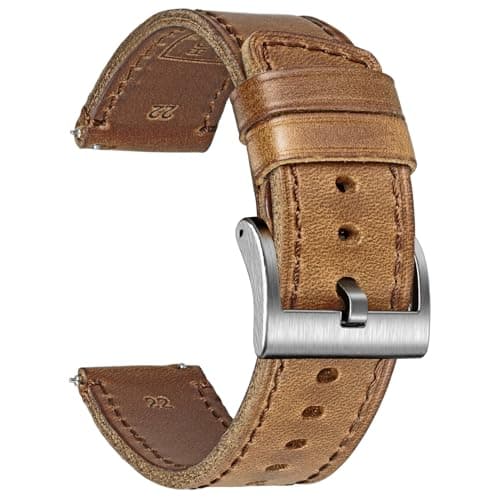
- Mid-brown leather with a steel buckle. The default. Dressy enough for an office, casual enough for a weekend.
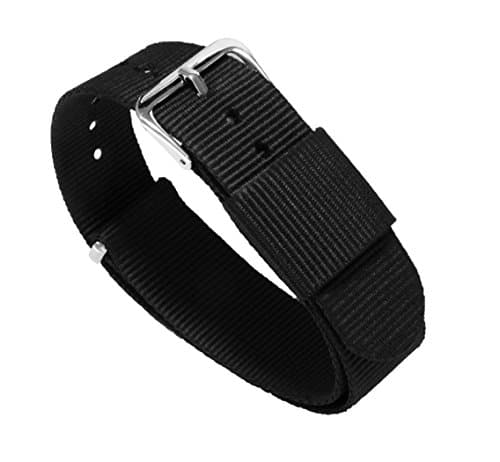
- Grey or black ballistic nylon. The strap you wear when the watch is going to get wet, knocked or sweated on, and the cheapest way to make a dress watch casual.
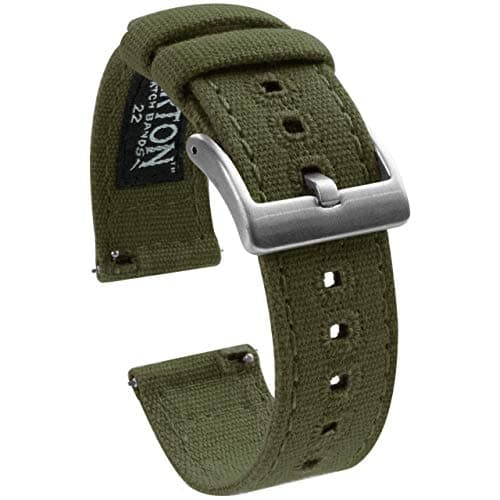
- Olive or khaki canvas. The outdoor look, and the one that makes a plain field watch look like it has a job.
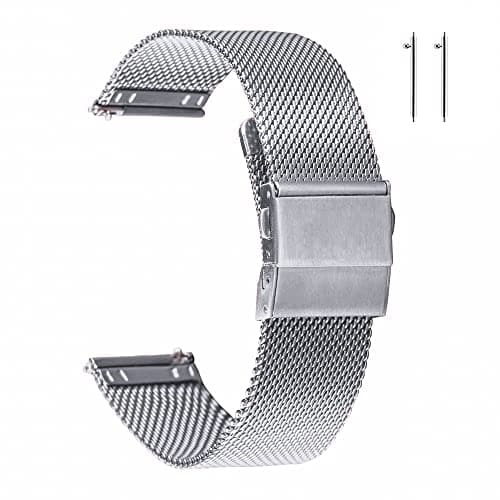
That is three straps for less than the price of most watches on this site, and it is the whole wardrobe. A fourth — steel mesh — is worth adding if you own a diver, because it is the one strap that makes a dive watch look dressed up. The picks below are our choice for each of those roles.
Before you buy a colour, get the width right
A strap in the perfect colour and the wrong width is a wasted purchase. Measure the gap between the lugs in millimetres — that number, not the case diameter, is what you order. Our watch lug width chart lists the common models, and how to measure a watch strap walks through doing it yourself with a ruler. Most watches here are 20mm or 22mm.
Quick-release bars make colour a low-stakes decision
Every leather and canvas pick on this page has quick-release spring bars, which means swapping colour is a ten-second job with a fingernail and no tools. That changes the economics of the decision entirely: you are not committing to a look, you are buying an option. The full ranking of tool-free straps is best quick-release straps.
Where to go next
For the leather field in full — grain, tanning and price — see best leather watch straps. For nylon, best NATO straps covers the colours and the hardware. If the watch is a field watch, straps for field watches is the shorter list, and for a diver, straps for diving rules out the materials that do not belong near salt water.
What this page is and is not
Colour advice is judgment, and we have labelled it as judgment rather than dressing it up as a rule. The specifications in the table — material, available widths, quick-release hardware — are the published figures from each listing. We have not photographed these straps on these watches, and we do not publish a combination we have not reasoned through from the materials. Our method is on how we review.