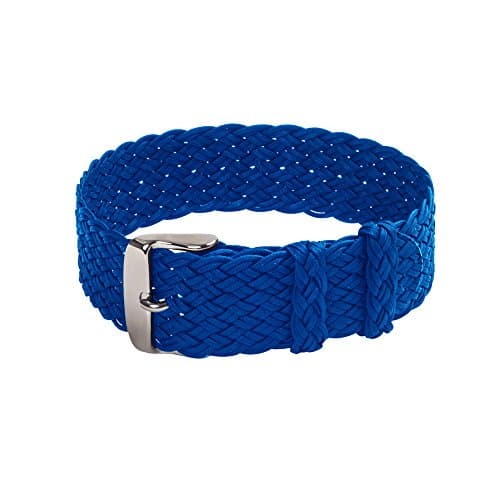
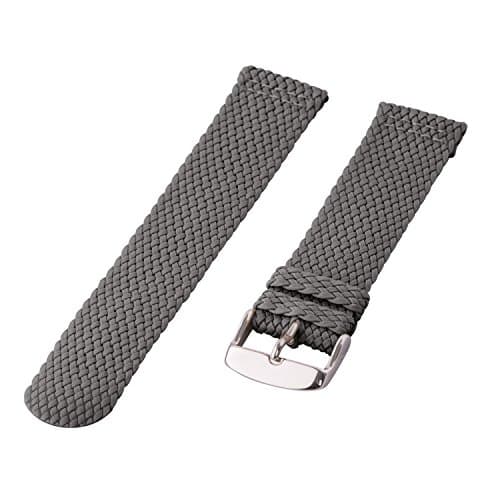
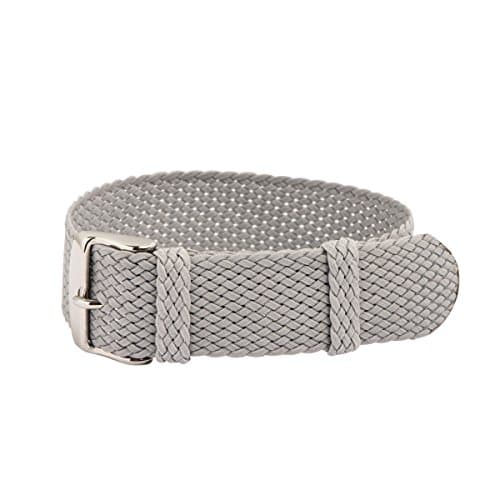
A perlon strap is a braided nylon strap with no adjustment holes. The buckle prong pushes through the weave wherever you want it to, so the strap fits every wrist at every hour of the day — including the hour after lunch in July when your wrist has swelled a size and a punched leather strap is a notch too tight in one hole and a notch too loose in the next.
That one property is the whole argument. Everything else about a perlon — the weight, the open weave that lets air through, the way it dries after a swim — is shared with a good NATO. The infinite adjustment is not, and it is why, as Gear Patrol put it, the strap can feel "completely non-existent" on the wrist in a way a NATO does not.
The category is narrower than leather or rubber, and honest about it: one American maker, Clockwork Synergy, dominates the Amazon listings, and the German originator, Eulit, does not sell there in a way we could verify. So this page ranks what can actually be bought with a real listing behind it, on four things, in this order. Braid density — single or double braid, which decides stretch and how a heavy watch sits. Construction — one-piece pass-through, which adds height under the case but keeps the watch on through a spring-bar failure, or two-piece, which sits lower and does not. Hardware — the buckle and keepers, which is where cheap perlons show their price. And width range, because a strap you cannot buy in your lug width is not a recommendation.
The short version: the Clockwork Synergy Braided Perlon at about twelve dollars is the one to buy first, because it is the definitive version of the thing and it costs less than lunch. The Double Braided is the same strap for a heavier watch. The 2-Piece is for a thick automatic that a pass-through would push off the wrist. And the Da Luca is the one you buy once you know you like perlon and want the braid and the buckle to match a watch you care about.
What perlon actually is
Perlon is a trade name for a German polyamide fiber — a nylon — developed around the same time as the American original, and the straps braided from it became popular in Europe through the late 1950s and 60s. The maker most associated with the style, Eulit, has been weaving straps in Germany since the 1920s. The modern straps on this page are braided nylon in that pattern; "perlon" now describes the construction rather than a specific supplier's fiber, and the Clockwork Synergy listings call it perlon while the WOCCI calls it braided nylon. We use the listing's own word for each.
The construction is a braid of small nylon loops rather than a single woven ribbon. That is the difference from a NATO, which is one strip of tightly woven nylon with punched holes, and it is what produces both the airiness and the adjustment: the prong of a tang buckle slips between the loops anywhere along the length.
Single braid or double braid
A single-braid perlon — the classic Clockwork Synergy — is thin, very light, and stretches a little under load. That is fine under a 40mm quartz field watch. Under a 200m automatic diver with a steel bracelet's worth of head weight, the stretch shows up as a watch that slides round to the underside of the wrist by mid-afternoon.
A double-braid perlon adds a second layer, which roughly doubles the thickness at the expense of some of the airiness, and holds a heavy head much flatter. If your watch is a Seiko Turtle or an Orient Kamasu, buy the double braid. If it is a Timex Expedition or a Hamilton Khaki, the single braid drapes better and you will not miss the second layer.
One-piece or two-piece: the height question
Almost every perlon is a one-piece pass-through: the strap runs under the caseback between the spring bars, exactly like a NATO. That has one real advantage — if a spring bar fails, the watch stays on your wrist — and one real cost. The strap adds its own thickness under the case, so a watch that already sits tall sits taller. On a slim field watch nobody notices. On a 13mm-thick automatic diver, the extra couple of millimeters is the difference between a watch that sits on the wrist and one that perches on it.
The 2-Piece Clockwork Synergy solves that by being a conventional strap: a buckle half and a tail half, each on its own spring bar, nothing under the case. It keeps the prong-anywhere adjustment, which is the point of the material, and gives up the spring-bar safety net, which is the point of the pass-through. Choose by which matters more to you and by how thick the watch is. We rank it third rather than first because most people buying a perlon are buying it for a light summer watch, where the one-piece is the better strap.
Hardware is where the price goes
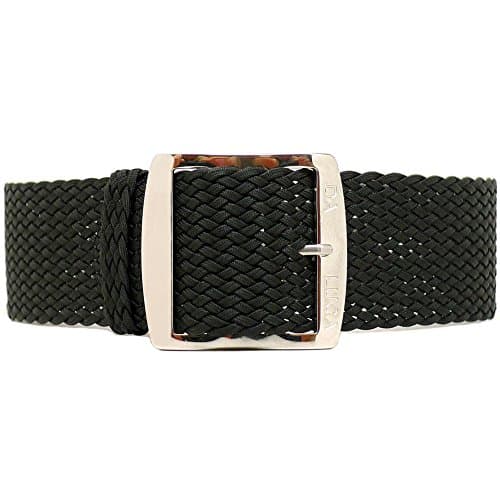
The braid on a twelve-dollar perlon and a forty-dollar perlon is more alike than different. The buckle and the keepers are not. Budget straps use a thin stamped buckle and a stamped keeper or two; the Da Luca's listing offers a polished or a black PVD buckle, and the extra money is visibly in that hardware and in a tighter, more even braid. Whether that is worth four times the price depends entirely on the watch it is going on. On a Casio Duro, no. On a Hamilton Khaki you wear to work, arguably.
One thing to know about any perlon buckle: because the prong goes through the braid rather than a reinforced hole, the braid will eventually loosen at your usual fastening point. It takes a long time and it does not affect the strap's function — you simply fasten a few millimeters along — but a perlon does wear in a way a NATO does not.
Width: match the lugs, then check the listing
Perlon straps are sold per width like every other strap, and the widths on offer in the listings we verified are 18, 20, 22 and 24mm for the single-braid Clockwork Synergy and the Da Luca; 18 and 22mm for the double braid; 22 and 24mm for the 2-piece; and 18, 20 and 22mm for the WOCCI. Our lug width chart lists the figure for most popular watches. Perlon is slightly forgiving because the braid compresses — a 22mm strap will squeeze into 21mm lugs — but do not buy a size down on purpose; it bunches at the spring bar and looks it.
Where perlon beats a NATO, and where it does not
Perlon wins on adjustment, on weight, on breathability and on a dressier texture — the braid reads more like a fabric than a strip of webbing, which is why a gray perlon on a field watch passes in an office where a striped NATO would not. It also has no excess tail to fold back through the keepers, because you fasten it exactly where your wrist is.
A NATO wins on toughness — a heavy ballistic nylon NATO will outlast a perlon several times over — on the retained-hardware security of the extra keeper piece, and on being the correct strap for a genuine military look. If you swim in salt water, both dry fast; the NATO's extra layers hold water longer. Our summer strap roundup compares the two alongside rubber and mesh if you are choosing between families rather than within one.
Which perlon for which watch
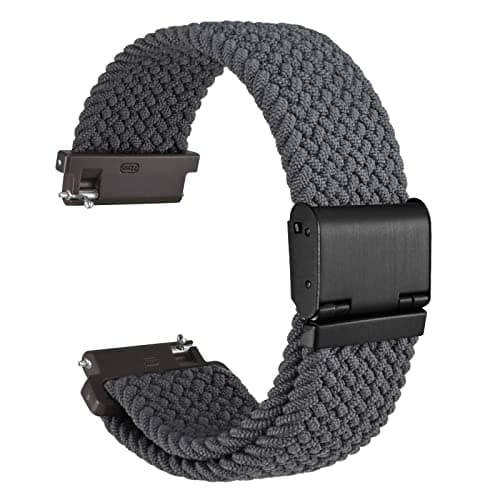
For a quartz field watch or a small dress watch — a Timex Expedition, a Khaki Field Mechanical, a Timex Marlin — the single-braid Clockwork Synergy in the right width is the answer, and a light gray or navy is the color that goes with everything. For a 200m automatic diver — a Seiko 5 Sports, a Turtle, a Kamasu — the double braid holds the weight, or the 2-piece if the case is thick enough that a pass-through bothers you. For a watch you want the strap to flatter, the Da Luca, in whichever buckle finish matches the case. And if you have never worn a braided strap and want to find out for ten dollars whether the texture is for you, the WOCCI, with the honest note that it is a braided nylon two-piece with a buckle, not a true prong-anywhere perlon.
Fitting is the same as a NATO: thread it under the spring bars, through the buckle, and fasten. Our guide to changing a watch strap covers getting the old strap off, and how to measure a watch strap covers the width if you do not know it.