The verdict
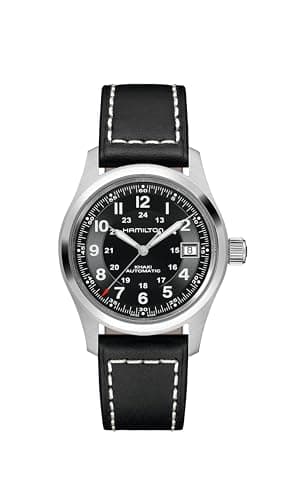
Our pick: Hamilton Khaki Field Mechanical (38mm)
Buy an automatic if the watch is going to be your daily watch: it winds itself from the motion of your wrist, so you put it on and it runs. Buy a manual — a hand-wound watch — if you want the ritual and a thinner case, and you do not mind that a watch left in a drawer for two days stops.
Our pick for a hand-wound watch is the Hamilton Khaki Field Mechanical, which has an 80-hour reserve, so in practice one winding on Monday morning lasts into Thursday. For an automatic, the Hamilton Khaki Field Automatic is the same watch with a rotor; the Seiko 5 Sports SRPD93 is the same idea for a third of the money.
Both manual and automatic watches are mechanical: a wound spring drives a gear train, an escapement releases it in measured steps, and no battery is involved anywhere. The only structural difference is how the spring gets wound. A manual watch is wound by turning the crown. An automatic has a weighted rotor that spins as your wrist moves and winds the spring for you. Everything else people argue about — accuracy, thickness, reliability, service cost — follows from that one piece of hardware.
If you are deciding between mechanical and quartz rather than between these two, that is a bigger decision and it is covered on quartz vs automatic watches. This page assumes you have already decided you want something mechanical.
What a rotor costs you
Thickness. A rotor and its bearing sit on top of the movement, and the case has to be deeper to fit them. This is why hand-wound dress watches are thin and automatics generally are not, and why a hand-wound Khaki Field sits a fraction closer to the wrist than the automatic version of the same watch.
Complexity. A rotor is one more assembly to wear out, and the winding mechanism is a common service point. Against that, hand winding puts daily wear on the crown, the stem and the keyless works, which is the manual watch's equivalent failure point. Neither argument is strong enough to decide a purchase.
What a rotor buys you
You never have to think about it. That sounds small and it is the entire reason automatics outsell hand-wound watches many times over. An automatic worn daily stays wound, stays within its optimal power band and shows you the time whenever you look at it.
A hand-wound watch is a watch with a daily task attached. Most owners either enjoy that or stop wearing the watch; there is very little middle ground. If you suspect you would resent it, believe yourself.
Accuracy: a smaller difference than the forums suggest
Mainsprings deliver more torque when fully wound and less as they run down, and a movement keeps better time in the middle of that curve. A watch wound by hand every morning sits high on the curve; an automatic on a desk-bound wrist may sit low on it. That is the real mechanism behind the claim that hand-wound watches run more accurately, and it is also why the fix for a drifting automatic is usually to wear it more, not to have it serviced.
Modern long-reserve movements flatten this out. The Hamilton H-50 and H-10 are both rated at 80 hours, and the point of a reserve that long is that the watch spends almost all its life in the stable part of the curve. Either way, both will drift seconds a day where a quartz watch drifts seconds a month — if accuracy is the deciding specification, neither of these is the answer and a solar quartz is.
Power reserve is the number that matters
Reserve is how long the watch runs from fully wound without input. It decides the day-to-day experience far more than the manual-versus-automatic label does:
80 hours (the Hamilton H-50 and H-10) means a watch taken off on Friday evening is still running on Monday morning. Around 41 hours (Seiko 4R36) means a watch worn today is still running tomorrow, and stopped by the day after. Around 40 hours on the hand-wound Timex Marlin means the same thing — it is a watch you wind every morning. A hand-wound 80-hour watch is less demanding than a 40-hour automatic that you only wear at weekends.
The short answer
Quick picks
| # | Watch | Key specs | Best for | Score | Price |
|---|
| 01 | | - 38mm
- 20mm lug
- 50m
- H-50 · 80h
| The one field watch to own | | $675.00·Amazon |
| 02 | | - 38mm
- 20mm lug
- 100m
- H-10 · 80h auto
| A set-and-forget field watch | | $795.00·Amazon |
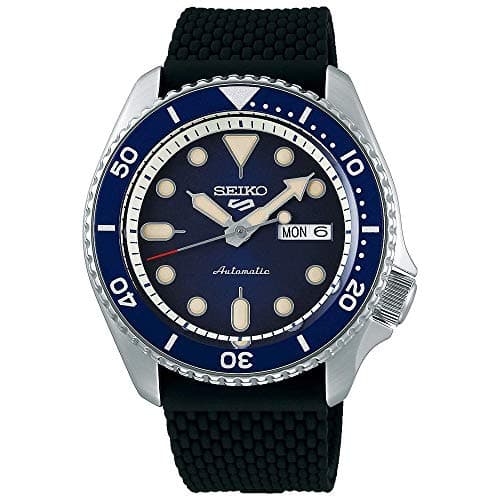
| 03 | Seiko 5 Sports SRPD93The default first automatic diver-style watch, and the direct heir to the beloved SKX. | - 42.5mm
- 22mm lug
- 100m
- 4R36 automatic
| Your first automatic | | $280.00·Amazon |
| 04 | | - 34mm
- 18mm lug
- 30m
- Hand-wound
| A small mechanical dress watch | | $237.00·Amazon |
#ad · Live prices from the Amazon Product API, as of October 11, 2026. Where we have no verified live price, we show none — we would rather leave a gap than print a number that has rotted. Specs are the published manufacturer or live-listing figures, as of the same date; a dash means we could not verify one.
Side by side
The spec table
Every published number that decides fit and function — including the lug width, so you know which strap fits before you buy.
In detail
The picks, in full
The one field watch to own
Hamilton Khaki Field Mechanical (38mm)
38mm20mm lug50mH-50 · 80h
The field watch enthusiasts point newcomers to. Swiss hand-wound, 38mm, near-perfect.
- Legibility
- 10
- Build
- 9
- Movement
- 8
- Versatility
- 9
- Value
- 8
Pros
- +A hand-wound Swiss mechanical with an 80-hour power reserve — the winding ritual is the point
- +Sapphire crystal and a correctly-sized 38mm case that suits almost any wrist
- +The direct descendant of the WWII-issue field watch, done properly
Cons
- −Only 50m water resistance — fine for rain and hand-washing, not for swimming
- −Hand-wound means you re-wind it every day or two; some people want automatic
Skip this one if…
…you'll resent winding a watch by hand each morning. The automatic H-10 version below removes that ritual for a little more money.
A set-and-forget field watch
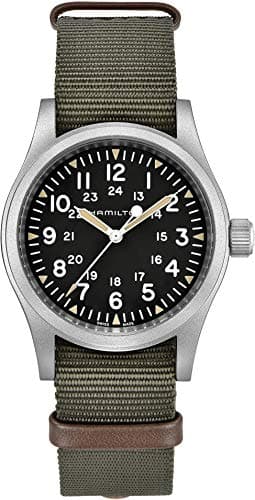
Hamilton Khaki Field Automatic (38mm)
38mm20mm lug100mH-10 · 80h auto
The Khaki Field for people who never want to wind a watch. Same brilliance, plus a rotor.
- Legibility
- 10
- Build
- 9
- Movement
- 9
- Versatility
- 9
- Value
- 8
Pros
- +The 80-hour automatic H-10 movement means it keeps running through a weekend off the wrist
- +Same 38mm case, sapphire crystal and field-correct dial as the mechanical
- +Genuine Swiss-made value at its price point
Cons
- −Sits a fraction thicker than the hand-wound version to fit the rotor
- −Costs more than the mechanical for the same look
Skip this one if…
…you actually enjoy the hand-winding ritual — the mechanical version is thinner, cheaper and more tactile if that's you.
Your first automatic
Seiko 5 Sports SRPD93
42.5mm22mm lug100m4R36 automatic
The default first automatic diver-style watch, and the direct heir to the beloved SKX.
- Legibility
- 9
- Build
- 8
- Movement
- 8
- Versatility
- 9
- Value
- 9
Pros
- +The 4R36 hacks and hand-winds — the two things the old SKX movement couldn't do
- +Genuinely great lume and the most recognizable dial in affordable watches
- +22mm lugs open onto the biggest strap aftermarket there is
Cons
- −100m water resistance, not the 200m of a true ISO diver — it is diver-styled, not a dive tool
- −Hardlex crystal scratches more easily than sapphire
Skip this one if…
…you actually dive or want a screw-down-crown 200m tool watch. The 100m rating and non-diver spec mean this is a desk diver — step up to the Turtle or a Prospex for the real thing.
A small mechanical dress watch
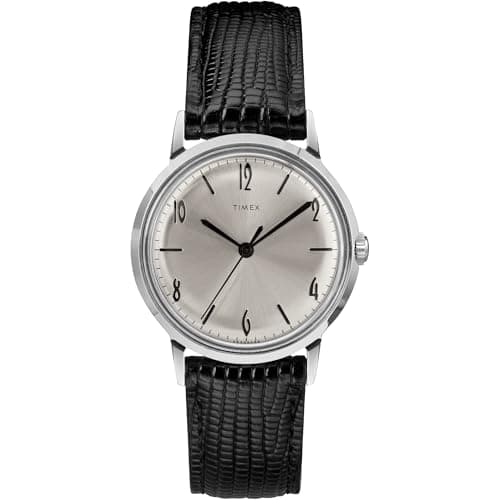
Timex Marlin Reissue (34mm hand-wound)
34mm18mm lug30mHand-wound
A hand-wound mechanical dress watch for the price of a nice dinner out — and a genuinely small one.
- Legibility
- 7
- Build
- 7
- Movement
- 8
- Versatility
- 6
- Value
- 8
Pros
- +A true hand-wound mechanical — you wind it every morning, and nothing else here at this price does that
- +34mm is a genuinely vintage-correct size, and one of the few watches on this site that suits a small wrist without compromise
- +The domed acrylic crystal gives the dial the warm distortion the 1960s original had
Cons
- −30m water resistance means rain and handwashing only — keep it away from the pool
- −Acrylic scratches easily (though it also polishes out with a cloth and a little compound)
Skip this one if…
…you want a watch you can wear without thinking. The Marlin needs winding daily, cannot get wet, and scratches — it is a deliberate, careful object, which is exactly the appeal.
Setting and winding, mechanically
Winding a manual: turn the crown forward in its resting position until you feel firm resistance, then stop. Thirty to forty turns from empty is typical. A hand-wound watch has a positive stop at the end of the spring, and forcing past the point where it goes hard is how stems and springs get damaged.
Winding an automatic: most modern automatics, including the Seiko 4R36 and the Hamilton H-10, can also be wound by hand — twenty to thirty turns is plenty to start a stopped watch. An automatic has a slipping clutch instead of a hard stop, so it cannot be over-wound, but there is no benefit in winding past the point where the rotor would take over. Older movements such as Seiko's 7S26 cannot be hand-wound at all; you shake them to start them. The practicalities are on do automatic watches need winding.
Hacking seconds, and why it matters
A movement "hacks" if the seconds hand stops when you pull the crown out to set the time, which is the only way to set a watch to the second. Seiko's 4R36 hacks and hand-winds. Orient's F6922 does both as well. The older Seiko 7S26 does neither, and the Orient F6724 in the Bambino does not hack. This has nothing to do with manual versus automatic — it is a per-movement feature, and worth checking before you buy either kind.
Service: the same bill either way
Both types are mechanical watches with oiled bearings and a spring, and both want servicing eventually — typically quoted in years rather than by any fixed rule, and costing a meaningful fraction of what an affordable watch cost new. We do not publish a figure because it varies enormously by movement and watchmaker, and an invented number is worse than none.
What we will say is that the movements in the picks above are the cheap ones to look after. The Seiko 4R36 is one of the most widely serviced calibres in the world, and Hamilton's H-10 is an ETA-based movement any Swiss-trained watchmaker knows. That is a real argument for buying a common movement rather than an unusual one.
Do you need a watch winder?
For a watch you wear daily, no. A winder keeps an unworn automatic running so that you do not have to reset a date or a calendar, which matters on a perpetual calendar and matters very little on anything on this site. Buying a winder for a single three-hand automatic is buying a solution to a thirty-second problem.
Which to buy
One mechanical watch, worn daily: an automatic. The Khaki Field Automatic if the budget allows, the Seiko 5 Sports SRPD93 if it does not. You like the ritual and want the thinner watch: the hand-wound Khaki Field Mechanical — 80 hours of reserve makes it far less demanding than hand winding sounds. You want to try hand winding cheaply: the Timex Marlin, a 34mm hand-wound mechanical with a domed acrylic crystal, at a fraction of the Swiss price. You will not wear it every day: a hand-wound watch, honestly — an automatic that lives in a drawer is always stopped anyway.
If the two Hamiltons are the shortlist, the straight comparison is on Hamilton mechanical vs automatic, and the wider field at that price is on the best automatic watches under $500.
How we picked
We do not run a testing lab
We compiled the published manufacturer specifications for every watch here — case size, lug-to-lug, lug width, water resistance, movement and crystal — did the wrist-fit and value math, and scored each pick against a published rubric. The scores are judgments from documented research — they are not measurements we took or wrist-time we logged, because we do not have these watches and we are not going to pretend we do. Where a spec could not be verified we wrote "data unavailable" rather than guessing.
Questions
Frequently asked
What is the difference between a manual and an automatic watch?+
Both are mechanical. A manual watch is wound by turning the crown; an automatic has a weighted rotor that winds the spring as your wrist moves. Everything else - thickness, daily routine, the accuracy argument - follows from that single difference.
Is a manual watch more accurate than an automatic?+
Slightly, and for a specific reason: a hand-wound watch is topped up daily and so runs in the stable part of the mainspring's torque curve, while an automatic on a sedentary wrist can run low. Long-reserve movements like Hamilton's 80-hour H-10 largely remove the difference.
Can you hand-wind an automatic watch?+
Most modern ones, yes - the Seiko 4R36 and Hamilton H-10 both hand-wind, and twenty to thirty turns will start a stopped watch. Some older movements, notably Seiko's 7S26, cannot be hand-wound at all and are started by shaking the watch.
Can you over-wind a watch?+
An automatic, no - it has a slipping clutch at the end of the spring. A manual watch has a hard stop, so you wind until you feel firm resistance and then stop. Forcing past that point is how stems and mainsprings get damaged.
Are manual watches thinner?+
Usually, yes. A rotor and its bearing add height to the movement and therefore to the case, which is why hand-wound dress watches are thin and automatics generally are not. It is the clearest physical consequence of the difference.
How long does a manual watch run before it stops?+
Whatever its power reserve is. The Hamilton H-50 is rated at 80 hours, so one winding lasts three days; the hand-wound Timex Marlin is around 40 hours, so it is a daily wind. Reserve matters more to daily life than the manual-versus-automatic label does.
Which is better for a first mechanical watch?+
An automatic, if it is going to be worn most days - there is nothing to remember. A hand-wound watch is the better first mechanical if you want to feel the mechanism and will enjoy the routine, and a long-reserve one like the Khaki Field Mechanical is the forgiving way to try it.
Receipts
Sources
We do not run a testing lab, and we do not pretend to. Every spec above traces to a manufacturer listing or a named standard; where we could not verify something, we say so on the page rather than quietly leaving it out. Read our full method.