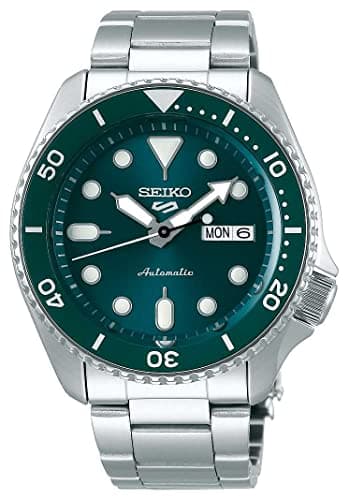
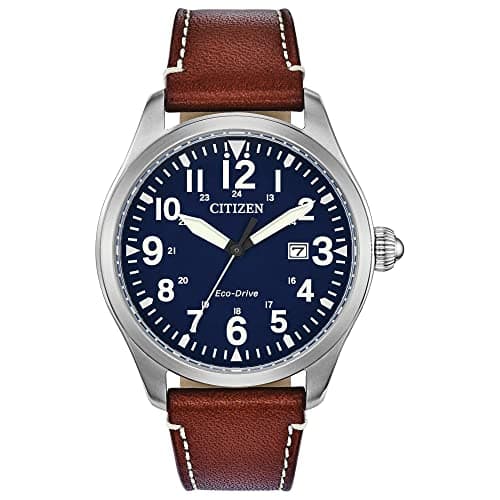
A solar watch converts light into stored power and runs a quartz movement. An automatic watch winds a mainspring from the motion of your wrist and runs a mechanical movement. On every measurable axis — accuracy, maintenance, reliability, cost of ownership — the solar watch wins, and it is not close.
And yet most people who care about watches buy automatics. That is not irrational. It is just that the thing being bought is not timekeeping accuracy; a phone in your pocket already does that perfectly. What an automatic sells is a mechanism, and mechanisms are why the hobby exists.
This page lays out the differences honestly and puts a benchmark of each below — the Citizen Eco-Drive Garrison and the Seiko 5 Sports SRPD — so you can compare the actual specifications rather than the arguments.
Accuracy: solar wins by an order of magnitude
A good quartz movement keeps time to within roughly 15 seconds a month. Seiko specifies its 4R36 automatic at approximately −35 to +45 seconds a day. Most automatics run far better than their specification in practice, but the gap is a factor of tens either way. If you want a watch that is simply right when you look at it, buy solar, and buy a radio-controlled one if you want it to be right to the second forever.
Maintenance: solar wins again
An automatic movement should be serviced roughly every seven to ten years — a full strip, clean, lubricate and regulate — and the cost is a meaningful fraction of an affordable watch's price. A solar watch has no such interval. The rechargeable capacitor lasts many years and is replaceable at a routine service when it eventually degrades. Over a fifteen-year horizon the solar watch is dramatically cheaper to own.
Where automatics genuinely win
Three places, and they are real. Longevity of the object: a mechanical movement contains no electronics and can, in principle, be repaired forever — a hundred-year-old watch can be brought back; a hundred-year-old capacitor cannot. Independence: an automatic needs nothing but motion, which is a quietly appealing property. The experience: the sweep of the seconds hand, the sound, the weight of the rotor. That is the actual product, and no amount of specification argument touches it.
The things people get wrong about both
"Solar watches die if you leave them in a drawer." A fully charged Eco-Drive runs for months in darkness, and many have a power-save mode that parks the hands and lasts far longer. "Automatics don't need batteries so they last forever." They need servicing, which costs more than batteries. "Solar is just cheap quartz." Citizen's Promaster and Skyhawk lines are among the most technically capable watches on this site.
How to choose in one question
Ask yourself why you want the watch. If the answer involves the word mechanism— you want to see the rotor, you like the idea of a machine on your wrist, you want something to hand on — buy an automatic. If the answer is any version of "I want a good watch that works and I do not want to think about it," buy solar. Both answers are correct; only one of them is correct for you.
Or buy one of each
It is the sensible outcome and it is cheaper than most people assume. A solar field watch for days you are not thinking about it and an automatic diver for days you are, on a shared strap collection, is a complete two-watch set for less than one mid-tier Swiss watch. See the solar picks and the automatic picks — or the best watches that need no battery, which ranks both technologies against each other in one list.
The practical complaint behind most of this comparison is an automatic that has stopped in a drawer. What that actually means, and how to restart one properly, is on do automatic watches need winding.