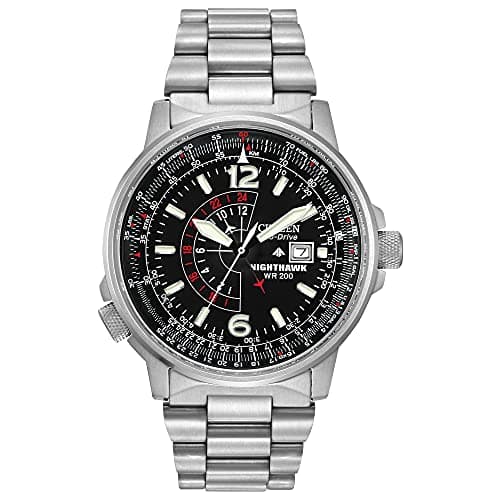
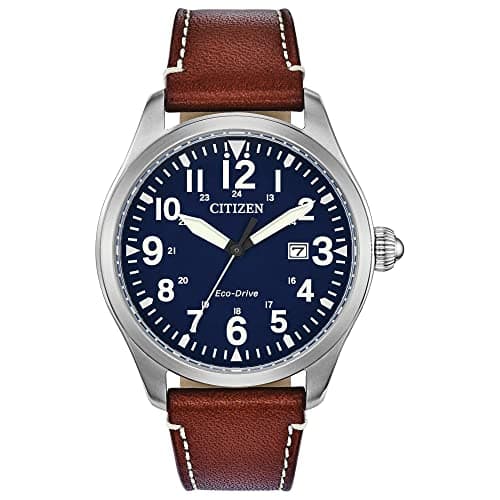
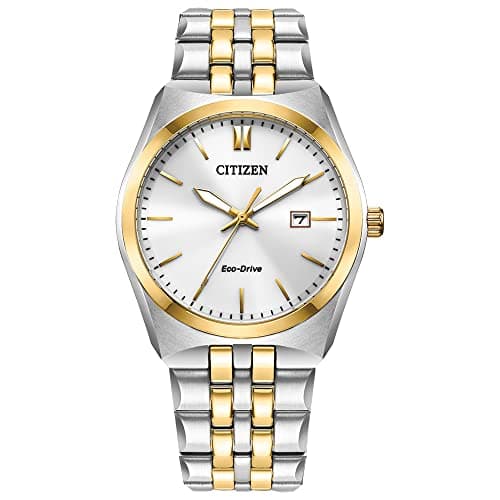
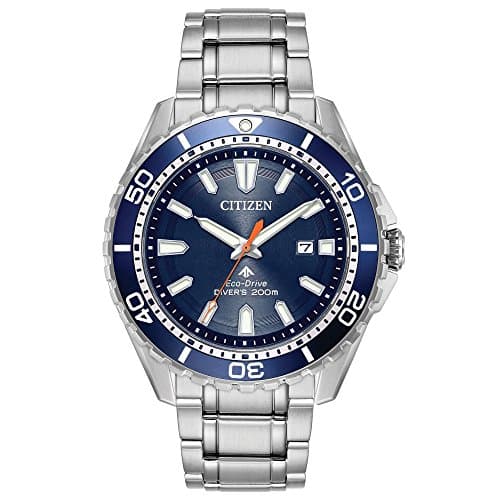
Eco-Drive is the reason Citizen is the brand people recommend when somebody says they never want to think about their watch again. It is not a battery technology and it is not a mechanical movement. It is a quartz watch whose power comes from light, through a cell hidden behind the dial, into a storage cell that holds the charge. Citizen launched the idea in the 1970s and has been building it into everything from forty-dollar-looking dress watches to atomic-timekeeping flight computers ever since.
How the system actually works
There are three parts. A photovoltaic cell sits under the dial, which is made translucent enough to pass light through to it. The cell converts that light into electricity. That electricity charges a rechargeable energy cell — not a disposable battery, a storage cell designed to be charged and discharged for the life of the watch. The cell runs an ordinary quartz movement. Everything you can see on the dial, including the hands and the date, is driven the way any quartz watch is driven. The only difference is where the electricity comes from.
This matters for a reason people miss: an Eco-Drive is as accurate as any other quartz watch, not more. The light is a fuel source, not a timekeeping improvement. If accuracy is what you are shopping for, the comparison that matters is quartz against automatic, not Eco-Drive against a battery.
How long it runs, and how long it takes to charge
Citizen's published figures are specific enough to plan around, and they vary by calibre, so treat these as the general shape rather than a promise about one model. Citizen states that a fully charged Eco-Drive runs for about six months in total darkness, and that some calibres with a power-save function run far longer — the company quotes up to seven years on certain movements and 365 days on the E365. Charging is faster than most people expect: Citizen's support pages give roughly 11 hours of bright direct sunlight for a full charge, about 40 hours on a cloudy day, and around 130 hours under a 30W indoor fluorescent light. Two minutes of direct sun buys about a day of running.
In practice this means a watch you wear with a shirt cuff over it, indoors, under office lighting, is charging slowly but constantly — and the one afternoon a week it sees daylight tops it up faster than a month of desk lamps.
The two warnings the watch gives you
Citizen builds two behaviours into most Eco-Drive calibres, and both look like faults if you do not know about them. The first is the insufficient-charge warning: when the stored charge runs low, the seconds hand starts moving in two-second jumps instead of ticking every second. The watch is not broken; it is asking for light. The second is power save: after a long stretch in the dark, the hands stop entirely to protect the charge, while the movement keeps correct time internally. Put it in light and the hands jump back to the right position on their own.
What goes wrong with light-powered watches
Three things, and they are worth knowing before you buy. Long dark storage. Citizen's own support guidance is not to leave an Eco-Drive in the dark indefinitely — one page advises keeping dark storage to no more than six months — because a fully depleted cell is bad for it. A watch in a drawer for two years is the one scenario where a cheap battery quartz is the less fussy object. Cell life. The storage cell is rechargeable, not eternal; it is a service item measured in many years, not a yearly battery swap, but it is not nothing. Dial design. The cell has to see light through the dial, which constrains what Citizen can do with dial materials — part of why Eco-Drive dials tend toward clean, flat finishes.
What to look for when you buy one
Eco-Drive is a power source, not a specification sheet, and the watches below it vary enormously. Check the four things that always decide a watch on this site. The water resistance, because Eco-Drive spans 50m dress watches and 200m ISO divers. The crystal — Citizen fits sapphire on the Brycen, the Skyhawk and some Promasters, and mineral on much of the rest. The lug width, and whether the watch has standard lugs at all, since the Nighthawk and the Skyhawk use integrated designs that limit you to what Citizen supplies. And the case size, which on the Promaster line runs to 45mm. The four picks below are chosen to cover one serious use case each: diving, flying, the field and the office.
Eco-Drive against Seiko Solar
They do the same job with the same physics, and the real differences are model-by-model rather than brand-by-brand. We put the two systems head to head on Citizen Eco-Drive vs Seiko Solar, and the wider ranking of every light-powered watch here is the best solar watches.
Eco-Drive against an automatic
The honest version: an Eco-Drive is the better tool and an automatic is the better object. A light-powered quartz keeps time you never correct, survives being ignored for weeks, and costs nothing to run. An automatic has a rotor, a service life measured in decades, and a reason to exist beyond function. Most people who ask this question want one of each. The long answer is on solar vs automatic, and if the winding question is what is bothering you, see do automatic watches need winding.
Is Citizen a good brand to buy into?
We think so, and we say why — including where Citizen's finishing lags Seiko's — on is Citizen a good watch brand. The brand's full line-up as we rank it is best Citizen watches.
What we are not claiming
Every charge figure and run-time figure on this page is Citizen's own published number, taken from the company's technology and support pages listed in the sources below, and Citizen's own pages note that figures differ by calibre. We have not measured a charge time ourselves and we do not publish a number we did not source. Our method is on how we review.