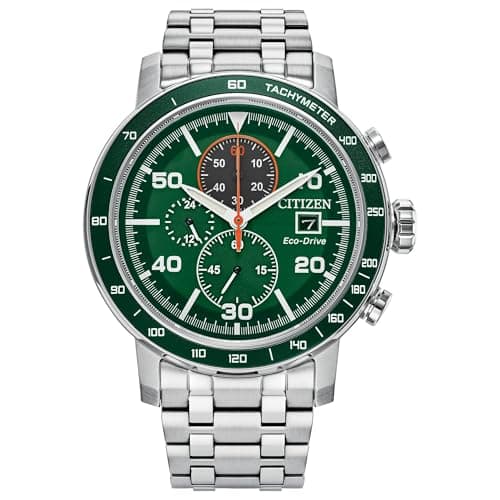
Citizen is the most quietly practical watch brand there is. While everyone else was arguing about mechanical movements, Citizen spent decades perfecting Eco-Drive — a watch that runs on light and never needs a battery — and then put it in every kind of watch it makes. Divers, pilot watches, chronographs, dress watches: all of them solar, all of them maintenance-free.
That is the reason to buy Citizen, and it is a genuinely good one. The reason people hesitate is that Citizen is not a brand with much romance attached. There is no equivalent of the Seiko SKX cult, no film collaborations, and the dials tend to prioritize function over charm. If what you want is a watch that works forever without thought, that is not a flaw.
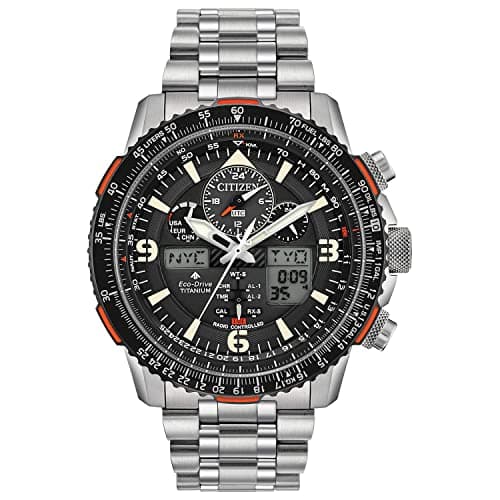
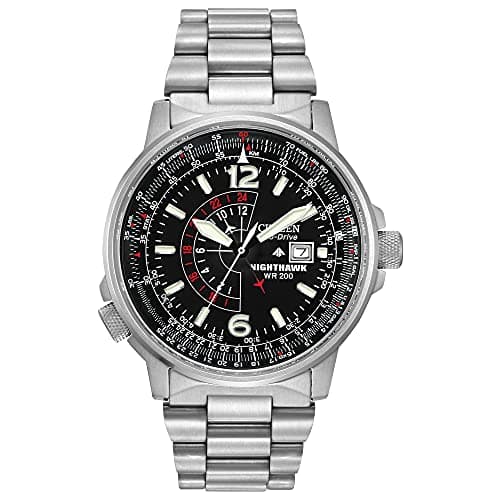
The short version: the Eco-Drive Nighthawk is the best watch Citizen makes for the money — dual time, a slide-rule bezel, 200m and solar power. The Promaster Dive Eco-Drive is the diver to buy if you want one you will never wind or service. And the Skyhawk A-T is the one for people whose travel justifies a watch that sets itself from a radio signal.
Eco-Drive, and why it is the whole argument
A photovoltaic cell sits under the dial and converts any light — daylight, office lighting, a desk lamp — into electricity, which charges a rechargeable cell that runs the movement. There is no battery to replace, which means the case is never opened at a counter and its water resistance is never quietly compromised by a poorly reseated gasket. On a watch you intend to swim in, that is worth more than it sounds.
The honest caveat: the rechargeable cell degrades over many years and is a workshop replacement rather than a two-minute swap. It is far rarer than a battery change and it is not never.
The Promaster line is the serious end
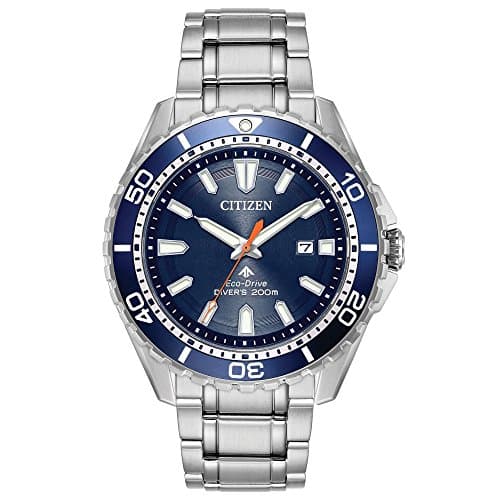
Promaster is Citizen's tool-watch range — the divers, pilot watches and field watches built to real specifications rather than styling. The Promaster Dive Eco-Drive here is ISO-compliant to 200m with a screw-down crown and caseback, which puts it in genuine dive territory alongside the Seiko Prospex line, and it does it while never needing a wind. If you buy one Citizen and want it to be a proper tool, buy a Promaster.
Where Citizen beats Seiko, and where it does not
Citizen wins on power source, breadth of solar range, and frequently on price for an equivalent specification. It also tends to fit sapphire more readily in the upper end of the range. Seiko wins on mechanical movements — Citizen's automatics exist but are not the brand's center of gravity — on lume, where Seiko is genuinely class-leading, and on the enthusiast aftermarket, where a Seiko has vastly more strap, bezel and dial support.
Case sizes run large — read the numbers
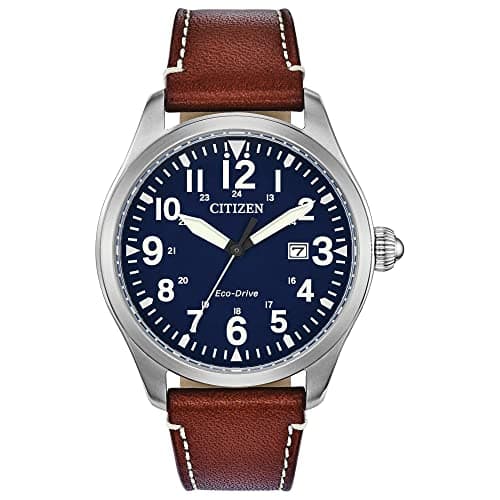
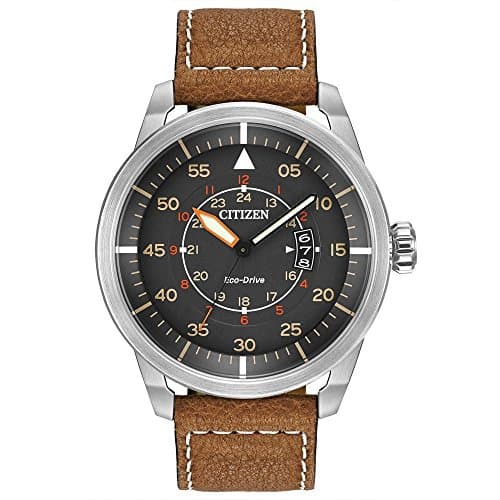
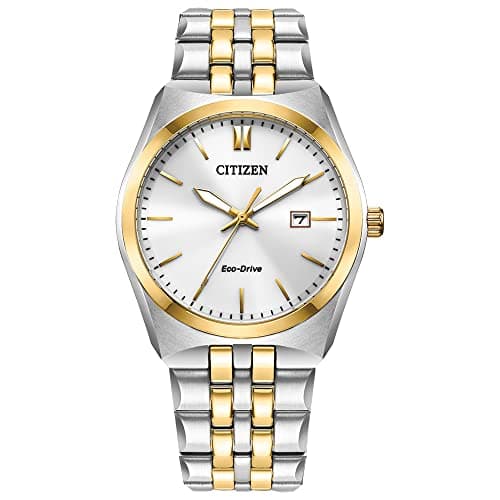
This is the one consistent complaint about Citizen and it is fair. The Skyhawk is 45mm, the Promaster Dive Eco-Drive is 45mm with a 48.8mm lug-to-lug, and the Nighthawk is a dense 42mm. If your wrist is under about 7 inches, the Garrison field watch, the Avion and the Corso are the picks to look at first — they are the ones built at classical proportions.
Legibility versus function
Citizen's design instinct is to add capability, which is why the Nighthawk carries two bezel scales and a dual-time track and the Skyhawk carries a digital display as well. These are superb instruments and they are not glance-and-go watches. The Avion and the Corso are the opposite — clean, three-handed, easy — and they are the ones to buy if reading the time quickly matters more to you than what else the watch can do.
Straps: mostly 20 and 22mm
Citizen sticks to standard widths, which means every watch here plugs straight into the strap aftermarket. The Promaster divers and the Skyhawk take 22mm; the field and dress picks take 20mm. Both are covered by our 20mm and 22mm strap guides, and the exact figure for each is in the spec table above.
Eco-Drive, since every watch here has it
Nine out of ten Citizens worth buying run on light, and the system is worth understanding before you spend: what is Eco-Drive covers how the cell charges, Citizen's published run time in the dark, and the two behaviours — power save and the two-second-step warning — that owners mistake for faults.