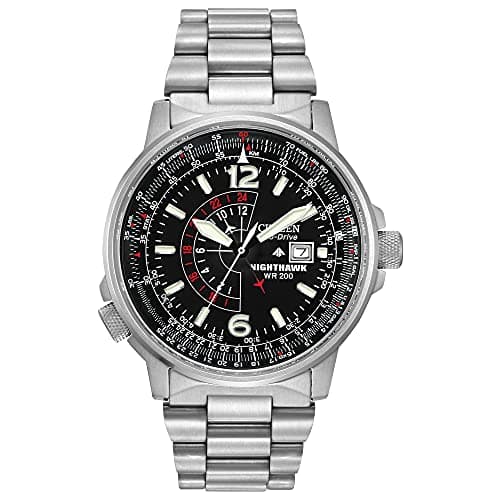
The Citizen Nighthawk has been the default answer to "what is a good affordable pilot watch" for the better part of two decades, and the reason is a spec sheet that does not add up at the price. It is rated to 200 meters — exceptional for a pilot-styled watch, and more than most dive watches on this site. It has a working slide-rule bezel, a dual-time 24-hour hand, and it runs on light, so it never needs a battery.
We do not own this watch and did not test it. What follows is compiled from Citizen's published specifications and the arithmetic of comparing it to its siblings, per how we review. It is also worth saying plainly what the Nighthawk is not: it is not a subtle watch, and it is not a strap-swapping watch.
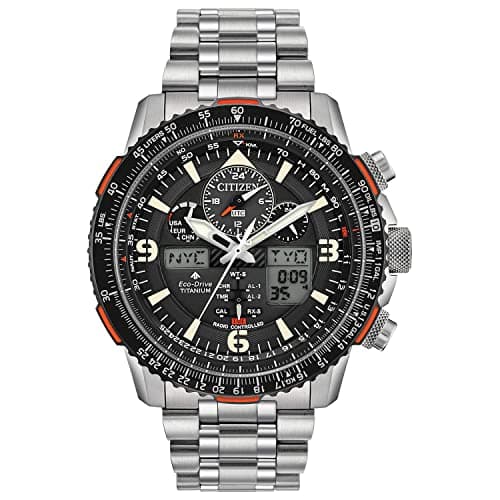
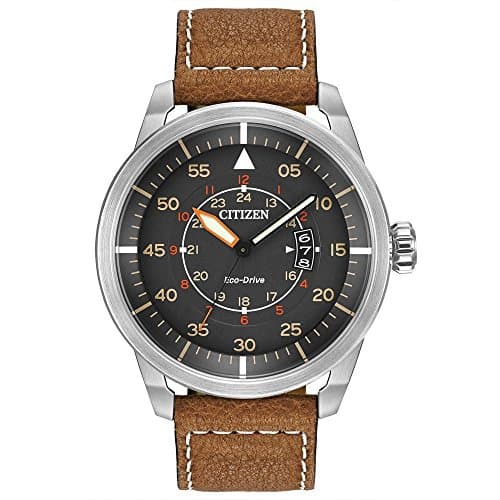
The verdict: if you want the most tool-watch capability per dollar and you like a busy, technical dial, the Nighthawk is close to unbeatable. If you want the same idea taken much further — atomic timekeeping, world time, a sapphire crystal — that is the Skyhawk A-T. If you want the pilot look without the complexity, the Avion is the clean, dressier answer for far less.
What the slide-rule bezel actually does
The rotating inner bezel on a pilot watch is a circular slide rule — the same logarithmic scale as the mechanical flight computers pilots trained on. Line up two numbers and you can multiply, divide, convert units, or work out fuel burn and ground speed. It is a genuine instrument, not decoration, and it works whether or not you fly. Most owners use it about twice and then simply enjoy that it is real. Be honest with yourself about which camp you are in before paying for it.
The 200m rating is the underrated part
Pilot watches are usually rated 50m or 100m, because aviation does not involve water. The Nighthawk's 200m rating means it is genuinely swimmable — you can wear one watch for everything, which is not true of most watches in this category. Combined with Eco-Drive (nothing to wind, no battery to fail), it makes an unusually strong single-watch case.
The real drawback: you cannot change the strap
On a site built around lug width, this is the honest criticism. The Nighthawk's case and bracelet are effectively integrated, so the aftermarket-strap game that makes watches like the Seiko 5 or Khaki Field so fun is simply not available here. You buy the Nighthawk as a finished object. If swapping straps is a large part of why you enjoy watches, that alone should push you toward the Avion — or toward a different pilot watch entirely.
Mineral crystal, and whether it matters
The Nighthawk uses mineral glass rather than sapphire. At this price that is normal, but the Skyhawk above it has sapphire, and sapphire is the upgrade you notice over years of ownership because it is the part that scratches. If you are hard on watches and the budget stretches, that difference is a real argument for the Skyhawk beyond its extra functions.
Legibility: the honest trade-off
A dial carrying a slide rule, a 24-hour track, a date and a dual-time hand is a busy dial. The Nighthawk manages it better than most, with strong contrast and good hands, but it will never be as instantly readable as a field watch. That density is the product — it is what you are buying — but if you want to read the time at a glance in poor light, a plain dial does it better.
Nighthawk or Skyhawk?
The Skyhawk A-T does everything the Nighthawk does and adds radio-controlled atomic timekeeping synced to 43 world cities, a UTC display, a perpetual calendar, a chronograph, alarms, a countdown timer and a sapphire crystal — for substantially more money and in a larger 45mm case. If you travel and want a watch that is always correct without being set, the Skyhawk earns its premium. For most buyers, the Nighthawk is the better value and the easier watch to live with.