A pilot watch is a legibility exercise with a specific history. The design brief was a dial that could be read instantly in a vibrating, badly lit cockpit by someone wearing gloves — which produced oversized Arabic numerals, a triangle at twelve, long luminous hands and, on the aviation-computer models, a rotating slide-rule bezel for fuel and speed calculations.
Under five hundred dollars the field is smaller than the marketing suggests, because a great many watches sold as "pilot" watches are simply large watches with a numeral at every hour. The three below have a genuine claim: a working slide rule, a proper aviation dial, and a flieger layout that traces directly back to the type-B observation watches of the 1940s.
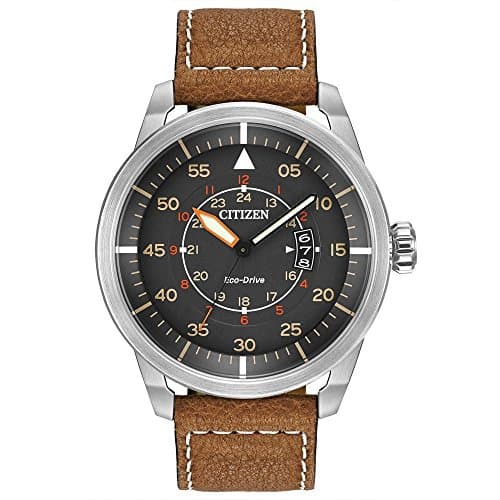
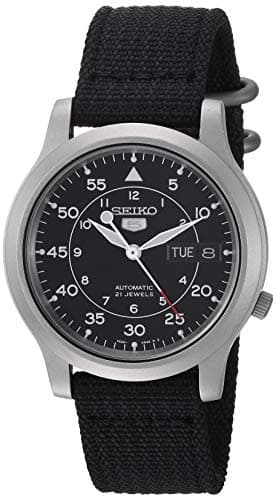
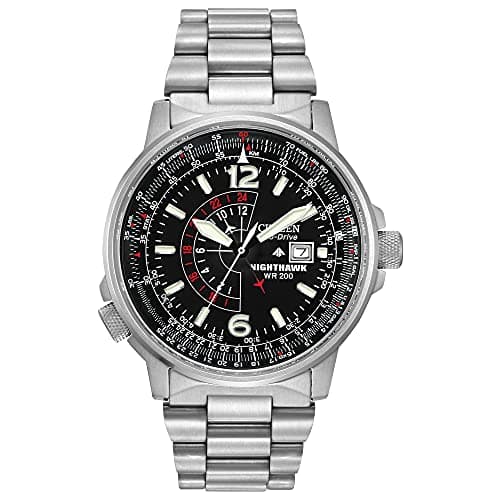
The short version: the Citizen Promaster Nighthawk is the best pilot watch value at any price — a working slide rule, 200m water resistance and Eco-Drive, so it never needs a battery. The Citizen Avion is the same idea with a cleaner dial for people who will never use a slide rule. And the Seiko 5 SNK809 is a 37mm mechanical flieger, and the smallest watch here — though it is discontinued, and its surviving listing now asks far more than the watch was famous for costing.
What a slide-rule bezel actually does
It is a circular logarithmic scale — the same mathematics as an old engineering slide rule — wrapped around the dial. Line up two numbers on the rotating and fixed scales and you can multiply, divide, and convert units without electronics: fuel burn against flight time, nautical miles to kilometers, currency, tips. Almost nobody uses one for its intended purpose in 2026. It is still the feature that makes the Nighthawk look like an instrument rather than a watch with a busy bezel.
Flieger, Navitimer-style, and the two dial traditions
There are really two pilot-watch families. The flieger is German in origin and utterly minimal: black dial, huge white numerals, a triangle at twelve, nothing else — the Seiko SNK809 is a direct descendant. The aviation computer family is American and Swiss, busy with scales and sub-dials, and the Citizen Nighthawk belongs to it. They look nothing alike and both are correct.
Eco-Drive is the specification advantage here
Both Citizens run on light. Eco-Drive charges from daylight and indoor light and holds a substantial reserve in the dark, so there is no battery to replace and no seal to break replacing it — which on a 200m watch like the Nighthawk genuinely matters. Over a decade of ownership that is the difference between a watch you maintain and a watch you simply wear.
Size, and why the Seiko is the outlier
Pilot watches trend large because the original brief demanded a big dial. Both Citizens here are 42mm. The Seiko SNK809 is 37mm with a 46mm lug-to-lug and an 18mm lug width, which makes it one of the few genuinely small mechanical watches left and the obvious pick for a wrist under about 6.5 inches. It is also the only mechanical watch of the three.
What you give up under $500
Mostly the crystal and the movement finishing. All three of these use mineral or Hardlex rather than sapphire, so expect hairlines over the years. The SNK809's 7S26 movement does not hack or hand-wind, which is a real limitation — you cannot set the seconds precisely and you cannot start it without shaking it. And the SNK809 is rated to 30m, which means splashes and nothing more.
Strap it correctly
The pilot tradition is a wide leather strap, often with rivets, and it suits all three. The Avion takes 20mm and the SNK809 takes 18mm — a narrower width that limits choice, so check before you buy. Citizen does not publish a lug width for the Nighthawk's integrated bracelet design, so we show a dash rather than guess. Our leather strap guide covers the options, and the lug width chart lists confirmed figures by model.