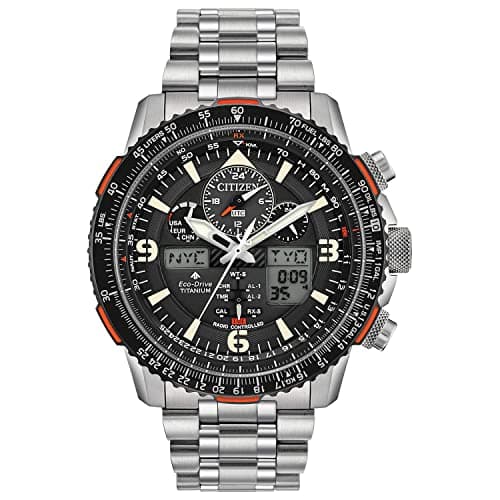
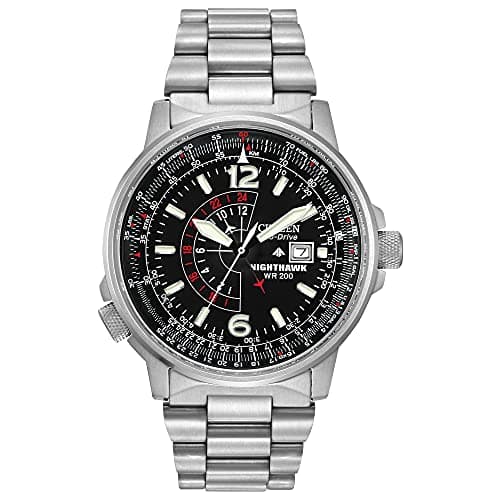
These two get cross-shopped constantly and the difference between them is easy to state: the Skyhawk sets itself. Both are Citizen Promaster aviation watches with slide-rule bezels, both run on light, and both are rated to 200 meters. The Skyhawk adds radio-controlled atomic timekeeping, world time, a sapphire crystal and about four hundred dollars.
A note on method. We do not own either watch and we did not test them. What follows is built from Citizen's published specifications and the aggregated pattern of owner reports, compared side by side — the method set out on how we review. Where a figure could not be verified we print a dash rather than a guess, which is why the Nighthawk's lug width is blank in the table.
The short version: buy the Nighthawk unless you specifically want a watch you never set. It has the same slide rule, the same 200m case and the same Eco-Drive movement for well under half the money. Buy the Skyhawk if atomic accuracy, world time and sapphire are worth the difference to you — for frequent international travelers, they often are.
Atomic timekeeping is the actual difference
The Skyhawk receives a radio time signal broadcast from an atomic clock and resets itself to it, in the regions where those transmitters exist — North America, Japan, China and Europe. You never set it, it is never wrong, and it handles daylight saving and time zone changes on its own. The Nighthawk is a very good quartz watch that you set yourself, twice a year and after every flight.
World time versus a single second zone
The Skyhawk carries a world-time function covering major cities, which is a different proposition from a GMT hand: you select a city and the watch shows that zone, rather than tracking one fixed second zone continuously. For someone who moves between many zones that is genuinely more useful. For someone who lives in one place and calls one other, a GMT watch does the job for a fraction of the price.
Sapphire versus mineral
The Skyhawk uses a sapphire crystal; the Nighthawk uses mineral. On a watch worn every day for a decade this is a real difference — mineral collects hairline scratches from doorframes and desk edges, and sapphire effectively does not. It is the least exciting line on the comparison and one of the two you will still notice in ten years.
Size: both are large, one is larger
The Nighthawk is 42mm, which is a manageable size for a busy aviation dial. The Skyhawk is 45mm with a 22mm lug width, which is a lot of watch and needs a wrist of roughly 7 inches or more to look right. If you are between sizes, this is the strongest argument for the Nighthawk that has nothing to do with money.
Where the Avion fits
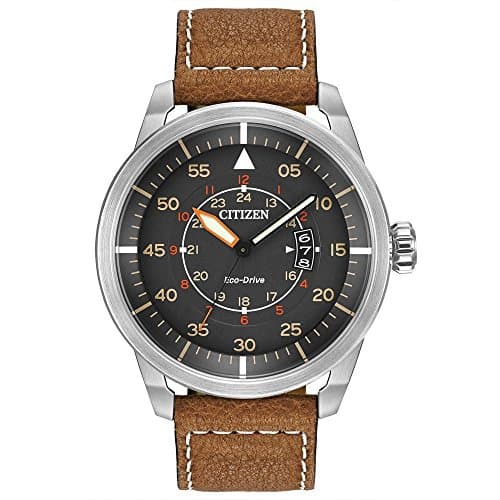
The Citizen Avion is the third option people should consider and usually do not: the same Eco-Drive technology and aviation styling with a clean, uncluttered dial and no slide rule, at 42mm with a 20mm lug width and a 100m rating, for less than the Nighthawk. If the slide rule is the part you were never going to use, it is the more legible watch and the cheaper one.
What both share, and why either is a good buy
Both run on light, so neither needs a battery replaced or a 200m case opened and resealed. Both carry a real 200-meter water-resistance rating, which is well beyond what an aviation watch requires. And both have the slide-rule bezel that gives the family its instrument character. Whichever way this decision goes, you end up with a watch that will still be running and still be accurate in fifteen years.