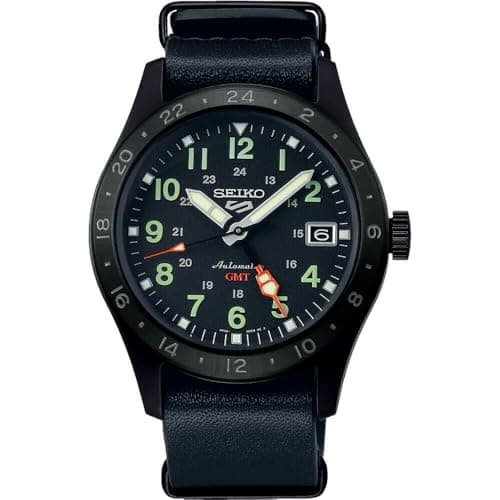
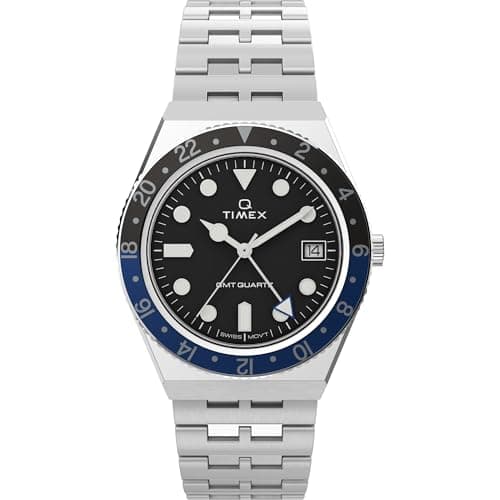
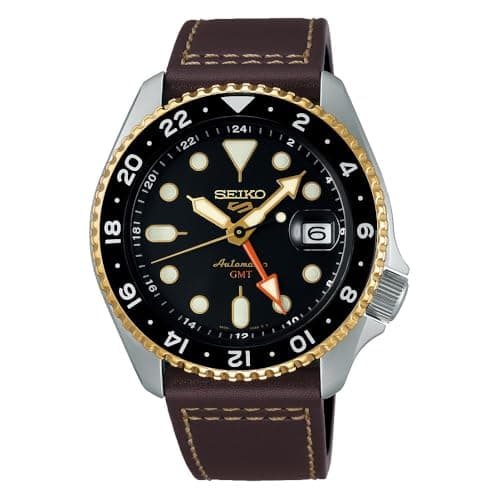
Until 2022 a mechanical GMT watch under a thousand dollars barely existed. Then Seiko put its 4R34 caliber into the Seiko 5 Sports case and the entire category changed overnight. This page is deliberately short, because the honest field under five hundred dollars is three watches deep — and padding it out with watches that merely have a 24-hour hand would be lying to you.
A GMT watch tracks a second time zone with an extra hand that sweeps the dial once every 24 hours, read against a 24-hour scale on the bezel or the chapter ring. It is the most genuinely useful complication in watchmaking for anyone who travels, works across time zones or calls family abroad, and it is far easier to read at a glance than doing the arithmetic in your head.
The short version: the Seiko 5 Sports GMT SSK036 is the colorway of the line that broke the price barrier you can actually buy right now — black dial, 42.5mm, on a leather strap — and still the answer if you want a real mechanical GMT with a rotating 24-hour bezel. The SSK025 takes the identical 4R34 movement and puts it in a 39.4mm field case on 20mm lugs, which is the better buy on a smaller wrist. And the Timex Q GMT gives you the function in quartz at 38mm for well under half the money.
Caller GMT or traveler GMT — the difference that matters
A traveler GMT lets you jump the local hour hand forward or back in one-hour steps without stopping the watch, which is what you want when you land somewhere new. A caller GMT does the opposite: the local hand is fixed and you adjust the 24-hour hand instead, which suits someone who stays put and calls elsewhere. Seiko's 4R34 is a caller GMT. If you fly often and this matters to you, know it before you buy rather than after.
How to actually use the 24-hour hand
Set the main hands to local time as normal. Set the 24-hour hand to your home time zone, reading it against the 24-hour bezel or chapter ring — note that on a 24-hour scale, 15:00 sits where 3 o'clock would be on the main dial. If the bezel rotates, you can then turn it to track a third zone, which is why pilots and traders have used the layout for seventy years.
What the Seiko 4R34 is, and is not
It is the standard Seiko 4R automatic with a GMT module: it hacks, it hand-winds, it runs a date, and Seiko rates it at roughly minus 35 to plus 45 seconds a day. It is not a chronometer and it is not a traveler GMT. What it is, is the only mechanical GMT movement available in a watch at this price from a manufacturer with a real service network — which is precisely why the SSK line sold the way it did.
Quartz GMT is a completely legitimate answer
The Timex Q GMT gives you the complication with better accuracy and a much smaller 38mm case, for well under half the price of the Seikos. What you give up is the mechanical movement and the 100m rating — the Timex is 50m with an acrylic crystal, which is splash-and-rain rather than swimming, and acrylic scratches easily even if it also polishes out. For a watch bought specifically to track a second zone, none of that may matter.
Size, and the strap that follows from it
The two Seikos are 42.5mm with a 46mm lug-to-lug and a 22mm lug width; the Timex is 38mm with an 18mm width. That is a large gap, and it is the main practical difference between them beyond the movement. Both widths are standard and well served by the aftermarket — our 22mm and 18mm guides cover the options, and a nylon strap suits the travel use case better than a bracelet does.
Why this list is only three long
Because it should be. There are plenty of watches sold as GMTs that simply have a printed 24-hour track and no independent hand, and plenty more with a fourth hand that cannot be set separately at all. Neither does the job. We would rather publish three watches that genuinely track a second time zone than pad the page to eight with watches that only look like they do.
How we picked
We do not run a testing lab
We compiled the published manufacturer specifications for every watch here — case size, lug-to-lug, lug width, water resistance, movement and crystal — did the wrist-fit and value math, and scored each pick against a published rubric. The scores are judgments from documented research — they are not measurements we took or wrist-time we logged, because we do not have these watches and we are not going to pretend we do. Where a spec could not be verified we wrote "data unavailable" rather than guessing.