When Seiko launched the 5 Sports GMT in 2022 it did something that had not happened in affordable watches for a long time: it took a complication that started at four figures and put it in a few-hundred-dollar watch, using a new movement — the 4R34 — built for the purpose. It is, on the numbers, one of the best value propositions in mechanical watches.
There is one word that decides whether it is the right GMT for you, and it is caller. This watch lets you set the 24-hour hand independently while the local hour hand stays put. That is the layout for watching a second zone from home. It is not the layout for landing in a new country and changing local time quickly, which is what a flyer GMT does — and flyer GMTs cost several times more.
A note on method: we do not own this watch and did not test it. What follows is built from Seiko's published specifications for the 4R34 and the SSK references, compared against the direct alternatives, per the approach on how we review. Unverified figures are marked rather than filled in.
How the 4R34 actually works
The 4R34 is Seiko's automatic GMT caliber: it hacks, it hand-winds, it carries a date, and it holds a power reserve of around 41 hours. The fourth hand circles the dial once every 24 hours and reads against the bezel. To set a second timezone you pull the crown to the first position and turn — the 24-hour hand moves, everything else stays where it is.
To use it well, most owners set the 24-hour hand to home time and read local time conventionally from the main hands. Rotating the bidirectional bezel then gives you a rough third zone, which is a genuinely useful trick and one the more expensive fixed-bezel GMTs cannot do.
SSK001, SSK003, SSK005, SSK036 — and which one you can actually buy
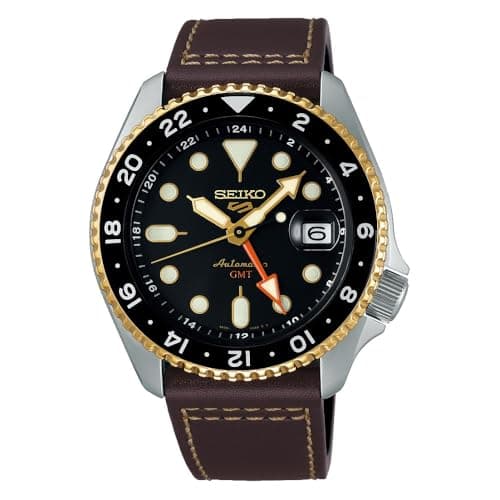
Seiko sells the SKX-cased 5 Sports GMT in several colorways and nothing separates them mechanically. Every one is 42.5mm with a 46mm lug-to-lug, a case around 13.6mm thick, a 22mm lug width, 100m water resistance, a Hardlex crystal and the same 4R34 movement. The SSK001 is the black dial, the SSK003 the blue, the SSK005 the orange sunray dial with a two-tone 24-hour bezel, and the SSK036 a later black-dial release. The first three ship on the five-row steel bracelet with a push-button three-fold clasp; the SSK036 comes on a leather strap.
The practical answer is narrower than the catalog, because availability moves. At our last check the SSK001, SSK003 and SSK005 listings all read currently unavailable, and the black-dial SSK036 was the one colorway of this case in stock at a normal price — so that is the watch priced and linked at the top of this page. It is the same watch mechanically; what you give up against the earlier references is the bracelet, and a 22mm one is an inexpensive fix. If you specifically want the orange SSK005 or the blue SSK003, this is a watch to buy from a Seiko dealer rather than from a marketplace listing.
The other live option: the field-cased SSK025
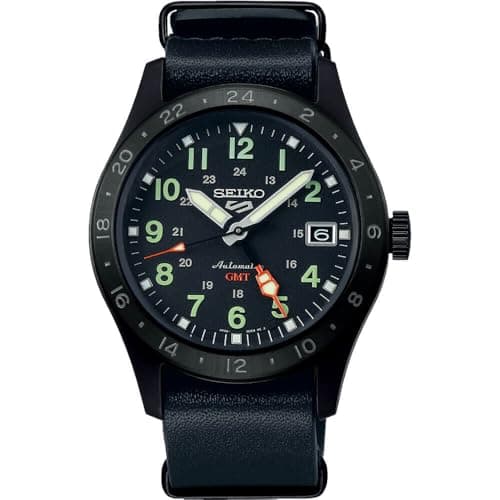
Ranked second here, and the more interesting watch for a lot of people. The SSK025 takes the same 4R34 caller-GMT movement out of the diver case and puts it in a 39.4mm field case with a plain 24-hour chapter ring instead of a bezel, a curved Hardlex crystal, the same 100m rating and a calfskin band on 20mm lugs. Seiko publishes a 13.6mm thickness and a 47.9mm lug-to-lug, and that second figure is the honest catch: it spans nearly as much wrist as the 42.5mm diver despite looking much smaller on paper — the arithmetic behind that is on what size watch to buy for your wrist.
Buy the SSK025 if you want the complication in a dressier, more wearable package and would rather put it on one of the 20mm field straps than a diver bracelet. Buy the SSK036 if you want the rotating bezel for a rough third time zone and the bigger wrist presence — and budget for a 22mm bracelet if that is the look you are after.
The 100m rating, and what it excludes
Like the rest of the Seiko 5 Sports line, this is a 100m watch without a screw-down crown. Swim in it, shower in it, get caught in the rain in it. Do not treat it as a dive watch — the bezel is bidirectional, which is right for a GMT and wrong for timing a dive, and the crown is gasket-sealed rather than screwed down.
Size and fit
At 42.5mm with a 46mm lug-to-lug and a case around 13.6mm thick, it wears like the Seiko 5 Sports diver it is based on — comfortably on a 7-inch wrist, snugly on a 6.75, and awkwardly below about 6.5. The 22mm lug width is the good news: this watch drops straight into the largest strap aftermarket there is, so whatever band the SKX-cased GMT ships on — the five-row bracelet on the SSK001/003/005, leather on the SSK036 — is a starting point rather than a commitment. If 46mm of lug-to-lug is already too much watch, the 39.4mm SSK025 is the version of this movement to buy.
Against the Timex Q GMT
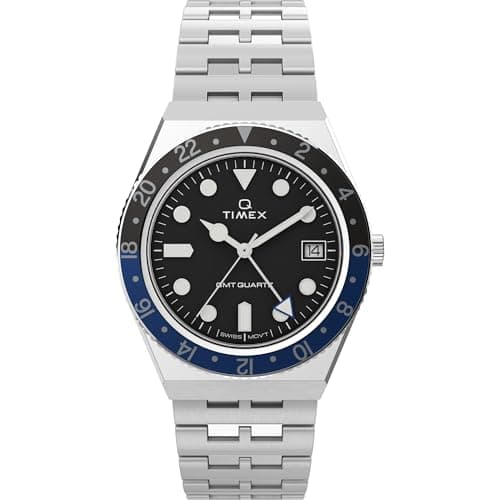
The Timex is quartz, 38mm, and costs a fraction of the Seiko. It has a true 24-hour GMT hand and a bidirectional bezel, so functionally it does the same job with better accuracy and a case that fits more wrists, though on a narrower 18mm lug width. What it does not have is a mechanical movement, and that is the entire reason to spend three or four times more on the Seiko. If the mechanism does not matter to you, buy the Timex and do not look back.
Who should buy it
Buy the Seiko 5 Sports GMT if you want a mechanical GMT and are not a frequent flyer — if your use case is "what time is it at home / at head office / where my family is." Skip it if you land in new time zones regularly, in which case you want a flyer GMT and should save toward one, or if you want maximum function per dollar, in which case the Timex or a Citizen Eco-Drive does more for less.