A GMT watch is a watch with a fourth hand that completes one rotation every 24 hours instead of twelve, read against a 24-hour scale on the bezel or the dial. Set that hand to a second time zone and you can read home time and local time at a glance — and, because the scale is 24 hours, whether it is day or night in the other place. Rotate the bezel and you can track a third.
The name is Greenwich Mean Time, the reference from which every time zone is counted, and the complication was invented for airline pilots. In the mid-1950s Pan American Airways asked Rolex for a watch its crews could use to keep home time and local time on long-haul flights; the result was the 1955 GMT-Master, with a 24-hour hand and a rotating 24-hour bezel, and the layout has barely changed since. What has changed is the price: a mechanical GMT from a major brand now starts under $500, and a quartz one under $250.
Below: the two kinds of GMT movement and why the difference matters more than the brand, then the three GMTs that show the complication best at three prices, then a step-by-step on setting and using one.
What to look for: caller or flyer
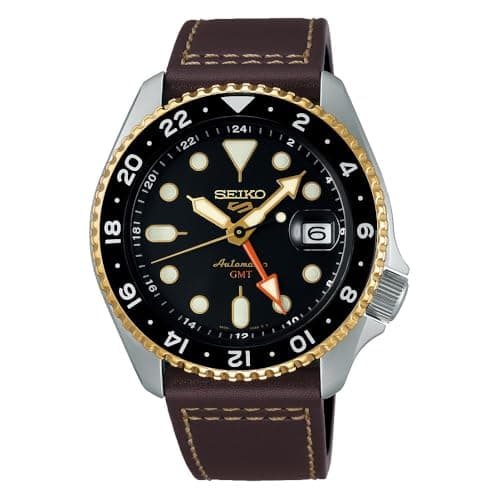
Every GMT has the same hands. What differs is which one moves when you adjust the watch, and that decides who the watch is for. On a caller GMT — sometimes called an office GMT — the 24-hour hand is set independently while the main hands stay put. That is the right layout for someone who stays home and needs to know the time somewhere else: set the GMT hand to the colleague's zone and forget it. The Seiko 4R34 in the Seiko 5 Sports GMT works this way.
On a flyer GMT — a "true" GMT — the local hour hand jumps in one-hour steps independently, while the 24-hour hand stays on home time and the watch keeps running. That is the right layout for someone who actually changes time zones: land, jump the hour hand to local time, done, with home time still on the 24-hour hand. Flyer movements cost more and are rare under $1,000, which is why every GMT on this site is a caller and why we say so on each page.
Beyond that, look for the things that make any tool watch work: a rotating 24-hour bezel if you want a third zone, a 24-hour hand in a contrasting color so it does not get lost among the others, and — on the mechanical ones — a movement that hacks so you can set it to the second. Lug width decides the strap as on every other watch; the Seiko takes 22mm, the Timex 20mm.
The short answer
Quick picks
#ad · Live prices from the Amazon Product API, as of Sep 18, 2026. Where we have no verified live price, we show none — we would rather leave a gap than print a number that has rotted.
Side by side
The spec table
Every published number that decides fit and function — including the lug width, so you know which strap fits before you buy.
In detail
The picks, in full
An affordable mechanical GMT
Seiko 5 Sports GMT (SSK036)
42.5mm22mm lug100m4R34 GMT
A true mechanical GMT for a few hundred dollars — a price that used to be impossible.
- Legibility
- 8
- Build
- 8
- Movement
- 9
- Versatility
- 8
- Value
- 9
Pros
- +A genuine caller-GMT mechanical movement at a price no other brand matches
- +Tracks a second timezone off the 24-hour hand and bezel — real travel utility
- +The SKX-derived case is comfortable and familiar
Cons
- −It is a 'caller' GMT (the GMT hand jumps, not the hour hand) — less convenient for frequent flyers
- −Hardlex and 100m keep it just short of a full tool-watch spec
Skip this one if…
…you never cross a timezone. A GMT you don't use is just a busier dial — one of the plainer divers will serve you better and cost less.
GMT function on a budget
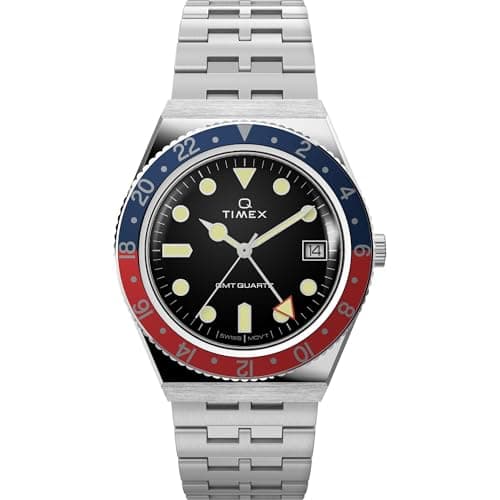
Timex Q GMT
38mm20mm lug50mQuartz GMT
A 38mm quartz-GMT throwback with a great price and a real second-timezone hand.
- Legibility
- 8
- Build
- 6
- Movement
- 7
- Versatility
- 8
- Value
- 9
Pros
- +A working GMT complication for a fraction of any mechanical GMT's price
- +38mm case and vintage styling that wears easily
- +Quartz accuracy and a battery hatch you can open yourself
Cons
- −Acrylic crystal and Timex-level finishing
- −The bracelet is divisive and many owners swap it immediately
Skip this one if…
…you want the mechanical GMT experience or better water resistance. The Seiko SSK036 is the real-movement upgrade when you're ready.
Serious travel & world time
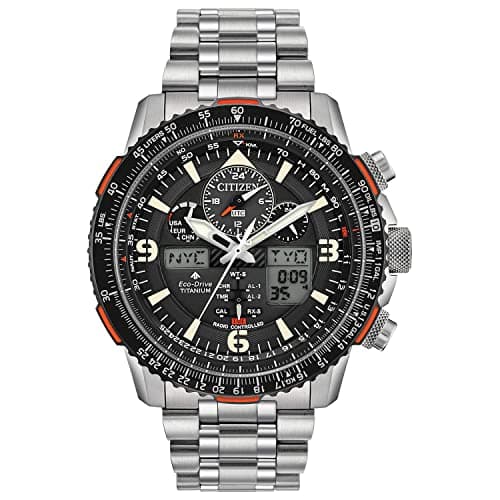
Citizen Promaster Skyhawk A-T
45mm22mm lug200mEco-Drive · atomic
The most watch on this site by function count: atomic-set world time, UTC, and a slide rule.
- Legibility
- 7
- Build
- 9
- Movement
- 9
- Versatility
- 6
- Value
- 7
Pros
- +Radio-controlled atomic timekeeping synced to 43 world cities, plus a UTC display and dual time
- +Sapphire crystal and 200m water resistance — genuinely tool-grade for a pilot watch
- +Perpetual calendar, chronograph, countdown timer and two alarms, all on solar power
Cons
- −45mm and busy — the analog-digital dial takes real learning and the manual is not optional
- −The most expensive tool watch here by a distance
Skip this one if…
…you want a watch you can read at a glance. The Skyhawk's whole point is density of function; a plain GMT tells you the second timezone faster.
Step by step
How to use a GMT watch
- 1
Set local time on the main hands
Pull the crown to the time-setting position and set the hour and minute hands to your local time as you would on any watch. On a caller GMT this also moves the 24-hour hand, so set local time first and the GMT hand second.
- 2
Set the 24-hour hand to your second time zone
Move the crown to the GMT-setting position and advance the 24-hour hand until it points to the second time zone on the 24-hour scale — the bezel or the inner track. Read it on a 24-hour clock: 3pm is 15, not 3. Leave the bezel with 24 at the top for now.
- 3
Read both zones at a glance
The main hands show local time on the 12-hour dial. The 24-hour hand shows the second zone against the 24-hour scale, and because it goes round once a day it also tells you whether it is day or night there — which is the actual reason the scale is 24 hours.
- 4
Add a third zone with the bezel
If the bezel rotates, turn it by the number of hours the third zone differs from the second zone — forward if it is ahead, back if it is behind. The 24-hour hand now reads the third zone against the rotated bezel. Reset the bezel to 24 at the top to read the second zone again.
- 5
When you travel, adjust the right hand
On a caller GMT, re-set the main hands to the new local time and leave the 24-hour hand on home time. On a flyer GMT, jump the hour hand in one-hour steps to the new local time without stopping the watch; the 24-hour hand stays on home time automatically.
How the 24-hour hand actually works
A normal hour hand goes round twice a day, which is why a 12-hour dial cannot tell you whether it is 3am or 3pm. The GMT hand is geared to go round once, so its position against a 24-hour scale is unambiguous: pointing at 15 means three in the afternoon. On the original GMT-Master the hand was set to Greenwich time, which is where the name comes from, but there is nothing special about Greenwich — you set it to whichever zone you want to keep.
The 24-hour scale lives either on the bezel, on the dial, or both. A watch with the scale on a rotating bezel — the Seiko 5 GMT and Timex Q GMT layout — shows a second zone with the bezel at 24-up and a third by rotating the bezel by the offset between them; you read one zone at a time and remember the offset. A watch with a fixed scale and no bezel shows two zones and stops there.
GMT vs world time vs dual time
A GMT tracks one extra zone with a hand. A world timer shows all 24 zones at once on a rotating city disc, and the Citizen Skyhawk ranked here is the affordable version of that idea, with radio-controlled setting and a UTC display. A dual time watch uses a second small dial for the second zone — a different mechanism for the same result. If you regularly deal with one other place, a GMT is the simplest; if you deal with several, a world timer earns its complexity. Our chronograph vs GMT page covers the other complication people weigh it against.
Mechanical or quartz GMT?
A mechanical GMT — the Seiko 4R34 — is the enthusiast's choice and, at the Seiko's price, a genuine bargain: until it launched, a mechanical GMT under $500 from a major brand did not exist. A quartz GMT — the Timex Q GMT — is more accurate, thinner and cheaper, and gives up nothing in function. The Skyhawk goes further: it sets itself by radio and never needs a battery. Our best GMT watches roundup ranks the whole field, and the under-$500 page covers the bracket where most people are shopping.
The GMT as a compass, and other things people ask
In the northern hemisphere, point the 24-hour hand at the sun and south is at 12 on the 24-hour scale — because the hand goes round once a day, like the sun. It is a real trick and roughly accurate, and it is the one party piece a GMT has that a chronograph does not. The 24-hour hand can also simply be used as an AM/PM indicator on a watch you never take off, which is what a surprising number of owners end up doing.
The three GMTs that show the complication best
The Seiko 5 Sports GMT is the mechanical answer: the 4R34 caller movement, a rotating 24-hour bezel for a third zone, 22mm lugs, and the price that made the whole category affordable. Our Seiko 5 GMT review goes through it in full. The Timex Q GMT is the quartz answer: a 38mm case, a real 24-hour hand and bezel, an acrylic crystal and a 1970s look, at well under half the Seiko's price. And the Citizen Skyhawk is the world-timer answer for people who need more than one extra zone — radio-set, solar, with a slide rule, and the most watch by function count on this site.
How we picked
We do not run a testing lab
We compiled the published manufacturer specifications for every watch here — case size, lug-to-lug, lug width, water resistance, movement and crystal — did the wrist-fit and value math, and scored each pick against a published rubric. The scores are judgments from documented research — they are not measurements we took or wrist-time we logged, because we do not have these watches and we are not going to pretend we do. Where a spec could not be verified we wrote "data unavailable" rather than guessing.
Questions
Frequently asked
What is a GMT watch?+
A watch with a fourth hand that rotates once every 24 hours, read against a 24-hour scale on the bezel or dial. Set it to a second time zone and you can read home and local time at once, and see whether it is day or night in the other place. With a rotating bezel you can track a third zone. It was invented in 1955 as the Rolex GMT-Master, for Pan Am's long-haul pilots.
What does GMT stand for on a watch?+
Greenwich Mean Time, the reference from which time zones are counted. The original GMT-Master's extra hand was set to Greenwich time so pilots had a fixed reference; on a modern GMT you set the hand to whichever zone you want — home, a colleague's office, anywhere — and Greenwich itself is irrelevant.
What is the difference between a caller GMT and a flyer GMT?+
Which hand adjusts independently. On a caller (or office) GMT the 24-hour hand is set on its own while the main hands stay put — right for someone at home tracking another zone. On a flyer (or true) GMT the local hour hand jumps in one-hour steps while the 24-hour hand stays on home time — right for someone who changes zones. Flyer movements cost more and are rare under $1,000; every GMT ranked on this site, including the Seiko 4R34, is a caller.
How do you set a GMT watch?+
Set local time on the main hands first, then move the crown to the GMT position and advance the 24-hour hand to the second zone, reading it on a 24-hour clock — 3pm is 15. Leave the bezel at 24-up. To add a third zone, rotate the bezel by the hour difference from the second zone and read the 24-hour hand against the bezel. The numbered steps above go through it.
Can you use a GMT watch as a compass?+
Roughly, in the northern hemisphere. Point the 24-hour hand at the sun and south lies at the 12 on the 24-hour scale, because the hand and the sun both go round once a day. It is a genuine technique and accurate enough to orient yourself; it is not a substitute for a real compass.
Is a GMT watch worth it?+
If you regularly need the time somewhere else — a remote team, family abroad, travel — yes, and it is the most useful complication after the date. If you do not, the 24-hour hand becomes an AM/PM indicator, which is harmless but not worth paying for. The Seiko 5 Sports GMT made a mechanical GMT affordable; the Timex Q GMT makes the function available for less than a good strap and a bracelet.
Receipts
Sources
We do not run a testing lab, and we do not pretend to. Every spec above traces to a manufacturer listing or a named standard; where we could not verify something, we say so on the page rather than quietly leaving it out. Read our full method.