A chronograph is a watch with a built-in stopwatch. It tells the time like any other watch, and separately — started, stopped and reset with the two pushers either side of the crown — it measures elapsed time on a large central seconds hand and one or more small subdials for minutes and hours. The word means "time writer," because the first one, Nicolas Rieussec's 1821 device built to time horse races for the French king, literally marked the dial with a drop of ink.
It is the most popular complication after the date and the one most often bought without being understood. The subdials look technical, the bezel carries a scale of numbers most owners never read, and the whole thing is used, in practice, to time an egg. None of that is a reason not to buy one — a chronograph is a genuinely useful tool once you know how it works, and the busy dial is much of the appeal — but it is a reason to read this page first.
Below: what to look for in a chronograph and the one distinction that matters more than the brand, then the three affordable chronographs that show the complication best, then a step-by-step on using one and reading the tachymeter.
What to look for
Quartz or mechanical. This is the decision. A quartz chronograph — every watch ranked here — is accurate, thin, cheap to run and tolerant of abuse; the Citizen Eco-Drive versions are also solar and never need a battery. A mechanical chronograph is a beautiful, complex thing that costs several times as much, is thicker, and needs careful use and expensive service. Under about $1,000, quartz is the only sensible answer, and it is a very good one.
Which subdials it has. The classic layout is a 60-minute counter, a 12-hour counter and a running seconds hand — three subdials. Some chronographs drop the hour counter and use one subdial for a 24-hour indicator or a date instead. If you will time anything longer than an hour, check that the watch actually counts hours.
A tachymeter or not. The scale on the bezel converts elapsed seconds into speed or rate. It is useful if you time laps or production; otherwise it is decoration, and a plain bezel makes the dial calmer. A sapphire crystal matters more on a chronograph than most watches, because you will handle it more. And size: chronographs run large — 42 to 44mm is typical — because there is a lot on the dial, so check the lug-to-lug against your wrist and note that most of the affordable ones do not publish a lug width, which decides the strap.
The short answer
Quick picks
#ad · Live prices from the Amazon Product API, as of Sep 18, 2026. Where we have no verified live price, we show none — we would rather leave a gap than print a number that has rotted.
Side by side
The spec table
Every published number that decides fit and function — including the lug width, so you know which strap fits before you buy.
In detail
The picks, in full
The best chronograph value
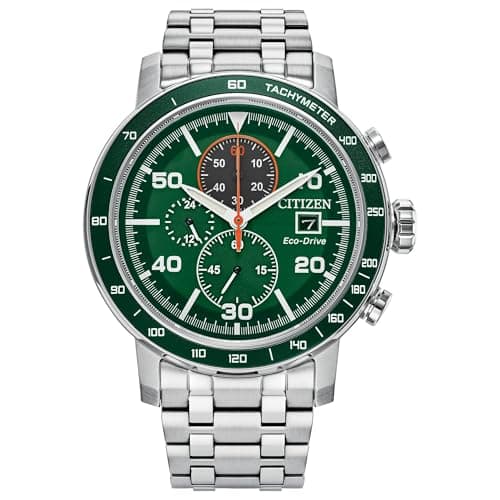
Citizen Eco-Drive Brycen Chronograph
44mm100mEco-DriveSapphire
The chronograph we'd buy: a real working stopwatch, sapphire, solar, no battery ever.
- Legibility
- 8
- Build
- 8
- Movement
- 8
- Versatility
- 8
- Value
- 9
Pros
- +A genuine 1/5-second chronograph you'll actually use, powered by light
- +Sapphire crystal and a slim, well-finished case
- +Never needs a battery, unlike almost every other quartz chronograph
Cons
- −44mm is on the larger side for smaller wrists
- −The sub-dial layout takes a moment to learn
Skip this one if…
…you want a mechanical chronograph. Those start at many times this price — this is the smart quartz answer that does the same job.
A dressier chronograph
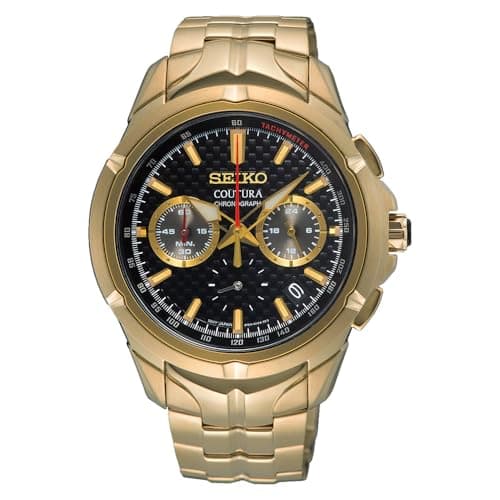
Seiko Coutura Chronograph (SSB438)
42.5mm100mQuartz chronoSapphire
A sharp, sapphire-crystal quartz chronograph with Seiko's dressier Coutura finishing.
- Legibility
- 8
- Build
- 8
- Movement
- 7
- Versatility
- 7
- Value
- 7
Pros
- +Sapphire crystal and a more polished, dress-leaning case than most tool chronographs
- +Reliable Seiko quartz chronograph movement
Cons
- −Battery-powered, so it will need a change every few years unlike the solar Citizen
- −The Coutura styling is glossier than a purist tool chronograph
Skip this one if…
…you want a chronograph you never service. The solar Citizen Brycen is the no-battery pick for similar money.
A classic-looking chronograph
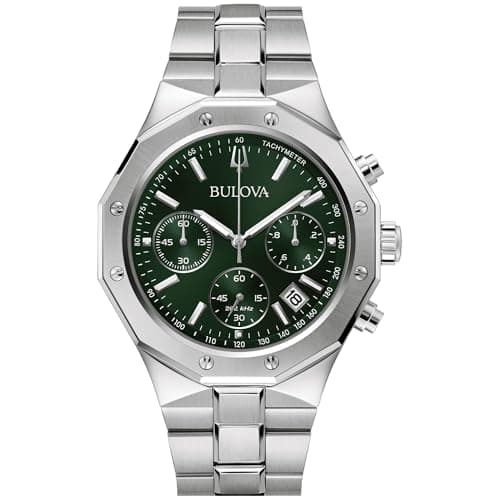
Bulova Classic Chronograph
43mm30mQuartz chronoMineral
A dressier American-brand chronograph with a clean dial and a fair price.
- Legibility
- 8
- Build
- 7
- Movement
- 7
- Versatility
- 7
- Value
- 7
Pros
- +Clean, restrained dial that works with a shirt cuff better than most sport chronographs
- +Bulova's finishing punches above the price
Cons
- −Only 30m water resistance — keep it dry
- −Battery quartz, so periodic service is unavoidable
Skip this one if…
…you need water resistance or a solar movement. This is a dress chronograph first — treat it like one.
Step by step
How to use a chronograph watch
- 1
Start the stopwatch
Press the top pusher, above the crown. The large central seconds hand starts sweeping; on most chronographs the small seconds hand in a subdial is the one that runs all the time, and the big central hand only moves when the chronograph is running.
- 2
Read elapsed time
Read seconds on the central hand against the main dial, elapsed minutes on the minute subdial, and — if the watch has one — elapsed hours on the hour subdial. On a watch with a 60-minute counter, the minute hand steps once each time the central hand passes 12.
- 3
Stop, and restart if you need to
Press the top pusher again to stop. The hands hold their position so you can read the result. Press the top pusher a third time and the chronograph resumes from where it stopped, adding to the elapsed time — useful for timing something with interruptions.
- 4
Reset to zero
With the chronograph stopped, press the bottom pusher. All chronograph hands snap back to zero. On a mechanical chronograph, never press reset while it is running — it strains the mechanism. Quartz chronographs tolerate it; the habit is still worth keeping.
- 5
Use the tachymeter for speed
Start the chronograph as you pass a mile or kilometer marker and stop it at the next. The central seconds hand points to your average speed on the tachymeter scale: if it took 45 seconds, the hand points at 80, so 80 mph or km/h over that unit of distance. The scale only works for events between about 7 and 60 seconds.
What the pushers and dials do
The top pusher starts and stops the chronograph. The bottom pusher resets it to zero. The central seconds hand is the chronograph seconds hand, not the running seconds — on a chronograph it normally sits still at 12, and the small seconds hand in a subdial is the one that shows the watch is running. The minute counter subdial records elapsed minutes, usually to 30 or 60; the hour counter, if present, records elapsed hours to 12. Once you know that the still central hand is normal, the dial stops looking broken.
A short history
The first chronograph was made by Louis Moinet in 1816 for astronomical work, and it measured to a sixtieth of a second — a fact rediscovered only in 2013, which is why Rieussec's 1821 ink-marking timer was credited as the original for nearly two centuries. The pusher-operated chronograph as we know it, with a separate button to start, stop and reset, arrived in the early twentieth century, and the tachymeter scale followed as motor racing gave people a reason to convert seconds into speed. The complication went to the moon on the Omega Speedmaster in 1969, which is the reason it remains the most desirable complication in watches.
The tachymeter, properly explained
A tachymeter is a scale that reads 3,600 divided by elapsed seconds. Time one unit of anything — a mile, a kilometer, one item off a production line — and the central hand points to how many of that unit happen per hour. Forty-five seconds to cover a mile reads 80, so 80 mph. Thirty seconds reads 120. The scale usually starts around 400 or 500 (about 7 to 9 seconds) and ends at 60 (one minute), so it cannot time anything slower than a minute per unit, which is why it is useless for a jog and useful for a car.
Chronograph vs GMT: which complication do you actually need?
A chronograph measures duration; a GMT tracks a second time zone. Both are tool-watch complications, both make a dial busier, and most people who want one would use the other more. If you time things — cooking, parking, laps, work — the chronograph earns its place. If you deal with another time zone, the GMT does. Our chronograph vs GMT page is the full comparison, and what is a GMT watch explains that complication the way this page explains this one.
The three chronographs that show it best
The Citizen Eco-Drive Brycen is the one we would buy: a genuine 1/5-second stopwatch, a sapphire crystal, 100m and a solar movement that never needs a battery. The Seiko Coutura is the dressier quartz chronograph — sapphire, 100m, Seiko's sharper finishing. The Bulova Classic is the plainest and the cheapest, a clean-dialed American-brand chronograph for people who want the complication without a tool-watch look. Our best chronograph watches roundup ranks the whole field, and the under-$500 page covers the bracket most people shop in.
How we picked
We do not run a testing lab
We compiled the published manufacturer specifications for every watch here — case size, lug-to-lug, lug width, water resistance, movement and crystal — did the wrist-fit and value math, and scored each pick against a published rubric. The scores are judgments from documented research — they are not measurements we took or wrist-time we logged, because we do not have these watches and we are not going to pretend we do. Where a spec could not be verified we wrote "data unavailable" rather than guessing.
Questions
Frequently asked
What is a chronograph watch?+
A watch with a built-in stopwatch. It tells the time normally and, separately, measures elapsed time on a large central seconds hand and one or more small subdials for minutes and hours, started, stopped and reset with the two pushers beside the crown. The name means "time writer," from Nicolas Rieussec's 1821 timer that marked the dial with ink.
What is a chronograph watch used for?+
Timing anything with a start and an end: a lap, a parking meter, a steak, a phone call, a production run. With the tachymeter scale on the bezel it also converts the time over a known distance into speed. Historically it timed horse races, then aircraft navigation and motor racing; today most owners use it for the kitchen and enjoy the dial.
How do you use a chronograph watch?+
Press the top pusher to start the central seconds hand, read elapsed minutes and hours on the subdials, press the top pusher again to stop, and press the bottom pusher to reset to zero. Never reset a mechanical chronograph while it is running. The numbered steps on this page go through it, including the tachymeter.
What is the difference between a chronograph and a chronometer?+
A chronograph is a watch with a stopwatch function. A chronometer is a watch whose movement has been certified for accuracy by a testing body, most commonly the Swiss COSC. A watch can be either, both or neither; the words are unrelated apart from the Greek root. None of the affordable chronographs ranked here are chronometers, and they do not need to be.
Why does the central seconds hand on my chronograph not move?+
Because that hand is the stopwatch hand, and it sits at 12 until you start the chronograph. The running seconds hand on a chronograph is the small one in a subdial. This is the single most common reason people think a new chronograph is broken.
Should I buy a quartz or mechanical chronograph?+
Quartz, unless you are spending well over $1,000 and want the mechanism for its own sake. A quartz chronograph is accurate, thin, tolerant of being reset while running and cheap to service; the Citizen Eco-Drive versions are also solar. A mechanical chronograph is thicker, several times the price, and needs careful use and expensive service. Every chronograph ranked here is quartz for that reason.
Receipts
Sources
We do not run a testing lab, and we do not pretend to. Every spec above traces to a manufacturer listing or a named standard; where we could not verify something, we say so on the page rather than quietly leaving it out. Read our full method.