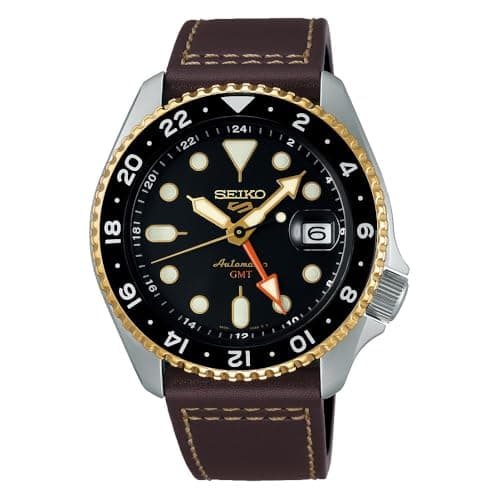
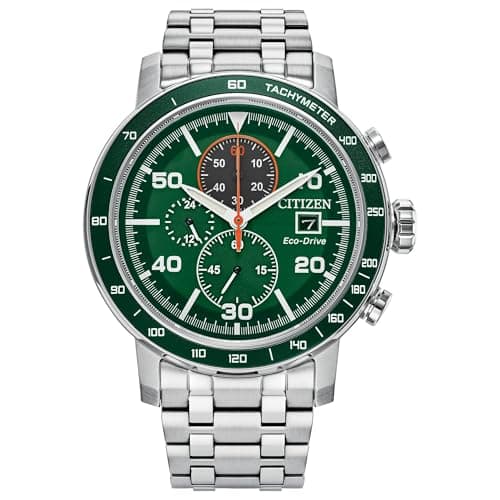
A chronograph and a GMT are the two complications most people consider first, and they have almost nothing in common. A chronograph measures elapsed time — it is a stopwatch built into a watch. A GMT shows a second timezone. They solve different problems, they cost different amounts, and the marketing for both is full of watches that only look like they have the function.
So rather than declare a winner, this page does something more useful: it tells you which one fits your life. We have put a benchmark of each below — the Citizen Brycen solar chronograph and the Seiko 5 Sports GMT — so you can compare the specs side by side and buy directly.
The short version: buy a chronograph if you time things — workouts, parking meters, cooking, anything with a start and a stop. Buy a GMT if you deal with another timezone regularly. If neither is true, buy neither; an unused complication is just a busier dial and a higher price, and a plain diver or field watch will make you happier.
What a chronograph actually is
Two pushers flank the crown. The top one starts and stops a central seconds hand that runs independently of the timekeeping; the bottom one resets it. The sub-dials count the accumulated minutes and hours. That is the whole mechanism. The most common trap in the category is the "multi-eye" watch — three sub-dials that show day, date and 24-hour time and do not start or stop anything. If a watch has sub-dials but no pushers, it is not a chronograph.
What a GMT actually is
A fourth hand circling the dial once every 24 hours instead of every 12, read against a 24-hour scale. Set it to a second timezone and you can see two times at once. Some GMTs let you jump the local hour hand independently (a "true" or flyer GMT, ideal for travelers); others have you set the 24-hour hand instead (a "caller" GMT, ideal for tracking home from your desk). The Seiko 5 Sports GMT is a caller.
Which one gets used more?
Honestly, the chronograph — by a wide margin, for most people. Timing something is a daily occurrence for almost everyone; needing a second timezone is not. The counter-argument is that a phone times things perfectly well, whereas glancing at a second timezone on your wrist is genuinely faster than unlocking a phone. If you work with colleagues in another country, the GMT wins on daily utility despite being the rarer need.
Cost, and why quartz is the smart buy for both
A mechanical chronograph is one of the most expensive complications in watchmaking — they start at many multiples of anything on this site. A solar quartz chronograph like the Brycen does the identical job, adds a sapphire crystal, and never needs a battery. Similarly, the Seiko 5 GMT is remarkable because it is a mechanical GMT at a low price; the Timex Q GMT does the same function in quartz for less again. In both categories, quartz is where the value is and mechanical is where the romance is.
Legibility and size
Chronographs are usually the larger and busier of the two — sub-dials eat dial space and push case diameters up. A GMT adds one hand and, at most, a bezel scale. If you have a smaller wrist or you value a clean dial, the GMT is the less intrusive complication by some distance.
If you only buy one
Buy the chronograph, and buy it in solar quartz. It is the more frequently useful complication for most people, the cheapest to buy well, and the version that never needs a service to keep working. Then, if you find yourself checking a second timezone on your phone more than once a week, add a GMT as watch number two.