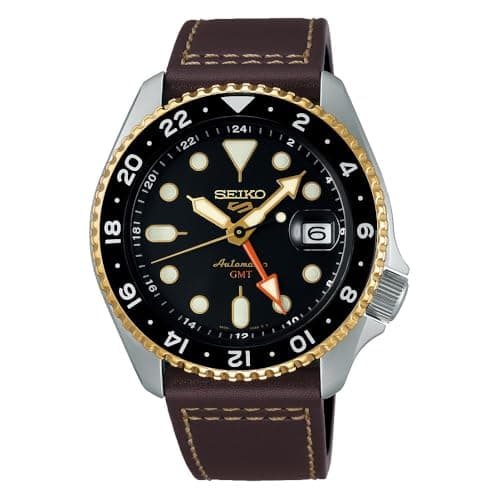
A travel watch solves one problem: knowing what time it is in two places at once. There are three ways to do that, and they cost wildly different amounts. A GMT adds a 24-hour hand for a second zone. A world timer holds every zone at once and lets you rotate to the one you want. And a radio-controlled watch sets itself from an atomic time signal so it is simply never wrong.
Which you need depends on how you actually travel. Someone who flies between two countries repeatedly wants a GMT. Someone who works across a dozen zones from a desk wants world time. Someone who wants to land and not think about it wants the radio-controlled watch and should skip the rest of this page.
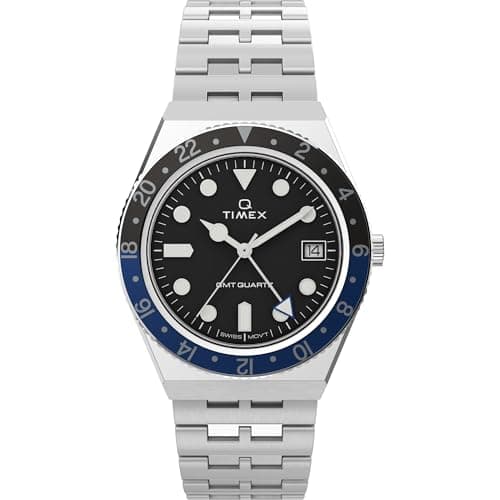
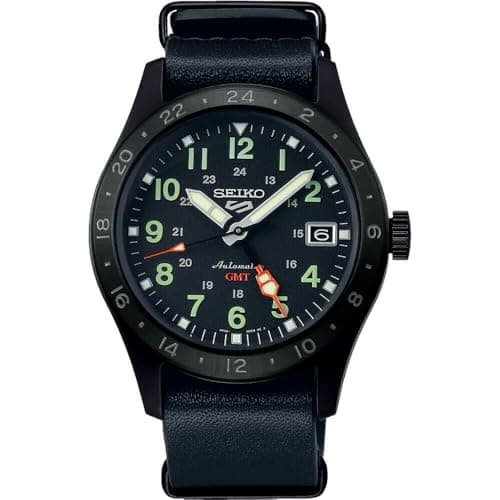
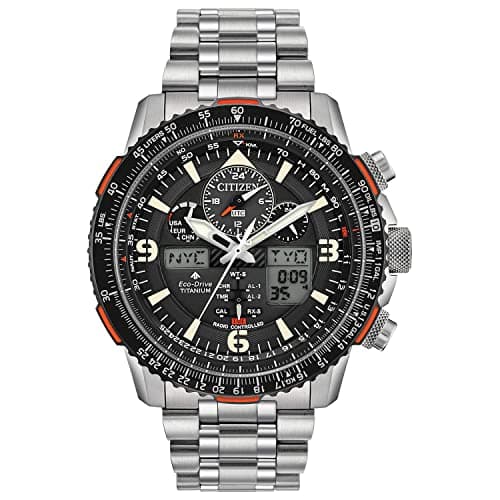
The short version: the Seiko 5 Sports GMT is the best mechanical answer at a sane price, the Timex Q GMT is the cheapest one worth owning, and the Citizen Skyhawk A-T is the watch for people whose travel is complicated enough to justify a manual.
Caller GMT versus flyer GMT — the distinction that matters
This is the single most useful thing to understand before buying a GMT, and most listings will not tell you. A callerGMT lets you set the 24-hour hand independently; the local hour hand is fixed to the minutes. That is ideal for someone sitting at home or a desk who wants to watch a second zone — you set the extra hand to your colleague's time and leave it.
A flyer (or true) GMT lets you jump the local hour hand forward and back in one-hour steps without stopping the watch, while the 24-hour hand stays on home time. That is what you want if you actually land in a new country and need to change local time in five seconds. The Seiko GMTs here are callers; genuine flyer GMTs start well above this budget. If you fly constantly, this distinction is worth more to you than any other spec on the page.
What atomic timekeeping actually does
The Citizen Skyhawk A-T receives a radio signal broadcast from atomic clock stations and resets itself — date, time, and the seconds — automatically. Combined with Eco-Drive solar power, that produces a watch that is never wrong and never needs a battery, which is a genuinely remarkable thing to own. The cost is complexity: it is 45mm, the dial is dense, and you will need the manual more than once.
The quiet case for a digital world timer
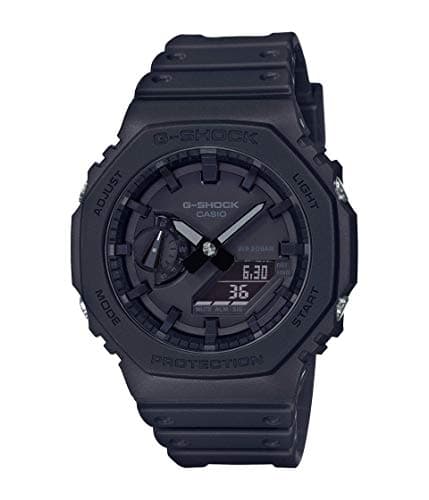
The Casio G-Shock GA-2100 is on this list for an unglamorous reason: it holds world time across 31 zones, it is rated to 200m, it survives being dropped on an airport floor, and it costs under $150. For a certain kind of traveler — carry-on only, hiking boots, no interest in the watch as jewelry — it is the correct answer and everything above it is over-thinking. Its one drawback for this site is that it takes a proprietary resin band rather than a standard lug width.
Water resistance and the airport reality
Travel is hard on watches in mundane ways: sunscreen, sea water, hotel pools, hand sanitizer, being knocked against a suitcase handle. The Skyhawk and the G-Shock are rated to 200m; the Seiko GMTs are 100m without screw-down crowns, which is fine for swimming and not for diving. If your travel involves water more than airplanes, weight that column heavily.
Size, and the case for packing small
Travel watches skew large — the Skyhawk is 45mm and the G-Shock is 45.4mm — because the functions need dial and screen space. The Timex Q GMT at 38mm is the outlier and the one to buy if you want something that disappears under a shirt cuff on a work trip. It also has the most useful trick on this page for the money: a bidirectional bezel that turns the GMT hand into a rough third timezone.
One strap, packed
The most practical travel upgrade is not a watch at all: it is a single nylon strap. It survives sea water, dries in an hour, adds no weight to a bag and costs less than an airport sandwich. Three of the five watches here use a 22mm lug width, so one strap covers most of this list — the G-Shock being the exception, as it takes G-Shock-specific bands.