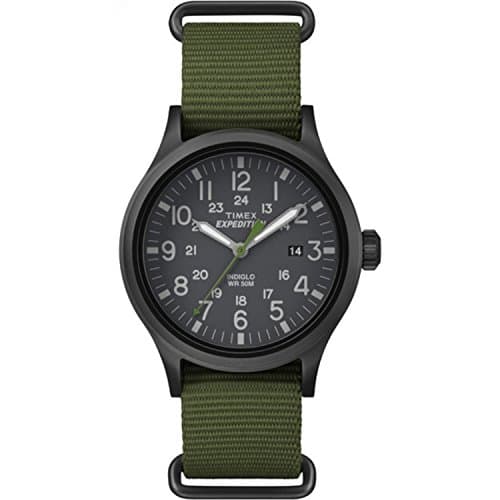
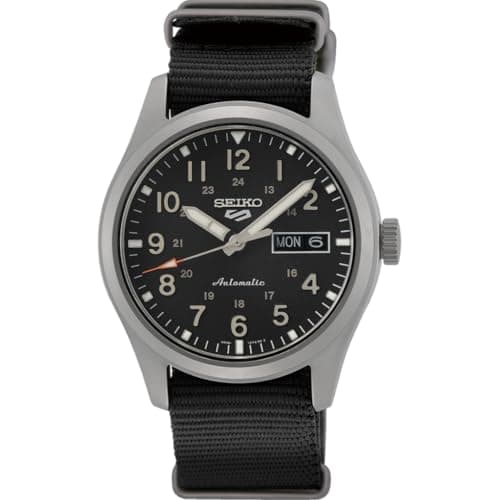
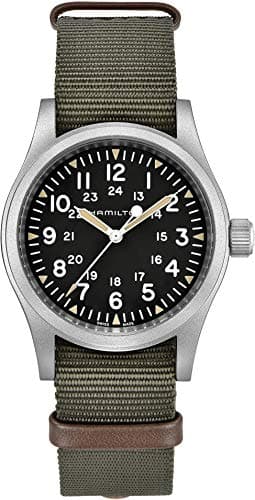
A field watch is a simple, legible, tough wristwatch descended from the watches issued to soldiers in the twentieth century. The defining features are consistent across a hundred years: a high-contrast dial — usually black with white Arabic numerals — a 24-hour inner track, luminous hands and markers, a modest case of roughly 36 to 42mm, a hacking seconds hand that stops when the crown is pulled so watches can be synchronized, and a fabric or leather strap on fixed lugs rather than a bracelet.
It is not a dive watch — no rotating bezel, usually a lower water-resistance rating — and it is not a dress watch, though the better ones pass under a cuff. It is the watch for reading the time fast, in bad light, on a wrist that is doing something else. That brief has not changed since the trenches of 1916, and it is why the field watch is the category most enthusiasts recommend to someone buying their first real watch.
Below: what to look for in one, the three references that show the category best at three prices, and then the history — from the trench watch through the American A-11 and the British W.W.W. "Dirty Dozen" — that explains why every feature is there.
The five things to look for
Legibility first. A field watch is judged on whether you can read it in a glance in poor light. That means a dial with real contrast, printed Arabic numerals rather than batons, and lume on both hands and markers. If the dial is busy, it is not a field watch, whatever the marketing says.
Hacking seconds. Pull the crown and the seconds hand should stop. This was a military requirement — it lets a unit set its watches to the same second — and it is the single feature that separates a genuine field-watch movement from a cheap one. The Seiko 4R36, Hamilton's H-50 and H-10 and most quartz movements hack; the old Seiko 7S26 did not.
Size and lug-to-lug. The originals were small — the A-11 was about 32mm across — and modern field watches run 36 to 42mm. The number that decides fit is lug-to-lug, not diameter; our field watch size guide ranks the current field by it. Under 47mm lug-to-lug fits almost everyone.
Lug width and strap. Nearly every field watch takes an 18, 20 or 22mm strap on standard spring bars, and the strap is part of the design: a NATO or a canvas strap can be washed, dried and replaced for less than lunch. Our field-watch strap roundup covers the options.
Water resistance and crystal. 50m is the historical norm and is fine for rain; 100m means you can swim. Sapphire resists scratches, mineral glass and Hardlex resist shattering. Neither is wrong on a field watch; they are the two places the price difference shows.
Where the field watch came from
The wristwatch itself became a military object in the First World War. Officers coordinating artillery and infantry needed the time without reaching into a jacket for a pocket watch under fire, so pocket watches were fitted with wire lugs and strapped to the wrist: the trench watch. Those improvised pieces set the brief — readable at a glance, tough enough for mud and impact, accurate enough to coordinate an attack — that every field watch since has followed.
The Second World War standardized it. The American A-11 specification, made by Elgin, Bulova and Waltham, called for a black dial, white Arabic numerals, a center seconds hand that could be stopped for synchronization, and consistent reliability across makers. It was small — around 32mm, with a 16mm strap on drilled lugs — and it was issued in enormous numbers. The British Army's 1945 W.W.W. specification — Watch, Wristlet, Waterproof — was filled by twelve Swiss makers including Omega, IWC, Longines and Jaeger-LeCoultre, and the set is known to collectors as the "Dirty Dozen," a nickname borrowed decades later from the 1967 film. Each had a black dial, white Arabic numerals, luminous hands and markers, a steel case and a hand-wound movement.
Hamilton made watches for the US military through both wars and after, and its Khaki Field is the direct descendant of that work — which is why it is the reference against which every other field watch is judged, and why it is the first pick above.
What changed, and what did not
Cases grew from 32mm to 38 or 40mm as tastes changed. Radium lume became tritium and then Super-LumiNova, which glows without being radioactive. Hand-wound movements became automatics and then, for most buyers, quartz. Water resistance improved from "waterproof" in name to a rated 50 or 100m. And the strap went from leather to nylon: the pass-through NATO strap, itself a British military issue item, is now the default field-watch strap because it keeps the watch on if a spring bar fails.
What did not change is the dial. A 2026 Khaki Field, a Timex Expedition and a Seiko 5 Sports field watch are all recognizably the A-11 dial: black, white Arabic numerals, a 24-hour inner track, lume, a seconds hand that hacks. The brief was right the first time.
Field watch vs dive watch vs dress watch
A dive watch adds a rotating bezel, a screw-down crown and a 200m rating, and is larger and heavier for it; our dive watch vs field watch page is the full comparison. A dress watch is thinner, plainer and usually on leather, with batons instead of numerals and no lume to speak of; our field watch vs dress watch page covers that. The field watch sits between them and is the most versatile of the three, which is why it is so often the recommendation for a first watch — it goes to work, to the trail and to dinner without changing, and it changes character entirely with a strap.
Mechanical or quartz?
The originals were all hand-wound, and a hand-wound field watch like the Khaki Field Mechanical is the most faithful modern version. An automatic like the Seiko 5 Sports field adds convenience. Quartz — the Timex Expedition, the Citizen Garrison, the Bertucci — is more accurate, cheaper and lighter, and arguably closer to the military brief, since a modern military would not issue a mechanical watch. Our quartz field watch roundup and automatic field watch roundup rank each side. There is no wrong answer; there is only the one you will wind.
Which field watch to buy
The Hamilton Khaki Field Mechanical is the category's reference — 38mm, hand-wound, 80 hours, sapphire — and the field watch to own if you own one. The Timex Expedition Scout is the cheap, correct answer: quartz, 40mm, an INDIGLO backlight, and everything a field watch has to do for about the price of a strap. The Seiko 5 Sports field is the automatic middle ground — 39.4mm, a day-date, 100m — and the pick for a smaller wrist that wants a mechanical movement. For the whole field ranked, see the best field watches; for the two brands most people are choosing between, Seiko vs Hamilton.