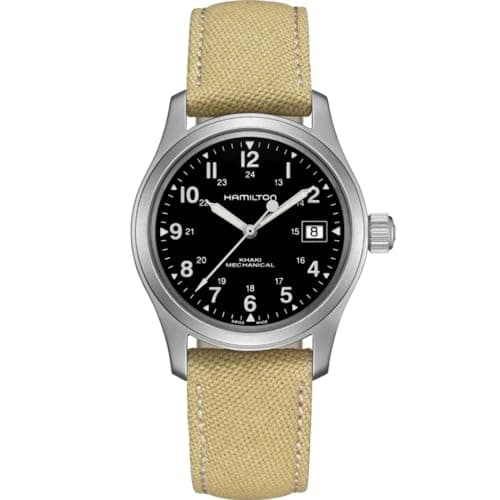
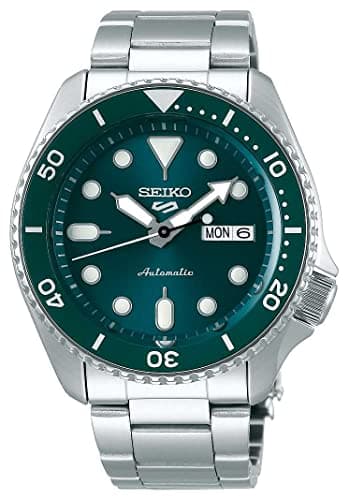
If you're buying your first proper watch, the choice often comes down to two archetypes: the dive watch and the field watch. Both are honest tool watches, both look right on almost anyone, and both can be had for very reasonable money. But they suit different people — and here is how to tell which one is you.
The short version: a dive watch is bigger, more water-resistant, and has more wrist presence — it makes a statement. A field watch is smaller, lighter, dressier and more versatile — it disappears and goes with everything. We've put a benchmark of each below (the Seiko 5 SRPD diver and the Hamilton Khaki Field) so you can compare specs and buy directly.
Size and presence
A dive watch is a larger object by design — 42–45mm cases, thicker for water resistance, with a rotating bezel that adds visual weight. A field watch is typically 36–40mm and slim, so it slides under a cuff and suits smaller wrists. If you have a wrist under about 6.5 inches, or you want something subtle, the field watch is the easier wear.
Water resistance and use
This is where the dive watch clearly wins: 200m and a screw-down crown mean you never think twice about water. Most field watches are 50–100m — fine for rain and washing, not for serious swimming. If your watch will actually get wet often, lean dive. If it lives on your wrist at a desk and occasionally sees a pool, the field watch is plenty.
Versatility and dress
A field watch on a leather strap can pass at the office and even with a jacket; a chunky diver reads sportier and is harder to dress up. If you want one watch to do everything from the trail to a dinner, the field watch is the more flexible choice — which is exactly why so many enthusiasts end up reaching for theirs the most.
The verdict
Buy a dive watch if you want presence, water resistance and a sporty tool watch you never baby. Buy a field watch if you want something smaller, versatile, dressier and easier on a slim wrist. If you genuinely can't decide, a field watch is the safer first purchase — it fits more wrists and more occasions — and you can add a diver as watch number two. Either way, both take the same straps, so the strap collection you build serves whichever you choose.
How we picked
We do not run a testing lab
We compiled the published manufacturer specifications for every watch here — case size, lug-to-lug, lug width, water resistance, movement and crystal — did the wrist-fit and value math, and scored each pick against a published rubric. The scores are judgments from documented research — they are not measurements we took or wrist-time we logged, because we do not have these watches and we are not going to pretend we do. Where a spec could not be verified we wrote "data unavailable" rather than guessing.