A watch worn to work is being asked a different question from a watch worn anywhere else. Nobody is going to admire it. What matters is whether it survives being knocked against a scaffold pole, whether the band can be hosed down at the end of a shift, whether you can read it with safety glasses on and one hand full, and how much it hurts to replace. Those four things, in that order, decide this list.
Which is why four of the six picks are Casios, and we may as well say that up front rather than pad the list for variety. Casio makes resin-cased, resin-banded, shock-protected watches at prices between fifteen and a hundred and fifty dollars, and no other brand competes on that specific combination. The two non-Casio picks are here because they answer needs the G-Shocks genuinely do not: a solar watch you never charge, and a featherweight titanium watch for people whose work is outdoors rather than on a site.
How this page is ranked
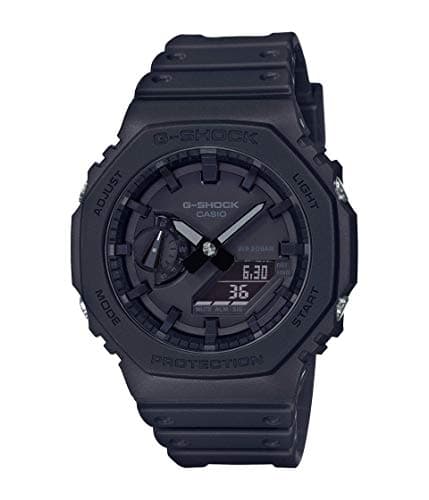
Impact and case construction first. Shock resistance is the specification that actually matters in a trade, and it is the one almost no dress or field watch has. G-Shock's whole engineering premise is a module suspended inside the case rather than bolted to it, which is why the two G-Shocks lead.
Water resistance second, because rain, washdowns and sweat are constant and a 30m watch is not rated for any of them in the way people assume — the full argument is on watch water resistance explained. Four of the six here are 200m. Then the band: resin and silicone rinse clean, nylon washes, leather does not survive, and a steel bracelet is the one genuinely risky choice near rotating machinery. Then legibility, and then price, because a work watch is a consumable and the list is ordered with that in mind.
The safety point nobody puts in a buying guide
If you work near rotating machinery, conveyors, lathes or live electrical work, the relevant question is not which watch is toughest — it is whether you should be wearing one at all, and what happens if it catches. Many sites and shops have a standing rule against jewellery and metal bracelets for exactly this reason. Follow your own site rules, and if a watch is permitted, a resin or silicone band that will break or slide rather than a steel bracelet that will not is the conservative choice. That alone rules a bracelet off this page.
The same logic applies to case size and profile. A tall watch catches on things. The GA-2100 is on this list partly because, at 11.8mm, it is the slimmest G-Shock most people will ever wear, and a watch that sits close to the wrist is a watch that stays out of the way.
Why a dive rating is the right spec for a dry job
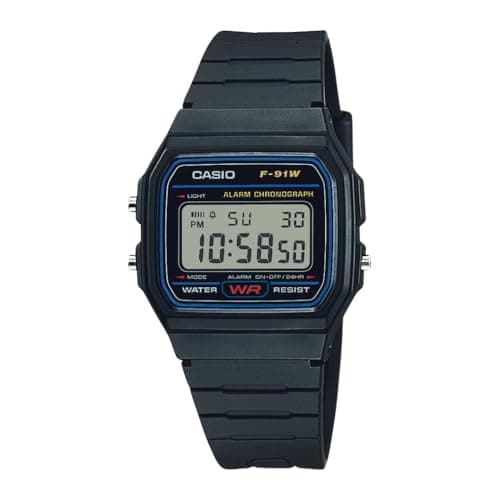
It looks like overkill and it is not. A 200m rating on a watch that never goes near the sea is buying you margin: a case tested to that pressure has a gasketed, screwed-down construction that keeps out dust, pressure-washer spray and the sweat that sits under a band all day. 30m, by contrast, means splash resistance in practice — the Casio F-91W on this page is rated at 30m and we have ranked it fourth rather than higher for precisely that reason.
The F-91W is still here because it answers a real question: the cheapest watch worth owning. An alarm, a stopwatch, a backlight, a resin band and a multi-year battery, for less than a decent pair of gloves. If the job is indoors and dry and the watch is going to be lost or destroyed inside a year anyway, it is the rational purchase and nothing else comes close on price.
Power: the argument for solar on a work watch
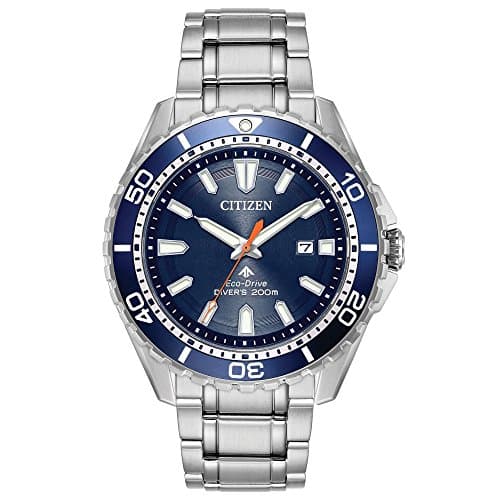
A dead battery at 6am is a small, repeated annoyance, and it is the one thing solar removes. The Citizen Promaster Dive Eco-Drive is on this page because it is an ISO-compliant 200m watch with a screw-down crown that charges off any light, including the light in a workshop — you put it on and it runs. It is the pick for someone who wants a serious analog watch for work and does not want to think about it again.
The cost is size and material: 45mm is a lot of watch for a tight space, and the crystal is mineral rather than sapphire, which on a watch that will meet concrete is a real consideration — see sapphire vs mineral crystal for why that matters more than it sounds. The full solar roundup ranks the alternatives if solar is the deciding feature.
Outdoor work is a different job from site work
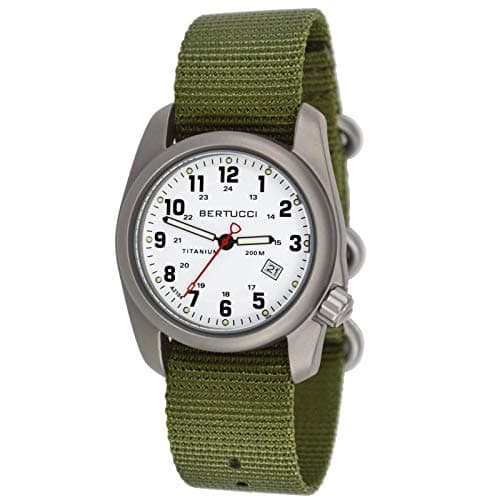
Surveying, forestry, agriculture, trail and utility work: the enemies are weight, sun and sweat rather than impact. The Bertucci A-2T is the answer there — a full-titanium 40mm case that is remarkably light, shrugs off sweat and scratches, and ships on a proper nylon field strap. Its fixed lug bars mean you cannot change that strap for a standard one, which is a genuine limitation and also a small security benefit: there is no spring bar to fail.
If the outdoor work is in fact hiking rather than a job, we have ranked that case separately on the best field watches for hiking, where power reserve and legibility in low light matter more than impact resistance does.
What we would buy, by job
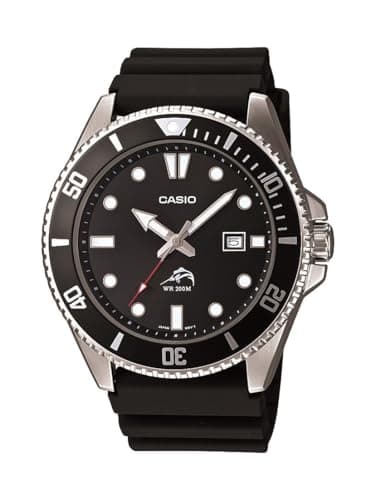
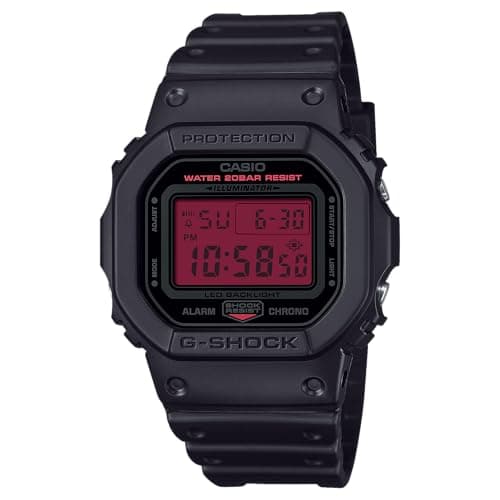
Construction, demolition, scaffolding: the DW-5600. Cheap, square, 200m, nothing to snag. Trades where you also meet clients: the GA-2100 — same protection, fits under a cuff. You want hands and a dial: the Casio Duro, a real 200m analog diver at a price where losing it is survivable. Indoors, dry, lowest possible cost: the F-91W. One good analog watch you never charge: the Citizen Promaster. Outdoor fieldwork: the Bertucci A-2T.