A digital watch today means one of two very different things. One is a smartwatch: a computer that needs charging every day or two, an account, a phone and a software update cycle. The other is a digital watch in the original sense — a quartz movement with an LCD instead of hands, a battery measured in years, and a fixed set of functions that will work identically in a decade. This page is entirely about the second kind, because that is what people are asking for when they search for a digital watch that is not smart.
All four picks are Casio, and we would rather say that in the second paragraph than pad the list for variety. Casio has made digital watches continuously since the 1970s, owns the module designs, and sells them between twenty and a hundred and fifty dollars. Nobody else competes on that combination at all. The honest consequence is that this is a ranking within one brand, and the real decision is which Casio.
How this page is ranked
Protection first. A digital watch is a beater by nature, so shock resistance and water rating decide the top of this list. The two G-Shocks are rated to 200m with G-Shock's suspended-module construction; the F-91W and the A168 are rated to 30m, which is splash resistance and nothing more — see watch water resistance explained for why that number is so widely misread.
Then battery life, because the whole appeal of a non-smart digital watch is forgetting about it. Casio rates the F-91W at around seven years and the A168 similarly; the GA-2100 is a three-year battery. Then legibility, which on an LCD means contrast and backlight quality rather than lume. Then size and weight, where these watches are unusually good: the F-91W is 21 grams and the A168 is 9.6mm thick, numbers no analog watch on this site approaches.
Digital versus smartwatch: the honest trade
A smartwatch does more. It also stops working when the battery dies, when the app is discontinued, or when the phone it was paired to is replaced. A digital Casio does less and keeps doing it: the time, a date, an alarm, a stopwatch, a light. If what you want is a watch that is simply there when you look at your wrist, the digital watch is the better object, and the broader version of that argument is on luxury watch vs smartwatch.
The one function people miss is fitness tracking. No watch on this page counts steps or measures a heart rate, and no amount of ranking will change that. If those are requirements, buy a smartwatch; if they are not, you are paying nightly charging for features you do not use.
The square against the octagon
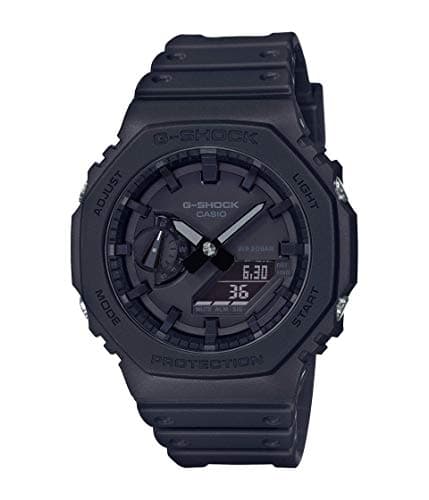
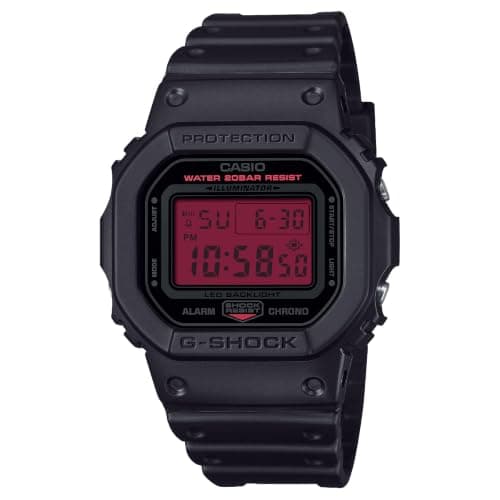
The DW-5600 and the GA-2100 are both 200m G-Shocks and they wear completely differently. The DW-5600 is the small square: fully digital, 42.8mm, light, and the shape the whole line is descended from. The GA-2100 is 45.4mm but only 11.8mm thick, with analog hands over a small LCD — the slimmest G-Shock most people will ever wear, and the only one that fits under a shirt cuff. Its full case numbers are on the Casio GA-2100 review.
Neither takes a standard strap. Both use proprietary resin bands, which means nothing in the strap drawer on this site fits them. If strap swapping is part of the appeal of owning a watch, that is a genuine reason to look at the A168 with its integrated steel bracelet or at an analog watch instead.
The two cheap ones, and which to buy
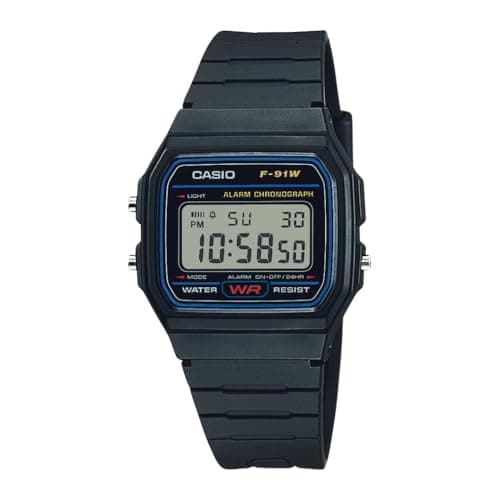
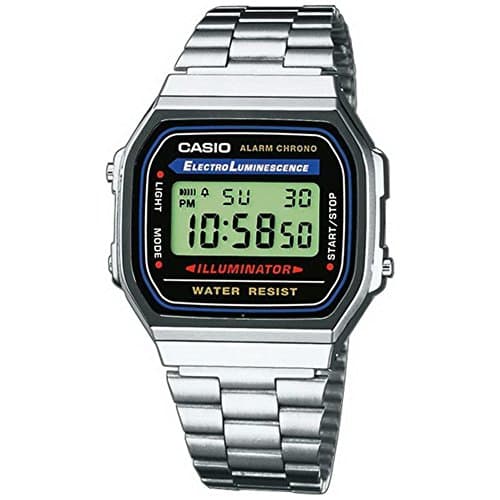
The F-91W and the A168 are both about the price of a takeaway and they answer different questions. The F-91W is the lighter and more invisible of the two at 21 grams and 8.5mm — it is the watch you forget you are wearing, and the best-selling watch design in history. The A168 is the one that looks like something: a steel case and integrated steel bracelet with an electro-luminescent backlight, for a few dollars more.
Both are 30m rated. That means hand-washing and rain, not swimming, whatever the internet tells you. If you want a cheap watch you can actually swim in, the answer is not digital at all — it is the Casio Duro, a 200m analog diver at a similar price, and the rest of that field is on the best budget dive watches.
Where digital beats analog outright
Three places. Timing things: a digital stopwatch reading to 1/100th of a second is more useful than any mechanical chronograph, and it costs twenty dollars rather than several hundred — the contrast with a mechanical chronograph is stark. Night reading: a backlight beats lume, because lume is a battery for light that discharges and a backlight is not — see what is lume on a watch. Accuracy: a cheap quartz module will out-keep any mechanical watch on this site by an order of magnitude.
What we would buy
One digital watch to keep: the DW-5600. Digital functions, analog looks, fits under a cuff: the GA-2100. Lightest, cheapest, most invisible: the F-91W. Cheap but looks like a watch: the A168. And if the job it has to do involves tools and grit rather than a desk, the ranking shifts slightly and is laid out on the best watches for work.