The specifications, from Citizen's own sheet
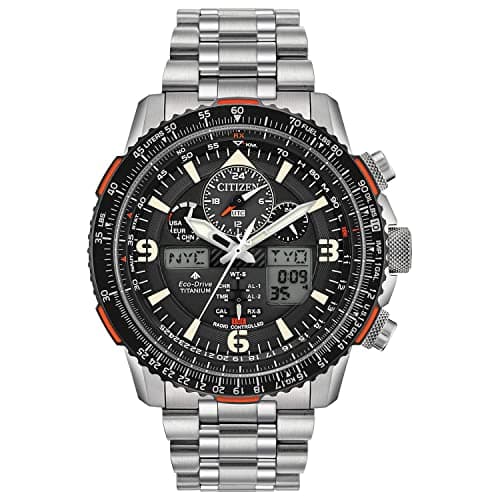
Citizen publishes the following for the JY8078-01L: a 45mm stainless steel case rated to 200m / 20 bar, a 22mm lug width, an anti-reflective sapphire crystal, caliber U680 Eco-Drive, a pilot's rotating slide-rule bezel, luminous hands and markers, and a digital backlight. The function list runs: radio-controlled time adjustment in 43 world cities, a 1/100-second chronograph measuring up to 24 hours, UTC display, a second time zone, a perpetual calendar, two alarms, a 99-minute countdown timer and a power reserve indicator.
Two figures Citizen does not publish, which we therefore do not print. There is no case thickness on Citizen's page for this reference, and there is no lug-to-lug figure — which is a nuisance, because lug-to-lug is the measurement that decides whether a 45mm watch fits you. Independent reviews of the line report a case depth in the region of 15mm, and we carry that as a third-party observation rather than a Citizen specification. Treat the 45mm diameter and the 22mm lugs as the only hard numbers you have for fit, and read watch size for your wrist before you commit.
There is also no published running time in darkness for the U680 on this page. Citizen publishes figures of that kind for other Eco-Drive calibers — the generalities are on what is Eco-Drive — but we are not going to borrow a number from a different movement and attach it to this one.
What "A-T" actually means, and why it is the reason to buy this watch
A-T is Citizen's label for radio-controlled atomic timekeeping. The watch receives a time signal broadcast from an atomic clock and sets itself — the date, the time, and the daylight-saving offset — without you touching it. Citizen states coverage for 43 world cities across the transmitter networks in North America, Europe, Japan and China.
This is the single feature that justifies the Skyhawk's existence and its price. Every other watch on this site drifts: a quartz movement by a few seconds a month, a mechanical by a few seconds a day — the figures are on quartz vs automatic. The Skyhawk does not drift, because it checks. If you have ever landed somewhere and had to work out whether the local date had rolled over, the appeal is obvious.
The honest limitation: radio sync needs a signal. Inside a steel-framed building, in a basement, or far from a transmitter, the watch falls back to being an ordinary quartz until it next catches a broadcast — usually overnight, by the window. It is still accurate to normal quartz standards in the meantime. This is not a flaw so much as a thing to know, and it is the reason the manual tells you where to leave it at night.
The slide rule, and whether anyone uses it
The rotating bezel is an E6B-style circular slide rule — a logarithmic calculator for multiplication, division and unit conversion. In aviation it is used for fuel burn, time, speed and distance. On a wrist in 2026 it is used, honestly, for currency conversion and tipping, and mostly it is used for nothing at all.
We think that is fine as long as you know it going in. The slide rule is the visual signature of a pilot watch and it is a large part of why the Skyhawk and the Nighthawk look like instruments rather than accessories. If you want the function explained properly before you pay for it, the Nighthawk review and best pilot watches both cover how to actually drive one. Buy it for the look and treat the arithmetic as a bonus; do not buy it believing it will change your life.
Legibility: the real cost of all those functions
This is where we have to be blunt. The Skyhawk has the lowest legibility score of any watch we rank in this hub, and it is not close. An analog-digital dial carrying a chronograph, a perpetual calendar, UTC, a second time zone, two alarms, a timer and a power reserve indicator has to put all of that somewhere, and it puts it on top of the hands you are trying to read.
The practical consequences: the digital windows are small, the sub-register markings are dense, and the manual is not optional. Setting a second time zone or clearing an alarm on this watch is a sequence of crown positions and pusher presses that you will look up the first several times. Citizen makes the manual available to download, and you will want it.
If a watch should tell you the time at a glance and nothing else, this is the wrong watch and we would point you at a plain GMT instead — the best GMT watches page ranks several that show a second time zone on a single extra hand, which is faster to read than any digital window.
Sapphire and 200m: the two specs that make it a tool
It would be easy to write the Skyhawk off as a gadget. Two published figures stop that. The first is the anti-reflective sapphire crystal, which is the one durability upgrade most worth paying for and which the cheaper Nighthawk does not have — the Nighthawk uses mineral glass. The reasoning is on sapphire vs mineral crystal, and the rest of the sapphire field is on best watches with a sapphire crystal.
The second is the 200m rating. That is a real figure, not a splash-resistance claim, and it means this watch can be swum and showered in without thinking about it — see watch water resistance explained for what the number means in practice. It is not a dive watch in the ISO 6425 sense, because a slide-rule bezel is not an elapsed-time bezel, but the sealing is there.
Add the 22mm lug width and the Skyhawk is better served by this site's strap pages than most of its competition: 22mm is the deepest part of the aftermarket, so the leather strap it ships on is a starting point rather than a commitment. Start with best 22mm watch straps.
Skyhawk or Nighthawk?
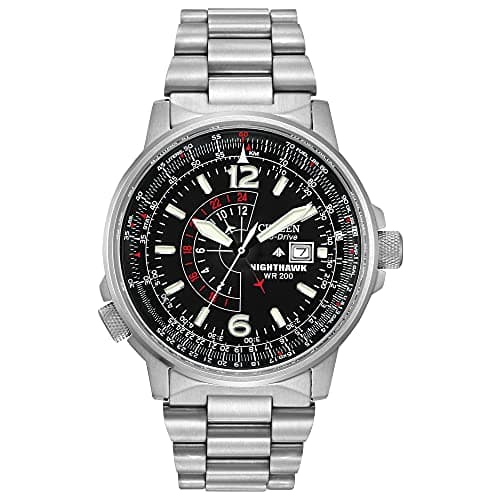
This is the decision almost everyone looking at the Skyhawk is actually making, and we have a whole page on it — Nighthawk vs Skyhawk — so here is the short version. Both are Citizen Promaster aviation watches, both run on light, both are rated to 200m, both have a slide-rule bezel. The Skyhawk adds atomic sync, world time, the extra digital functions and the sapphire crystal, and it is a much larger watch at 45mm against the Nighthawk's 42mm.
Our view: the Nighthawk is the better buy for most people and we rank it second here only because this page is a review of the Skyhawk. You lose the atomic sync and the sapphire, you keep the Eco-Drive, the slide rule, the 200m rating and the look, and you save a lot of money. The Skyhawk earns the gap only if the self-setting is something you will genuinely use — which, if you fly regularly, it is.
Where the Avion fits
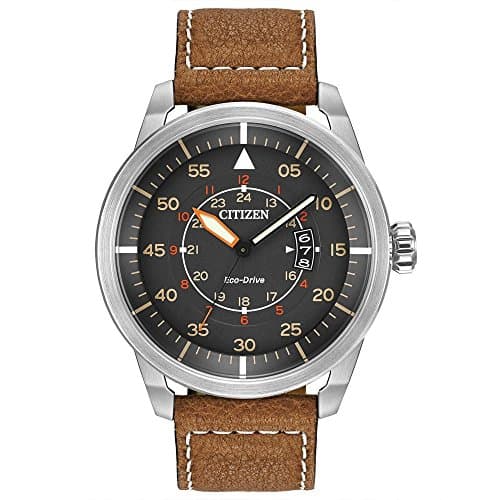
The Citizen Eco-Drive Avion is the third watch here and it is the honest cheap exit. It is the same Eco-Drive idea in a plain three-hand-and-date pilot design: no slide rule, no digital, no atomic sync, much less money. It is also much more legible than either of the others, which is the point we keep returning to.
Buy the Avion if what appealed about the Skyhawk was really "a solar pilot watch I never have to wind or change a battery in." That is most of the appeal for most people, and the Avion delivers it without the 45mm case or the manual. It gives up the 200m rating, so check the water resistance figure in the table above against how you actually live.
Who should buy it
Buy the Skyhawk A-T if you cross time zones often enough that a self-setting watch is a genuine convenience, you have a wrist that carries 45mm comfortably, and you like dense, instrument-looking dials. On those three conditions it is excellent and nothing else here competes.
Skip it if you want a watch you read without thinking, if your wrist is under about 7 inches, or if the budget is the constraint — the Nighthawk is the better value and the Avion is the better bargain. And skip it if the appeal was the slide rule specifically, because the Nighthawk has the same one for considerably less.