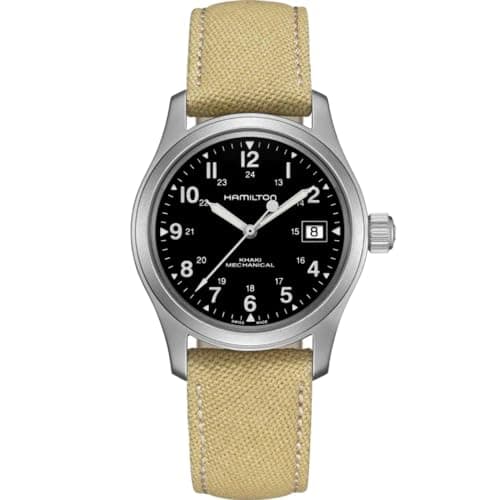
Start with the uncomfortable part, because it is the most useful thing on this page. There are exactly five references in our registry that publish a 38.0mm case, and three of them are the same Hamilton. That is not us being lazy with the list. It is the market: 38mm is what an enormous number of buyers say they want and it is a size that almost nothing affordable is actually built in, because the industry spent two decades selling 42-45mm and has only partly turned around. If you have been searching for this size and finding the same handful of watches everywhere, that is why.
The second uncomfortable part: 38mm on its own does not tell you whether a watch will fit you. Diameter is the number on the box. The number that decides whether the watch sits inside your wrist or hangs over the edge is the lug-to-lug span, measured from the tip of one lug to the tip of the lug diagonally opposite. Across these five 38mm watches that span runs from a published 44.2mm to a published 46.5mm— a 2.3mm spread inside one nominal case size, which is more than the difference between a 38mm and a 40mm case on paper. Our watch size for your wrist guide shows how to measure yours, and the field watch size guide works through the same arithmetic with photographs.
So the ranking below goes: lug-to-lug span and how the watch actually sits first, then crystal, then what the movement does and how long it runs, then what the case is rated for, then price. Three of the five are Hamiltons sharing one case and two calibers, so we have ranked them against each other on the two things that genuinely differ between them — water resistance and whether you wind it yourself — and said so rather than padding the list to five different-looking watches.
Everything quoted here is a published manufacturer figure or an Amazon listing specification, linked in the sources. We do not have these watches on a bench and we are not going to pretend we measured anything; how we review explains exactly what our scores are and are not.
The three Hamiltons, and why they are all here
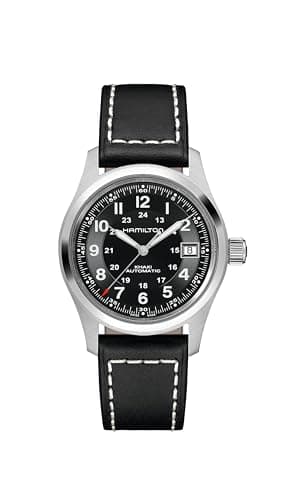
Hamilton publishes the same 38mm steel case and the same sapphire crystal for all three, and the same 80-hour power reserve for both of its calibers. What actually differs:
Khaki Field Mechanical — the hand-wound H-50. You wind it every day or two, which for a lot of owners is the entire point of owning a mechanical watch. It is the thinnest of the three because there is no rotor, and it publishes the lowest rating at 50m: fine for rain and washing your hands, not for swimming.
Khaki Field Automatic — the self-winding H-10. Same case, same sapphire, same 80 hours, and Hamilton publishes 100m for it, double the hand-wound version. If you are only going to own one watch, that 100m rating is worth more than the winding ritual, which is why it is ranked above the Murph.
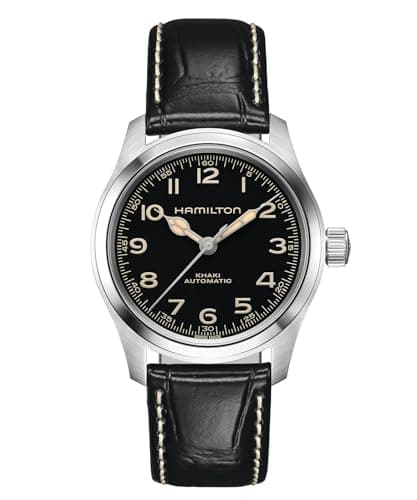
Khaki Field Murph — the same H-10, the same 100m, a display caseback and the dial from Interstellar. It costs the most of the three and the extra money buys a design story and some typography, not a specification. We have ranked it last of the Hamiltons for exactly that reason, and our Murph review and mechanical against automatic comparison are the long versions of both decisions.
Three Hamiltons out of five picks means this page shares three of its five with best Hamilton watches, and we would rather tell you that than have you find it. The difference is the question being asked: that page ranks the Hamilton line against itself at every size, and this one ranks everything we can find at one size, which is why a $255 Timex and a $266 Seiko are on it.
The Seiko is the one that wears smallest, by a clear margin
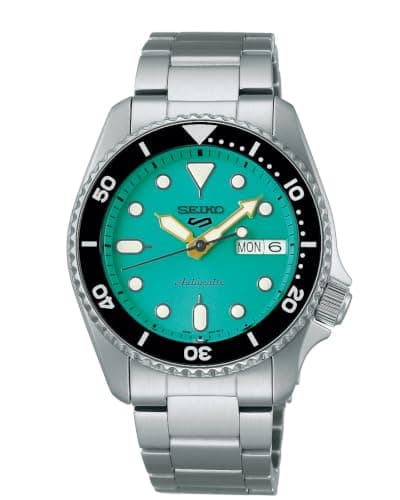
Seiko publishes 38mm with a 44.2mm lug-to-lug for the 5 Sports SRPK33. Against Hamilton's published 46.5mm for the Khaki Field, that is 2.3mm less watch across your wrist at the same nominal diameter — and on a 6.5-inch wrist that is the difference between a watch that looks right and one that looks borrowed. It is the shortest span of any sports watch on this site, which is why it also wins our dive watches for small wrists page.
What you give up is the crystal and the finishing. Seiko publishes Hardlex, its hardened mineral glass, not sapphire, and the case and bracelet are finished to a Seiko 5 standard rather than a Swiss one. What you gain beyond the price is the 4R36 movement, which hacks and hand-winds, and a published 100m rating — twice the hand-wound Hamilton's. It has no screw-down crown, so it is a sports watch rather than a dive tool, and what makes a watch a dive watch explains why that line matters.
The 38mm watch with a complication, for the price of a strap
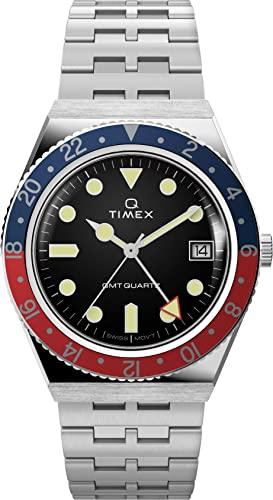
The Timex Q GMT is the outlier on this page and it earns its slot on one fact: it is the only 38mm watch here with a second time zone, and it costs less than any other pick. A mechanical GMT does not exist anywhere near this money — the cheapest one we rank is several times the price on best GMT watches under $500.
Two caveats, both on its card. Timex publishes an acrylic crystal, which scratches easily (though it also polishes out with a cloth and a little compound), and the lug width is 18mm— the only pick here that is not 20mm. Eighteen is a perfectly real size with a thinner selection than 20mm; our 18mm strap roundup is the short answer, and the lug width chart has the full table.
The watches that just miss 38mm, and what to do about it
If you are shopping this size, these near-misses are worth knowing, because a millimeter and a half is usually not the thing standing between you and a watch you like.
Seiko 5 Sports Field, 39.4mm — the same 4R36 and the same 100m as the SRPK33 in a field dial, and the closest thing to a 38mm automatic field watch under $300. It is ranked on best automatic watches under $300. Invicta Pro Diver, 40mm — a 200m automatic for about seventy dollars, and the cheapest real mechanical watch we rank anywhere. Timex Weekender and Expedition Scout, 40mm — both well under fifty dollars and both on best watches under $200. Orient Bambino V2, 40.5mm — the dress answer, with a domed crystal and an unusual 21mm lug.
Two we deliberately will not recommend for this search. The Seiko 5 SNK809 is 37mm, which is genuinely inside the size you are looking for, but Seiko discontinued it and the surviving listing now asks several times what it sold for new — at that price the SRPK33 is a better watch in every respect. And the hand-wound Timex Marlin is 34mm, a lovely vintage-correct size, but the only hand-wound Marlins currently listed are Peanuts collaborations with character artwork on the dial, which is not what someone searching for a 38mm watch is picturing.
Is 38mm actually the right size for you?
Probably, if your wrist is between about 6 and 7 inches — but measure it rather than guessing, because the answer is cheap to get right and expensive to get wrong. The quick version: wrap a tape measure around your wrist bone, then compare that to the lug-to-lug figures in the table above rather than to the diameters. A 46.5mm span on a 6.25-inch wrist will slightly overhang; a 44.2mm span will not.
The other thing worth saying is that 38mm is not automatically a small watch. A 38mm case with a thick bezel and a small dial opening can read smaller than a 40mm case with a thin bezel, and none of these makers publishes a dial-opening figure, so we have not invented one. If presence on the wrist is what you want rather than discretion, our best watches for large wrists page is the other end of this argument, and it is built on the same lug-to-lug logic.
Where to go next
If the price rather than the size is your real constraint, three of these five are over $600 and the mechanical alternatives are on best automatic watches under $300. If you want 38mm specifically because you liked how a 39mm Tudor sat, the Tudor Black Bay alternatives page makes that comparison directly and reaches an awkward conclusion about it. And if you want the field-watch version of this size question with more models, best field watches is the place to start.