The specifications, from Hamilton's own sheet
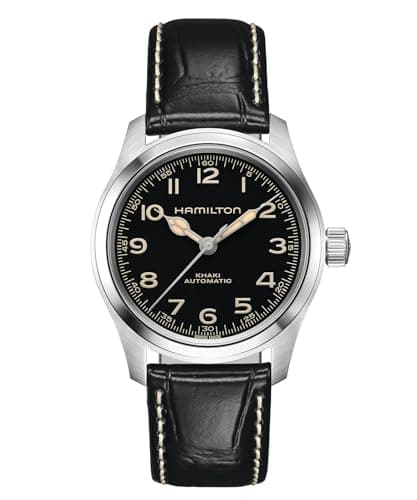
Hamilton publishes the following for the H70405730: a 38mm stainless steel case, 11.1mm thick, rated to 10 bar / 100m, with a sapphire crystal carrying an anti-reflective treatment, an open caseback, a 20mm lug width, an 18mm buckle width, Super-LumiNova, a Nivachron hairspring and the H-10 automatic caliber with an 80-hour power reserve. It ships on a cow leather strap with a pin buckle, and Hamilton lists it at $995.
The figure Hamilton does not publish is the lug-to-lug, which is the measurement that actually decides whether a watch fits — the spec table above prints a dash for it rather than a guess. At 38mm across with a published 11.1mm depth this is a small, flat watch by modern standards and we would expect it to sit comfortably on most wrists, but that is an inference and we are flagging it as one. If you are between sizes, watch size for your wrist and what size field watch to buy are the pages that work the problem properly.
What the specification sheet is actually telling you
Three lines on that list are doing most of the work, and they are not the ones the marketing leads with.
The 80-hour power reserve. This is the H-10, Hamilton's ETA-derived automatic, and 80 hours is a genuinely different ownership experience from the Japanese automatics this site ranks most of. A Seiko 4R36 runs roughly 41 hours and the Orient F6922 about 40 — take either off on Friday evening and it has stopped by Sunday lunch. Take the Murph off on Friday and it is still running on Monday morning. That is the single most noticeable difference between this watch and a $300 automatic in daily use, and it is explained properly on what power reserve means.
The Nivachron hairspring. Hamilton publishes "Nivachron: Yes" on this reference. Nivachron is the Swatch Group titanium-alloy balance spring, sold on its resistance to magnetic fields — the everyday enemy of a mechanical watch, since laptop speakers, tablet covers and bag clasps all carry magnets strong enough to upset a conventional steel hairspring. Hamilton does not publish a gauss figure for this reference and we are not going to borrow one from another caliber, so treat it as a real specification with an unquantified benefit. It is a line you will not find on any Seiko, Citizen or Orient at any price on this site.
100m, not 50m. The hand-wound Khaki Field Mechanical is rated to 50m. The Murph doubles that, which moves it from "rain and handwashing" into "you can swim in it" — the brackets are set out on water resistance explained. For a leather-strapped field watch that is a more useful rating than it sounds, because it is the difference between a watch you take off at the pool and one you simply forget about.
The film part, stated honestly
Hamilton says the watch is featured in Interstellar (2014) and worn by Murph Cooper, and calls it a faithful recreation of the on-screen watch. The detail collectors actually care about is published too: the word Eureka is spelled out in Morse code in lacquer on the seconds hand, which Hamilton describes as a hidden tribute to Murph's discovery in the film.
We are not going to pretend that is a specification. It is a design flourish on a watch that costs about $200 more than the version without it, and whether that is good value is not a question specifications can answer. What we will say is that it is an unusually tasteful piece of film merchandise: no logo, no limited-edition engraving, no co-branding on the dial. If you did not know the story you would read it as a slightly typography-heavy field watch, which is exactly how a tie-in should age.
The honest counterweight: the dial is busier than a classic field dial, with a full 24-hour inner track and a heavier numeral treatment. Some people bounce off it on sight. It is worth looking at the photograph on the listing for a full thirty seconds before buying, because this is the one thing about the watch nobody else can decide for you.
Murph vs the plain Khaki Field Automatic
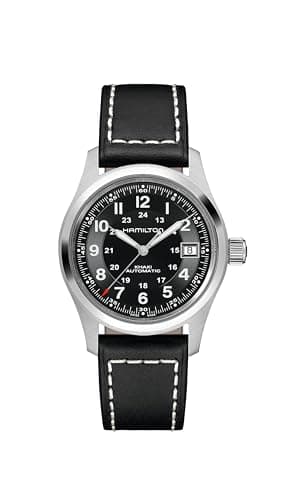
This is the decision almost everyone reading a Murph review is actually making, so here it is without hedging. The Khaki Field Automatic in 38mm is the same case size, the same 100m rating, the same sapphire crystal, the same 20mm lug width and the same 80-hour H-10 movement. On the listings we verified before writing, it sits roughly $200 below the Murph.
So the premium buys the dial, the Morse-code seconds hand and the film association. Nothing mechanical. Nothing you will feel in a year of wearing it. If the story is why you are here, pay it happily — that is a legitimate reason to buy a watch and we are not going to sneer at it. If you came for the best Swiss field watch your money will buy, take the plain Automatic and put the difference toward a second strap for it. The wider Hamilton range is ranked on best Hamilton watches, and the mechanical-versus-automatic question has its own page on Khaki Field mechanical vs automatic.
38mm or 42mm, and the strap consequence
The 42mm Murph (H70605731) is the original and the one that was in the film's marketing. The 38mm arrived later and is the better watch for most wrists — a field watch is supposed to disappear under a cuff, and 38mm with an 11.1mm depth does that in a way 42mm does not.
The consequence that matters on this site: the 38mm takes 20mm straps and the 42mm takes 22mm straps. If you already own straps, that is not a detail — it decides which reference you should buy. 20mm is also the single most common width in the aftermarket, which is a quiet argument for the 38mm: the drawer you can shop from is bigger. The full picture is on the lug width chart.
One more published figure worth knowing before you order a strap: the buckle width is 18mm, not 20mm. The stock strap tapers. Most aftermarket 20mm straps are either straight-cut 20mm throughout or taper to 18mm, and both will fit the lugs — but if you want the stock proportions, buy a 20mm strap that tapers to 18mm.
The titanium alternative, and when it makes sense
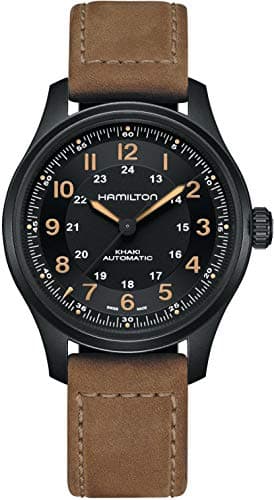
The third watch on this page is the Khaki Field Titanium Automatic in 42mm. It is the same H-10 movement, the same 100m rating, the same sapphire crystal and a 20mm lug width despite the bigger case — in titanium, which is substantially less dense than steel. It is the most expensive watch on this page.
It exists here for one specific buyer: somebody who wants a larger field watch and has found that large steel watches are uncomfortable rather than merely big. Titanium solves weight, not footprint, and we say so on titanium vs stainless steel. If your wrist is under about 6.75 inches, the 38mm watches on this page are the right answer and the titanium is not.
What we would mark it down for
Three things, none of them fatal.
The price against the capability. At list price this watch costs more than three times the 200m automatic divers we rank at a fraction of the money, and it is rated to half their depth. You are buying Swiss finishing, the 80-hour reserve, the sapphire and the magnetic resistance — not more capability. That is a perfectly good trade; it is just worth naming.
The lume is field-watch lume. Hamilton publishes Super-LumiNova, which is the right compound, but a field dial has painted numerals and slim hands rather than the fat applied blocks of a dive dial — there is simply less surface area to glow. If reading the time in the dark is near the top of your list, the honest answer is a Seiko diver, and we work through why on the best watch lume.
The stock strap is the first thing to change. A pin-buckle cow leather strap at this price is adequate rather than special, and a 20mm lug width means the aftermarket is wide open. This is the cheapest meaningful upgrade the watch can take, and the picks are on best leather watch straps.
Our verdict
The Khaki Field Murph is a very good watch with a story attached, and both halves of that sentence are true at once. The specification sheet — 38mm, 11.1mm thick, sapphire with an anti-reflective treatment, 100m, the 80-hour H-10, a Nivachron hairspring, 20mm lugs — is one of the strongest in this hub, and at 38mm it is a size that suits almost everybody.
Buy the Murph if you want the Murph. If you are cross-shopping it against the rest of the field purely on merit, the plain Khaki Field Automatic is the same watch for less, and the money you save buys two good straps and a service fund. Either way you are buying into the best-value Swiss mechanical field watch there is — which is why three of them sit on the best field watches.