How we decided this
Five criteria, in the order they matter for a watch you will actually wear rather than test.
1. The crystal. It is the part you look through every day and the part that decides whether the watch still looks new in five years. On an affordable watch it is the single most consequential specification, and the full argument is on sapphire vs mineral crystal.
2. Fit, measured as lug-to-lug. Case diameter is the number brands advertise; lug-to-lug is the number that decides overhang. We rank on it deliberately, and watch size for your wrist explains why.
3. Dive credentials, as published. A 200m rating and an ISO 6425 certification are not the same claim. One is a pressure rating; the other is a standard covering legibility, bezel function, shock, magnetic resistance, strap security and salt water.
4. What the watch asks of you. An automatic needs wearing or winding and eventually a service. A solar quartz needs light. Neither is better in the abstract.
5. Lug width. This is a strap site. 20mm and 22mm open different drawers, and one of these three opens the bigger one.
The crystal: the Kamasu's clean win
Orient publishes a sapphire crystal for the Kamasu (RA-AA0003R). Citizen publishes a mineral crystal for both the NY0129 and the BN0191 — on the BN0191 page Citizen describes it as impact and shatter resistant, which is a fair claim for mineral glass and not a hardness claim.
That matters more than it sounds. Sapphire sits at 9 on the Mohs hardness scale against roughly 5 to 6 for ordinary mineral glass, and the things that scratch a watch in real life — grit, stone worktops, door frames, a seatbelt buckle — live in between. In practice a mineral crystal picks up fine hairlines over a couple of years and a sapphire one does not. Mineral's one genuine advantage is that it is less brittle under a hard impact.
We are not going to soften this: at these prices a sapphire crystal on a 200m automatic is unusual, and it is the main reason the Kamasu leads our roundup of watches with a sapphire crystal as well as this page.
The fit numbers, which are the surprise here
Read the case diameters and you would expect the 41mm Citizen automatic to be the small one. The published lug-to-lug figures say otherwise:
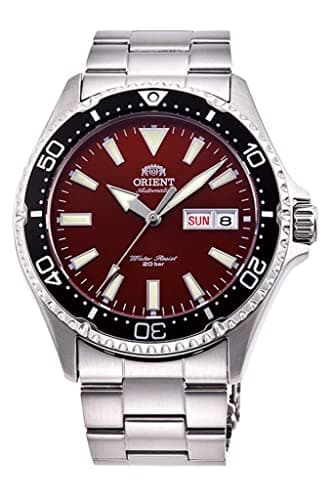
Orient Kamasu — 41.8mm across, 46.8mm lug-to-lug (Orient's own page rounds it to 47mm), 12.8mm thick.
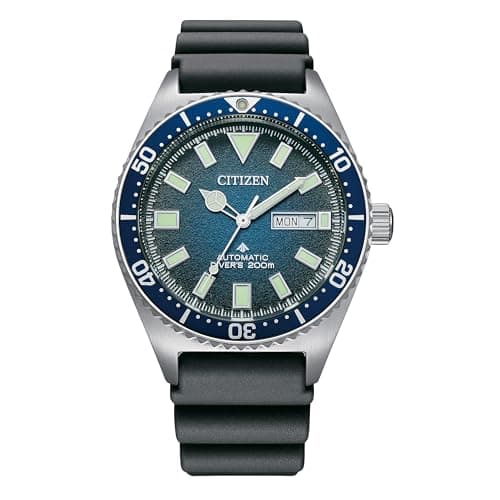
Citizen Promaster Dive Automatic NY0129 — 41mm across, 50mm lug-to-lug.
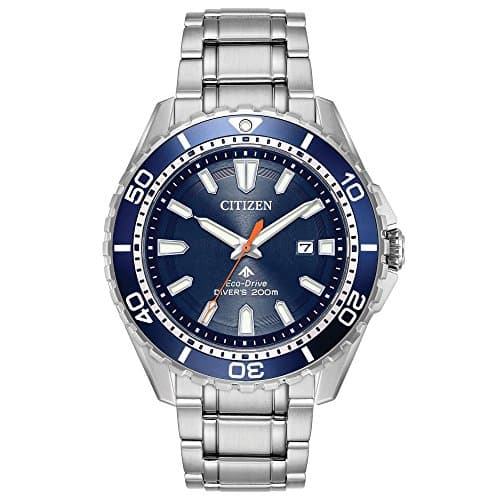
Citizen Promaster Dive Eco-Drive BN0191 — 45mm across, 48.8mm lug-to-lug.
So the smallest-diameter watch of the three has the longest lug-to-lug, and the 45mm Eco-Drive is shorter across the wrist than the 41mm automatic. That is lug geometry: the NY0129 has long straight lugs, and the BN0191 is a wide case with short downturned ones. If your wrist is around 6.5 to 7 inches, the Kamasu is the one that will sit inside your wrist bones and the NY0129 is the one most likely to overhang — the opposite of what the spec headline implies. This is exactly why every spec table on this site carries a lug-to-lug column.
ISO 6425: Citizen's real advantage
Citizen publishes ISO 6425 certification for the Promaster Dive Automatic and describes the BN0191 as a 200M/20bar scuba-rated diver with a screw-down crown and caseback. Orient publishes a 200m rating and a screw-down crown for the Kamasu, but does not claim ISO 6425 for it.
If you are actually going to dive with the watch, that distinction is the whole argument and it points at the Citizen. ISO 6425 is a standard rather than a pressure number: it covers legibility at 25cm in the dark, a unidirectional bezel with minute markings, shock and magnetic resistance, strap-attachment strength, salt-water resistance and a condensation test. A 200m rating on its own is a static pressure test and nothing else — we work through what the rating does and does not promise on water resistance explained.
If you are not going to dive — and almost nobody buying a $300 diver is — then 200m with a screw-down crown is already far more water resistance than your life will test, and the certificate becomes a tiebreaker rather than a decider. We would not pay a mineral crystal for it.
Movements: hacking automatic, plain automatic, or light
The Kamasu uses Orient's in-house F6922, which hacks (the seconds hand stops when you pull the crown, so you can set it to the second) and hand-winds, with an approximately 40-hour power reserve. Both features matter day to day and they match Seiko's 4R36 feature for feature — which is the whole reason the Kamasu is a value benchmark rather than just a cheap watch.
The NY0129 uses Citizen's caliber 8204. It is a proven movement and the honest note we carry on it is that the hand-winding action feels less refined than Seiko's or Orient's.
The BN0191 uses E168 Eco-Drive, which converts any light into power and never needs a battery change or a wind. If you own several watches and hate finding a stopped one, this is a genuinely different proposition from either automatic — there is no 40-hour clock running down in the drawer. The mechanism is on what is Eco-Drive, and the wider argument is on solar vs automatic.
Lume, with the honest caveat
All three publish luminous hands and markers, and that is as far as either brand goes. Orient lists "luminous hour markers and hands" without naming a compound. Citizen lists "luminous hands and markers" and likewise names nothing. Neither publishes a charge time or a glow duration.
So we are not going to rank them against each other on lume, because there is no published figure to rank on and we have not measured them. What we can say is that Seiko is the only brand on this site that publishes a measurable claim for its lume, which is why a Seiko diver and not one of these wins the best watch lume.
Straps: 22mm, 20mm, and what that means
The Kamasu and the BN0191 are both 22mm at the lugs. The NY0129 is 20mm.
22mm is the dive-strap standard — it shares a drawer with every Seiko diver on this site, so the whole of best straps for diving and best 22mm straps applies without thinking about it. 20mm is the broadest width in the aftermarket overall, because it spans field watches and divers alike, so the NY0129 is not short of options — it just looks slightly slimmer at the wrist, which some people prefer on a 41mm case. The reference table is the lug width chart.
Where each one wins
Buy the Orient Kamasu if you want one 200m automatic and you are not diving with it. It has the best crystal, the shortest lug-to-lug, a hacking and hand-winding movement, and it is usually the cheapest of the three. The honest marks against it: the bracelet and clasp are a step below Citizen's and Seiko's, and Orient's US service network is thinner. Full write-up on the Kamasu review.
Buy the Promaster Dive Automatic (NY0129) if the ISO 6425 certificate matters to you, if you want 20mm lugs, or if it is simply cheaper on the day you look. The marks against it: a mineral crystal, and a 50mm lug-to-lug that is the longest here despite the smallest case.
Buy the Promaster Dive Eco-Drive (BN0191) if you never want to think about the movement again. No winding, no battery, no stopped watch — just light. The marks against it: 45mm with a 48.8mm lug-to-lug is a lot of watch, and the crystal is mineral. Under about a 7-inch wrist, this is not your watch. Our fuller take is on the Promaster review.
What they share, and why it is the real story
Underneath the argument, all three of these are the same unusually good deal: a 200m case with a screw-down crown, a unidirectional timing bezel, a bracelet and a movement from a major Japanese manufacturer, for the price of a mid-range pair of shoes. A decade ago this specification cost considerably more in real terms.
Both of the real compromises are shared too. Neither brand publishes a lume figure, and both of the Citizens use mineral glass where the money arguably should have gone. If you want to see how the whole bracket stacks up rather than just these three, the ranked list is best dive watches under $500 — and if you are coming at this from the Seiko side instead, the head-to-head is Orient Kamasu vs Seiko 5.