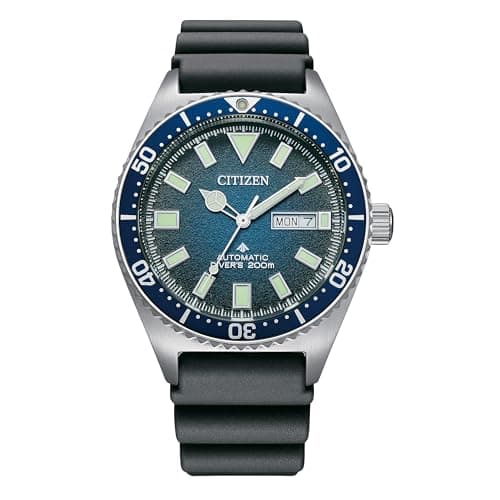
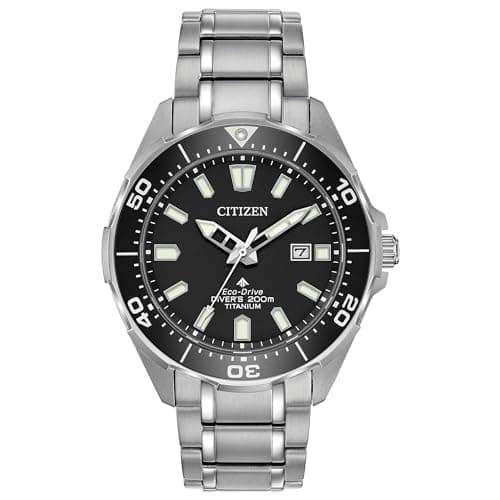
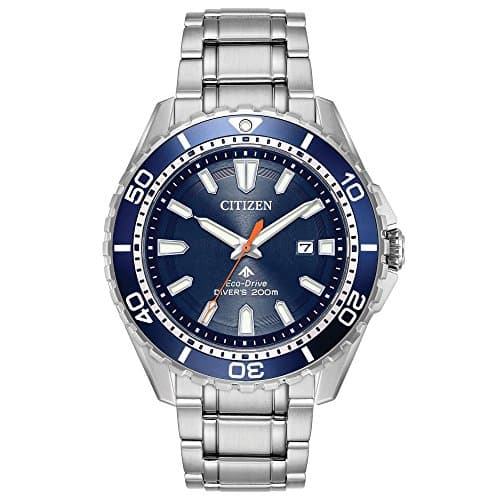
Citizen is the most under-discussed dive-watch brand at this price, and the reason is structural rather than aesthetic: it is the affordable house most willing to publish an ISO 6425 dive specification. That standard is not a marketing line. It covers the crown, the bezel, legibility in darkness, resistance to shock, magnetism and salt water, and the watch has to keep working afterwards. Our Seiko dive roundup is the obvious comparison; this is the same page for the brand that quietly out-certifies it.
"Citizen Promaster" is not one watch, which is the real confusion this page exists to clear up. The three references below share a dive specification and almost nothing else: one is light-powered and 45mm, one is mechanical and 41mm, and one is the 45mm specification again in titanium. Ranked on our usual order — published water resistance and certification, then the movement and what it asks of you, then crystal, then fit measured as case size, lug-to-lug and lug width.
One thing to note before the ranking: the price spread between the two steel references is a few dollars, not a tier. So the budget pick here is genuinely the cheapest of the three, but it is not the compromise the phrase usually implies — choose between the NY0129 and the BN0191 on case size and movement, not on money.
Eco-Drive or automatic — the only decision that matters
Everything else on this page is a detail. The BN0191 is Eco-Drive: a cell charged by any light source, accuracy of a few seconds a month, no winding, and — the part most buyers miss — a case that never has to be opened. Every time a water-resistant watch goes to a counter for a battery, its water resistance becomes a question about whoever reseated the gasket. A light-powered diver never has that conversation. Our what is Eco-Drive page explains how the charging and dark-running work.
The NY0129 is an automatic with Citizen's 8204 caliber: it runs on wrist movement, keeps time to a few seconds a day rather than a month, and will eventually want a service. What you get for that is the thing a quartz movement cannot give you — a sweeping seconds hand and a mechanism worth caring about. Our solar vs automatic page argues the trade with the published figures.
41mm against 45mm, and the number that inverts it
The case diameters say the NY0129 is the small one and the BN0191 is the large one. The lug-to-lug says otherwise: Citizen publishes 50mm for the 41mm NY0129 and 48.8mm for the 45mm BN0191, so the smaller-diameter watch is actually the longer one across the wrist. That is not a typo — it is the consequence of different lug geometry, and it is exactly why our watch size for your wrist guide tells you to size on lug-to-lug rather than diameter. If your wrist is flat or under about 6.75 inches, measure both before assuming the 41mm is the safer buy.
What the titanium buys, and what it costs
The BN0200-56E is the BN0191's specification in Citizen's Super Titanium: roughly 40 percent lighter than steel, with Citizen's Duratect surface hardening, which Citizen states is up to five times harder than stainless steel. It is the cleanest material comparison you can buy — same ISO rating, same Eco-Drive movement, same 22mm lug width, different metal. The cost is money: it is substantially the most expensive watch on this page. Our titanium roundup puts it against the other two titanium watches we rank.
Where Citizen loses to Seiko
Two places, said plainly. The first is crystal: all three references here use a mineral crystal rather than sapphire, and at these prices an Orient Kamasu gives you sapphire for less — see our Orient dive roundup. The second is lume: Citizen publishes no compound and no duration for these dials, only "luminous hands and markers", where Seiko publishes performance figures for LumiBrite. We will not rank what a maker will not publish, so our lume roundup says the same thing.
Straps for these
22mm on the BN0191 and the BN0200, 20mm on the NY0129 — all three figures are in the table above. The 22mm references take anything from our dive strap picks; if you bought the titanium for the weight, a nylon or FKM strap rather than a steel bracelet is the obvious follow-through.